Open an Estate or Trust Account With Sunset (2026)
Open an estate bank account online after verification and EIN setup. See how Sunset helps executors request an estate or trust account.
October 27, 2026
By Stephen Walter, Attorney and CEO
*Part 6 of 10: How Sunset Works*
Short answer
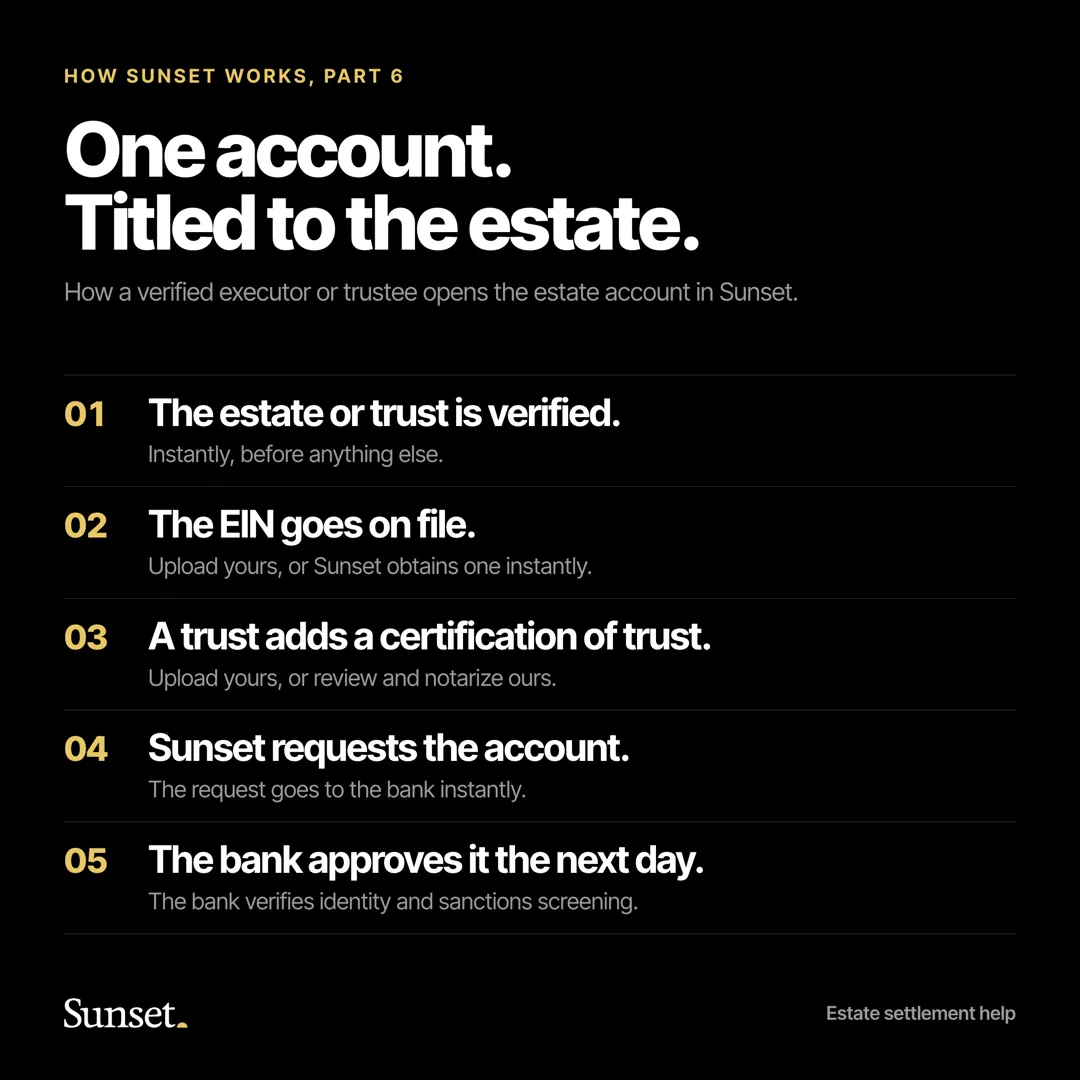
A verified executor, administrator, or successor trustee can open an estate bank account online inside Sunset after the estate or trust is verified and its EIN is on file. Sunset submits the account opening request instantly, and the FDIC-insured bank approves the account next day.
This guide explains what happens at each step, what documents or records are involved, and how the account fits into estate settlement. It is informational only and is not legal advice.
At a glance
| Step | Who does it | Typical timing | What you get |
|---|---|---|---|
| Verify the estate or trust | Sunset | Instant | A verified estate or trust |
| Add the EIN | You upload one you already have, or Sunset obtains it on request | Instant | The EIN on file, verified |
| Add a certification of trust (trusts only) | You upload one you have, or Sunset generates one for you to review and notarize | Varies | A notarized certification of trust on file |
| Request the account | Sunset | Instant | An account opening request sent to the bank |
| Approve the account | The FDIC-insured bank | Next day | A commercial checking account owned by the estate or trust |
| Use the account during settlement | You | Through the settlement | One account for the estate's money |
Verify the estate or trust
Before Sunset can request an estate checking account or trust account, the estate or trust must be verified. This is the first gate. Sunset needs to confirm that there is a real estate or trust to open the account for, and that the person acting has the right role.
The record involved is the verified estate or verified trust inside Sunset. Verification is instant. For more detail on that earlier step, see How Sunset Verifies Death and Authority.
This step exists because the account is not a personal account for the executor. It is also not Sunset's account. The account is a commercial checking account owned by the estate, or by the trust, the way a corporate account is owned by the business. It is managed by the executor, administrator, or successor trustee.
That distinction matters. During estate settlement, money may need to be collected, recorded, and later transferred according to the estate or trust process. Keeping the money in an account titled to the estate or trust helps separate estate money from personal money.
Add the EIN
The second requirement is the EIN. Two things must be true before the account can be opened: the estate or trust is verified, and its EIN is on file.
An EIN for estate bank account setup is needed because the deceased's Social Security number can no longer be used for new accounts. The estate needs its own EIN. If the user already registered an EIN with the IRS, the user uploads it and Sunset verifies it instantly. If not, the user can request that Sunset obtain the estate's EIN, and that is instant.
The same idea applies to a trust bank account after death. A revocable trust becomes irrevocable at death and needs its own EIN. Sunset obtains it the same way.
The document or record involved is the EIN record for the estate or trust. If you already have the IRS EIN letter, you can add it to Sunset. If you want to see what that document looks like, Sunset has a guide to an estate and trust EIN letter example.
This step exists because the bank needs the correct tax identification number for the entity that will own the account. The account is titled to the estate or trust, not to the person who died and not to you personally.
For executors comparing the timing, Sunset has a separate guide on estate account setup after an EIN. In this Sunset flow, once the estate or trust is verified and the EIN is on file, Sunset can submit the account opening request instantly.
Add a certification of trust for trusts only
If you are acting as successor trustee, there is one trust-only step: the certification of trust. A verified successor trustee can open a bank account titled to the trust the same way an executor can open one for an estate, with the same features as an estate account.
If you already have a certification of trust, you upload it and Sunset verifies it. If you do not have one, Sunset generates one instantly. The trustee then reviews it and has it notarized.
There are two ways to handle notarization. Sunset can send it to an online notary, or the trustee can print it, notarize it in person, and upload it again. The timing for this step varies because it depends on the trustee.
The document involved is the notarized certification of trust on file. This step exists because the bank needs a record showing that the trust exists and that the successor trustee is the person managing it.
For executors and trustees, the key point is simple: the bank account is owned by the trust, not by the trustee personally. The trustee manages the account in that role.
Request the account
After verification is complete and the EIN is on file, Sunset submits the account opening request. That submission is instant.
The record involved is the account opening request sent to the bank. You do not need to turn the request into a separate branch visit inside the Sunset flow. Sunset uses the verified estate or trust record and the verified EIN record to send the request for a commercial checking account owned by the estate or trust.
This is the step where the online part matters most for a busy executor. At a traditional bank branch, the account opening process may require an in-person visit, a certified death certificate, court-issued letters, the EIN letter, and the executor's ID. It can take several visits if a document is missing or if the branch needs a different department.
Inside Sunset, the request can be sent once the required items are in place. That does not mean bank approval is instant. Sunset submits the request instantly, then the FDIC-insured bank reviews and approves the account next day.
If you are still deciding whether you need an estate account, Sunset has a plain-language guide on how to open an estate bank account.
Approve the account
The bank approves the account. The approval turnaround is next day after the estate or trust is verified, the EIN is on file, and the account opening request has been submitted.
The institution involved is an FDIC-insured bank. Funds are deposited only at an FDIC-insured institution. Each estate account and each trust account is insured by the FDIC.
As part of approval, the bank verifies identity and sanctions screening. This is the bank's approval, not Sunset's.
What you get is a commercial checking account owned by the estate or trust. It is managed by the executor, administrator, or successor trustee. It is not Sunset's account. It is not the executor's personal account. It is not a new account under the Social Security number of the person who died.
This step exists because the account will hold estate or trust money. The bank needs to approve the account before funds can be deposited there.
Use the account during settlement
Once approved, the account becomes the place where the estate's cash can be collected during settlement. Money from every account Sunset closes can be sent into this one account, so the estate's cash is in one place with one record.
That record can be useful because executors often have to track money coming in and money going out. The estate may receive balances from closed accounts. It may also need to pay estate expenses or prepare for later transfers. This article does not cover those later steps, but the point of the account is to give the estate or trust its own place for money during the process.
The account is an estate checking account or trust checking account, depending on who owns it. You manage it in your role as executor, administrator, or successor trustee.
This separation is one of the main reasons executors open estate accounts. If estate money goes into a personal account, records can become harder to explain later. With a dedicated account owned by the estate or trust, deposits from closed accounts can be kept together.
What you do and what Sunset does
What you do:
- Confirm your role as executor, administrator, or successor trustee.
- Upload an EIN you already have, or ask Sunset to obtain it.
- For a trust, upload a certification of trust you already have, or review and notarize the one Sunset generates.
- Manage the account during settlement after the bank approves it.
- Keep estate or trust money separate from personal money.
What Sunset does:
- Verifies the estate or trust instantly.
- Verifies an uploaded EIN instantly, or obtains the EIN on request.
- Generates a certification of trust instantly if the trustee does not already have one.
- Submits the account opening request instantly once the requirements are met.
- Lets money from accounts Sunset closes be sent into the estate or trust account, so the cash is in one place with one record.
What Sunset does not do at this stage
Sunset does not approve the bank account. The FDIC-insured bank approves it, and the approval turnaround is next day after the required steps are complete.
Sunset does not open a new estate or trust account under the deceased's Social Security number. The estate needs its own EIN, and a revocable trust that becomes irrevocable at death needs its own EIN.
Sunset does not own the account. The commercial checking account is owned by the estate or trust and managed by the executor, administrator, or successor trustee.
For trusts, Sunset does not control how long notarization takes. If a certification of trust is needed, the timing varies because the trustee must review and notarize the document.
What to ask any estate settlement service
Before you use any estate settlement service to request an estate or trust account, ask:
- What has to be verified before an account request can be sent?
- How is the EIN added, verified, or obtained if I do not have one yet?
- For a trust, who prepares the certification of trust and who handles notarization?
- Is the account owned by the estate or trust, or by the executor personally?
- Who approves the account, and how long does approval usually take?
- Are funds deposited only at an FDIC-insured institution?
These questions help you compare the actual account process, not just the promise that an account can be opened.
How Sunset Works, in 10 parts
- How Sunset settles an estate, step by step
- How Sunset verifies the death, your identity, and your authority
- How Sunset uses IRS records to find accounts
- What Sunset searches for after a death
- How Sunset finds the right department at each institution
- Opening an estate or trust bank account (you are here)
- How Sunset notifies institutions and closes accounts
- What you can pay and manage from the estate account
- How Sunset prepares probate documents by county
- Security, people, and what Sunset does not do
FAQ
Can I open an estate bank account online?
Yes. A verified executor or administrator can open an estate bank account online through Sunset after the estate is verified and the EIN is on file. Sunset submits the account opening request instantly, and the FDIC-insured bank approves the account next day.
Do I need an EIN for estate bank account setup?
Yes. The estate needs its own EIN because the deceased's Social Security number can no longer be used for new accounts. If you already have the EIN, you can upload it and Sunset verifies it instantly. If you do not have one, Sunset obtains the estate's EIN for you.
Can a successor trustee open a trust bank account after death?
Yes. A verified successor trustee can open a bank account titled to the trust the same way, with the same features as an estate account. A revocable trust becomes irrevocable at death and needs its own EIN.
Is the estate checking account my personal account?
No. The account is a commercial checking account owned by the estate, or by the trust if it is a trust account. It is managed by the executor, administrator, or successor trustee, but it is not a personal account and it is not Sunset's account.
How long does approval take?
After the estate or trust is verified and the EIN is on file, Sunset submits the account opening request instantly. The bank approval turnaround is next day.
If you are ready to collect estate cash in one place, get started with Sunset.