Paying Estate Bills From a Sunset Account (2026)
Learn how to pay estate bills from estate account funds with Sunset, including expenses, debt order, records, and heir distributions.
November 3, 2026
By Stephen Walter, Attorney and CEO
Part 8 of 10: How Sunset Works
Short answer
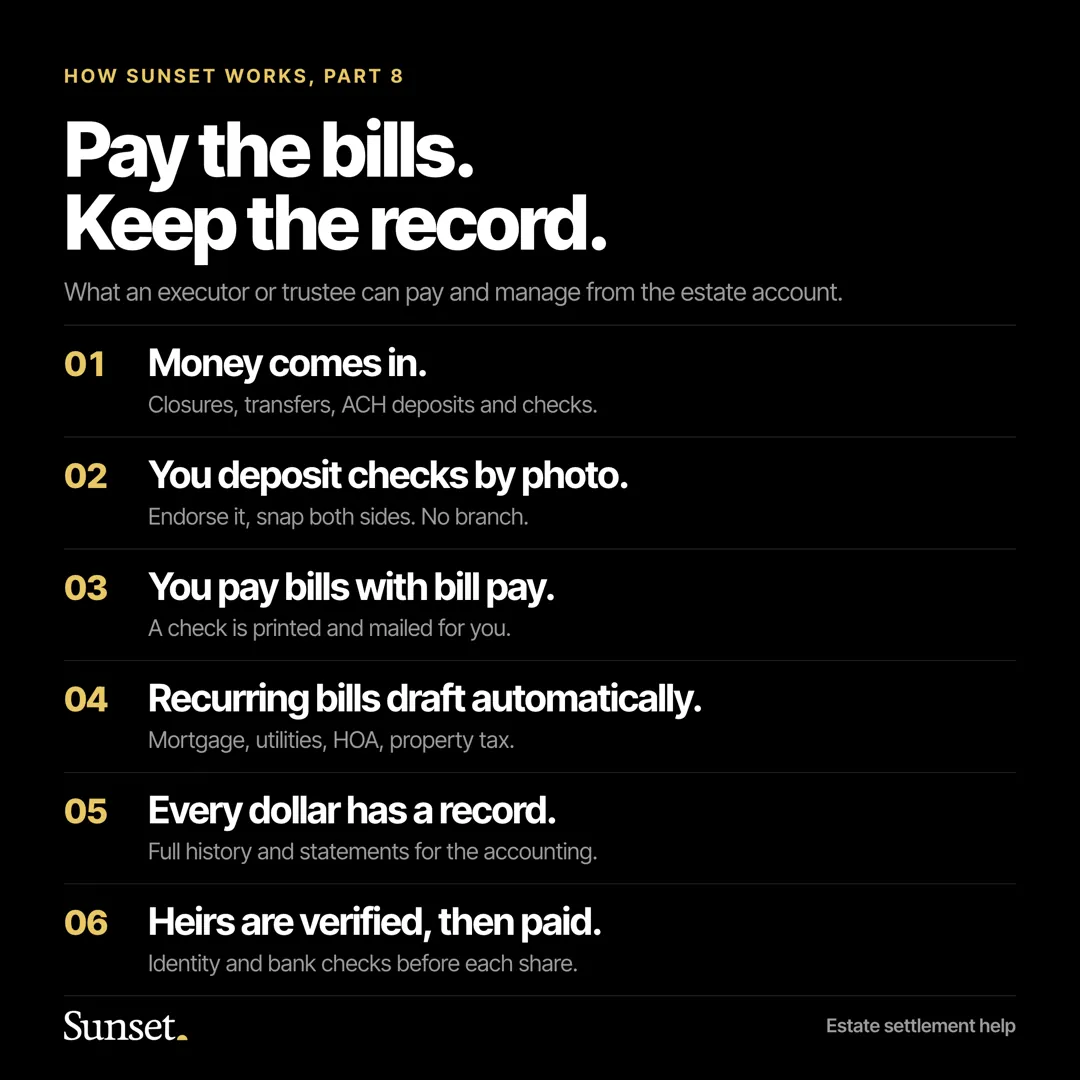
The executor uses the Sunset estate or trust account to receive estate funds, pay estate or trust expenses, keep records, and send distributions when the estate is ready. Sunset does not pay bills for the estate. The executor initiates each payment. You can pay by mailed check or ACH, and each payment is documented in the estate or trust account history.
Executors often ask how to pay debts of an estate without mixing personal funds with estate funds. This part explains how to pay estate bills from estate account funds in Sunset, what records are created, and why debts usually come before distributions to heirs. This article is informational and is not legal advice.
At a glance
| Step | Who does it | Typical timing | What you get |
|---|---|---|---|
| Receive money into the estate or trust account | The institution | Varies | Proceeds, transfers, ACH, and checks held in one account |
| Deposit checks made out to the estate or trust | You, or Sunset if mailed to its office | Varies | A deposit by phone photo, or a direct deposit by Sunset |
| Pay estate or trust bills by mailed check | You | Varies | A printed check mailed to the payee and a recorded administration expense |
| Handle recurring bills and ACH | You | Varies | Account history showing each draft or ACH payment |
| Track expenses, reimbursements, and statements | Sunset | Varies | Transaction history and statements for the final accounting |
| Send distributions to heirs or trust beneficiaries | You | Varies | Verified recipient details and a court-ready distribution record |
Receive money into the estate or trust account
The first step is getting estate money into an account that is separate from personal funds. Money can come into a Sunset estate or trust account from proceeds of accounts Sunset closes, Instant Inheritance transfers, incoming ACH, and checks.
The record involved is the estate or trust account history. When funds arrive, the account history shows the incoming item, so the executor can match money received against the estate expenses paid later. This matters because executors are usually expected to show what came in, what went out, and what remains before they distribute the estate to heirs.
The account is FDIC-insured, and funds are held only at an FDIC-insured institution. Co-executors can see the account, which helps when more than one person has authority to act for the estate or trust.
This step exists because estate settlement works best when assets and liabilities are handled in order. Before paying bills or making distributions, the executor needs a place to receive estate money and keep it apart from personal money. For more on this part of the process, see Sunset's guide to the estate bank account.
Deposit checks made out to the estate or trust
Some estate money still arrives by paper check, such as a refund, a final paycheck, or an insurance check made out to the estate or trust. A check can land in one of two places, and the steps depend on where it arrives.
If the check comes to your home, endorse the back, log in to Sunset, and click Deposit check. You take a photo of the front and back with your phone, which is called remote deposit capture, and the money goes into the estate or trust account. No branch visit is needed.
If the check is mailed to Sunset at its Salt Lake City office, Sunset deposits it directly into the estate or trust account. This is common when Sunset closes an account through Automated Closure or Instant Inheritance and the institution pays by check. You do not handle that check at all.
The document involved is the check itself. The related record is the deposit entry in the estate or trust account history. The deposit helps show that the money belonged to the estate or trust and went into the right account.
This step exists because checks should be deposited into an account held for the estate or trust, not into the executor's personal bank account. That separation protects the record. It also makes later accounting easier because the check, deposit, and later use of funds are all tied to the same account history.
Pay estate or trust bills by mailed check
After money is available, an executor may need to pay estate expenses. Bills an estate typically pays include funeral and burial costs, the mortgage, HOA dues, utilities, insurance, and property tax on a house the estate still holds. Other possible bills include final medical bills, debts, taxes, and professional fees.
To pay an estate expense or a trust expense in Sunset, such as a legal bill, court filing fee, or property tax, you initiate the payment with the bill pay feature in your Sunset estate account. A physical check is printed and mailed to the payee. Every payment is recorded against the estate or trust as an administration expense, which keeps a clear record for the final accounting and for beneficiaries.
The document involved is the bill, invoice, tax notice, court fee request, or other payment request. The record created is the outgoing check entry in the estate or trust account history. That entry matters because an executor may later need to explain why the payment was made and which estate obligation it satisfied.
This step exists because paying estate bills is not the same as paying ordinary household bills. The executor is paying from money that belongs to the estate or trust. A written record of each payment helps show that funds were used for estate or trust purposes.
If you paid an estate expense personally before the estate account was ready, you may be able to reimburse yourself from the estate. The executor can reimburse themselves for estate expenses they paid personally. Any Sunset fee counts as an estate administration expense the executor can reimburse from the estate.
Handle recurring bills and ACH
Some bills cannot wait for a single mailed check request each month. If the estate still holds a house, the mortgage, HOA dues, utilities, or property tax may need to be paid while the estate remains open. The executor can give a biller the estate or trust account's account and routing numbers, so those payments are drafted automatically from the estate account.
The record involved is the account history. Each draft shows up as an estate expense. This is useful because recurring payments can become hard to track if they are paid from different personal accounts or reimbursed later from memory.
You can also initiate a payment by ACH. That may be needed to pay a bill that will not take a check, or to send a distribution to an heir's bank account when the estate is ready. Sunset does not issue payment cards, physical or virtual. Every payment goes out by mailed check or ACH, so each one is documented.
This step exists because estates often have ongoing costs. A house may need utilities to prevent damage. Insurance may need to stay active. Property taxes may come due before the estate is closed. If you want a deeper explanation of final account payments and account closures, see Sunset's guide to final payments and closing accounts.
Track expenses, reimbursements, and statements
The account has a full transaction history and statements. Those records become the record for the final accounting. They help show money coming in, estate or trust expenses going out, reimbursements to the executor, and any remaining balance.
The documents involved may include bills, receipts, tax notices, closing proceeds, refund checks, and statements. The Sunset account history ties those items to deposits, mailed checks, ACH payments, and distributions. If co-executors are involved, they can see the account as well.
This step exists because beneficiaries and courts may need a clear explanation of the estate. A final accounting usually needs to show the path of the money. Even when a court filing is not required in every case, a careful record can reduce confusion among beneficiaries.
The order of payment also matters. State law sets the order debts are paid in, and debts are paid before heirs receive anything. Sunset can help keep payment records, but the correct legal order depends on the estate and state law. If you are unsure whether to pay a debt, dispute a claim, or wait, consider asking an attorney or tax professional.
Send distributions to heirs or trust beneficiaries
After estate debts, taxes, expenses, and other required payments are handled, the executor may be ready to make distributions. Distributing to heirs is different from paying bills because the money is leaving the estate as a share for a beneficiary.
In Sunset, each beneficiary goes through identity and bank account verification. Each beneficiary also agrees not to dispute the estate before receiving a share. Distributions are recorded in a court-ready record.
The documents and records involved include the beneficiary details, the bank account verification, the beneficiary agreement not to dispute the estate, and the distribution entry. When money goes out by ACH, that payment also appears in the account history.
This step exists because an executor should not treat a distribution like an ordinary transfer. Debts are paid before heirs receive anything, and the executor needs a record of who received a share and when. The same tools work for a trust account, including paying trust expenses and making distributions to trust beneficiaries.
If an account was jointly owned, the rules for ownership and estate funds can be different from an account held only by the person who died. For more background, read Sunset's guide to a joint bank account when one owner dies.
What you do and what Sunset does
What you do:
- Review bills, invoices, and notices that come to the estate or trust.
- Decide which expenses to pay, using advice from professionals when needed, and initiate each check or ACH payment.
- Endorse checks that arrive at your home, then deposit them by phone photo with Deposit check in Sunset.
- Give billers the estate or trust account and routing numbers for approved recurring drafts.
- Keep receipts for expenses you paid personally if you plan to request reimbursement.
- Review the account history, statements, and distribution records.
What Sunset does:
- Holds estate or trust funds in an account that is FDIC-insured, with funds held only at an FDIC-insured institution.
- Receives proceeds from account closures, Instant Inheritance transfers, incoming ACH, and checks.
- Deposits checks mailed to its Salt Lake City office directly into the estate or trust account.
- Provides the bill pay feature, which prints and mails a physical check for each payment you initiate.
- Records payments as administration expenses against the estate or trust.
- Keeps transaction history and statements that support the final accounting.
- Records verified beneficiary distributions in a court-ready record.
What Sunset does not do at this stage
Sunset does not replace legal or tax advice about which debts must be paid, whether a debt should be disputed, or the exact order required in your state. State law sets the order debts are paid in, and debts are paid before heirs receive anything.
Sunset does not issue payment cards, physical or virtual. Sunset does not support wires. Payments go out by mailed check or ACH.
Sunset does not skip beneficiary verification before distributions. Each beneficiary goes through identity and bank account verification and agrees not to dispute the estate before receiving a share.
Sunset also does not remove the executor's duty to review bills and keep good records. The account history and statements help, but the executor still decides what to pay and when to seek professional advice.
What to ask any estate settlement service
Before choosing an estate settlement service, ask direct questions about how money is handled and recorded:
- How does money come into the estate or trust account?
- How are checks made out to the estate or trust deposited?
- Can estate bills be paid by mailed check and by ACH?
- How are administration expenses recorded for the final accounting?
- Can co-executors see the account history and statements?
- What steps happen before distributions are sent to heirs or trust beneficiaries?
The answers should make it clear how the service handles deposits, payments, records, and distributions. If the process is vague, ask for more detail before you move estate money.
How Sunset Works, in 10 parts
- How Sunset settles an estate, step by step
- How Sunset verifies the death, your identity, and your authority
- How Sunset uses IRS records to find accounts
- What Sunset searches for after a death
- How Sunset finds the right department at each institution
- Opening an estate or trust bank account
- How Sunset notifies institutions and closes accounts
- What you can pay and manage from the estate account (you are here)
- How Sunset prepares probate documents by county
- Security, people, and what Sunset does not do
FAQ
Can an executor pay estate bills from an estate account?
Yes. An executor can use estate funds to pay estate expenses such as funeral and burial costs, mortgage payments, HOA dues, utilities, insurance, property tax, final medical bills, debts, taxes, and professional fees. In Sunset, the executor initiates the payment with the bill pay feature, and a physical check is printed and mailed to the payee. The executor can also initiate a payment by ACH.
What bills should be paid before heirs receive money?
In general, debts and estate expenses are paid before heirs receive anything. State law sets the order debts are paid in, so the right order can depend on the state and the type of claim. This article is informational, not legal advice.
Can an executor reimburse themselves for estate expenses?
Yes. The executor can reimburse themselves for estate expenses they paid personally. Any Sunset fee counts as an estate administration expense the executor can reimburse from the estate.
Can Sunset handle trust expenses too?
Yes. The same tools work for a trust account. A trustee can pay trust expenses and make distributions to trust beneficiaries, with payments and distributions recorded in the account history.
How are heir distributions recorded?
Each beneficiary goes through identity and bank account verification and agrees not to dispute the estate before receiving a share. Distributions are recorded in a court-ready record, and the account history shows the money leaving the estate or trust.
Paying bills from the right account can make the final accounting clearer and help beneficiaries understand what happened. If you are settling an estate or trust and want help receiving funds, paying expenses, and recording distributions, get started with Sunset.