How Sunset Finds the Right Bank Department (2026)
Who to contact at a bank when someone dies: how Sunset matches each account to the right department by email, web form, fax, or phone.
October 22, 2026
By Stephen Walter, Attorney and CEO
*Part 5 of 10: How Sunset Works*
Short answer
Once Sunset finds an account, it does not rely on the public customer service number. The phone number, email address, or PO box for a bank's estate services team, or for the legal team that handles estates and account closures, is often not published anywhere. Sunset keeps a private repository of those contacts, built by helping more than 20,000 families, and sends each notice to the team that handles that account type after a death.
For an executor asking who to contact at a bank when someone dies, the hard part is often that the name on the record is not the name of the team that must receive the notice. Sunset exists to remove that research burden from the estate settlement work, while keeping the process understandable for the person in charge.
At a glance: nine institution types, nine different processes
Sunset classes every institution as one of nine types, because what happens after a death depends on the type.
| Institution type | What it usually holds | What happens after a death |
|---|---|---|
| Bank | Checking, savings, CDs | Accounts are frozen, then paid to a named beneficiary or closed into the estate |
| Credit union | Member savings and loans | Same as a bank, but handled through the credit union's member or estate team |
| Brokerage | Stocks, bonds, mutual funds | Holdings move to a beneficiary or an estate account, or are sold |
| Custodian | IRAs and other retirement accounts | Named beneficiaries roll the account over or take distributions under the plan rules |
| Insurance | Life insurance policies | The beneficiary files a claim with a death certificate |
| Creditor | Mortgages, auto loans, personal loans | The lender is notified, and the debt is paid from the estate or stays with the property that secures it |
| Card issuer | Bank credit cards | The card is closed and the balance becomes a claim against the estate |
| Retail card | Store credit cards | Same as a card issuer, often through a separate servicing team |
| Other | Anything that fits none of the above | Handled case by case |
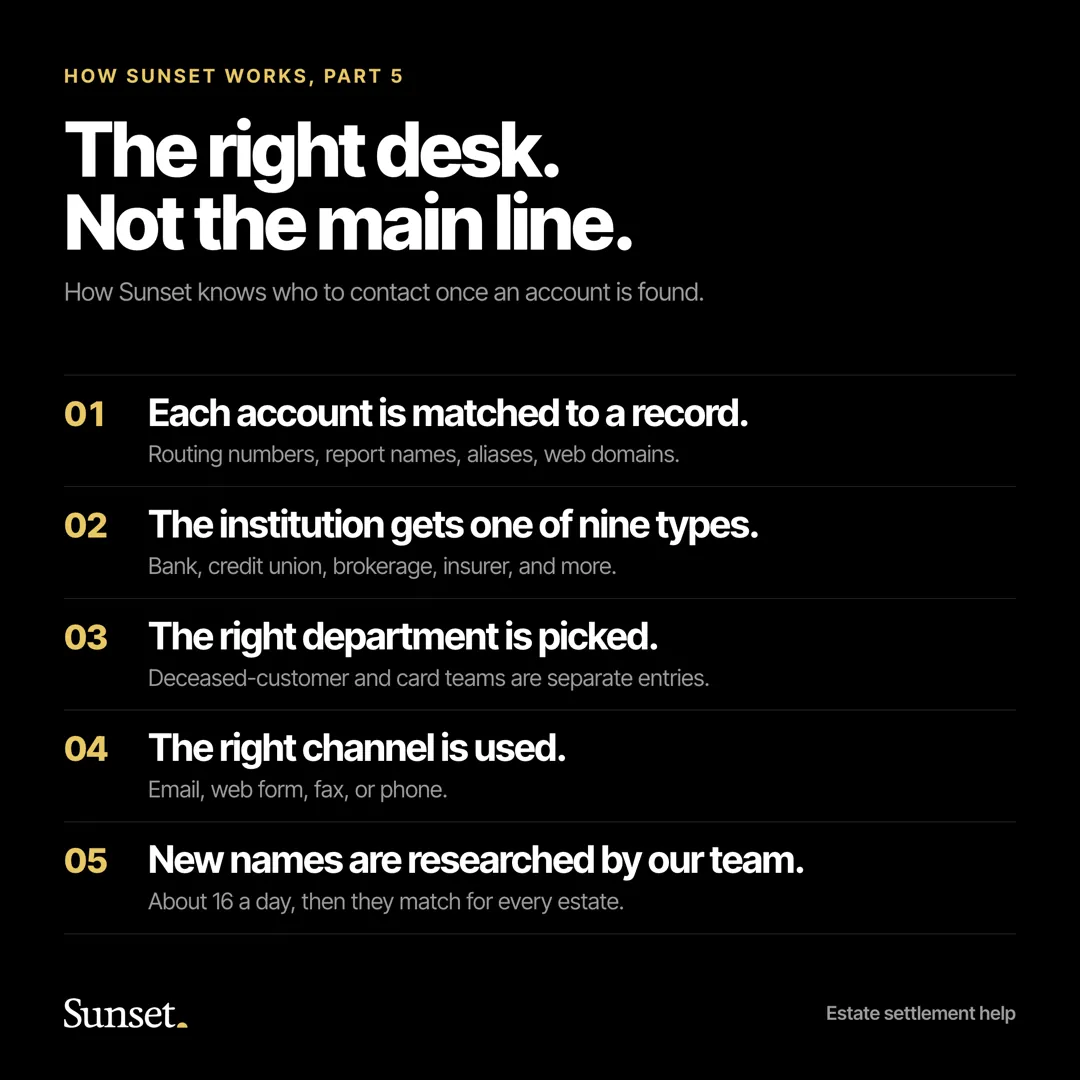
Step 1: The account name appears in a record
The first record Sunset sees may not look like the bank name an executor expects. A name on a tax form, a credit report, or another account record can be a formal legal name, a card issuer name, a servicing name, or an older alias.
For example, the name on a credit report might read `CHASE BANK USA NA`, while a tax form such as a 1099 might say `JPMorgan Chase`. Those can refer to the same institution, but the right team can differ by account type. A credit card account may need a card servicing team. A bank deposit account may need a deceased-customer team. An investment or tax form may point to a different handling path.
This step exists because the executor should not have to guess from an unfamiliar name. If you are settling an estate, you may see old statements, credit report entries, tax forms, email records, mailed letters, or account alerts. Each one may use a different name for the same larger financial institution.
That is why simply searching the web for a main phone number can lead to long hold times and transfers. The public number may reach general customer care, not the bank bereavement department or the team that handles estate notices. Sunset's process starts with the name as it appears in the record, then works toward the department that can act on it.
If you are still working on the earlier step of identifying accounts, see Sunset's guide to who verifies accounts after death.
Step 2: Sunset matches the name to an institution record
After an account is found, Sunset matches it to an institution record in its own institution database. That database has more than 3,000 financial institutions, including banks, credit unions, brokerages, insurers, creditors, and others. It grows every week.
The match is based on details that are more reliable than a casual web search. Sunset uses routing numbers, the exact names that appear on credit reports, known aliases, and web domains. Each of those details can help connect an account record to the right financial institution.
The document or record involved depends on where the account was found. A credit report may show an exact creditor name. A tax form may show a payer name. A bank document may include a routing number. A web domain may appear in an email or online account clue. Sunset uses those pieces to connect the account to a known institution record.
This step exists because financial institutions often appear under more than one name. A person may have had a checking account, a credit card, and a tax document connected to the same larger company, but each record may use a different label. The executor sees names. Sunset maps those names to records.
That mapping matters because the next step is not just contacting a company. It is contacting the right department at that company. If the wrong department receives the notice, the executor may be told to call another number, upload papers elsewhere, or start over with a different team.
Step 3: Sunset classes the institution type
Once an account is matched, Sunset classes the institution as one of nine types: bank, credit union, brokerage, insurance, creditor, retail card, card issuer, custodian, or other.
This classification helps clarify what kind of account or relationship may be involved. A bank may hold a checking or savings account. A credit union may have its own member process. A brokerage may hold investment accounts. A creditor, retail card, or card issuer may be connected to a debt or card balance. A custodian may hold assets for another purpose. Some institutions fall into other when they do not fit the main groups.
The record involved here is the institution record inside Sunset's database. That record is not just a name. It carries the type assigned to the institution, which helps guide what kind of contact path may apply.
This step exists because each type of institution handles a death through a different process. Notifying a creditor of a death is a completely different process from rolling over a retirement account, and closing a checking account is different again from filing a life insurance claim. A person might say, "I need to call the bank," when the record is actually a card issuer, a brokerage, or an insurer. The type tells Sunset which process applies before any notice goes out.
Sunset also treats annuities carefully in this classification work. An annuity is handled as an investment for this purpose, while the insurance type is kept for life policies. That distinction can matter because a life policy and an annuity may need different processing paths after a death.
The point is practical. Before sending a notice or asking an executor to gather papers for a call, Sunset needs to know what kind of institution record it is looking at.
Step 4: Sunset selects the department and channel
After Sunset identifies the institution, it looks at the contacts stored for that institution by department. Each department is then organized by channel: email, web form, fax, and phone.
This is the core answer to the question of who to contact at a bank when someone dies. A bank's deceased-customer team and its card servicing team can be separate entries. The right estate services department contact may depend on whether the account is a deposit account, a card account, a brokerage account, an insurance policy, or another account type.
Many of these contacts are not public. The direct line, email address, or PO box for an estate services team, or for the legal team that handles estates and account closures, often does not appear on the institution's website or in a web search. Sunset has built a private repository of these department contacts by helping more than 20,000 families settle estates, and it keeps growing.
The document or record involved at this stage is the institution contact record. It holds the department options and the channels for reaching them. Sunset uses that record so an executor does not have to search for a number, wait on hold, explain the death repeatedly, and ask which department handles estates.
This step exists because general contact pages are often built for everyday customer questions. Estate work is different. The institution may need proof of death, proof of authority, or other estate documents before it can discuss an account or take action. If the notice starts in the wrong place, the executor can lose time and may be told to resubmit information through another channel.
Sunset's mapping does not mean every institution uses the same process. Some may use a web form. Some may accept a fax. Some may list an email contact. Some still rely on phone contact for certain requests. The value is that the contact path is organized by department and channel before the executor has to begin.
If you are at the later stage of closing an account, see Sunset's guide to how to close a bank account after death. This post focuses on the step before that: finding the right team to contact.
Step 5: Unmatched names go to Sunset for research
Not every name matches right away. When a name does not match any existing institution record, it goes to the Sunset team for research.
Sunset sees about 16 new names a day that need this kind of review. These may be unfamiliar report names, alternate spellings, lesser-known entities, older names, or names that do not clearly point to the right financial institution at first glance.
The record involved is the unmatched name itself, along with any useful details connected to it. That might include the exact name as it appeared on a credit report, a web domain, or another clue from the account record. The goal is to determine whether the name can be mapped to an institution record.
This step exists because the financial system is full of aliases and servicing relationships. Executors often run into this problem in a more personal way: a bank statement says one thing, a card says another, a tax form says a third, and an online search leads to a main corporate site. It is easy to spend an afternoon trying to decide whether those are separate accounts or different names for one company.
When Sunset maps a new name, that work does not stop with one estate. Once a name is mapped, it matches automatically for every future estate. That is why the institution database grows every week.
This is also why Sunset does not ask the executor to become a financial-institution researcher. The executor may still need to provide documents, review information, or make decisions about the estate, but finding the right contact path is Sunset's job.
If you are building a broader notice list, Sunset also has a guide on who to notify when someone dies. That list is wider than banks and financial institutions.
What you do and what Sunset does
What you do:
- Review the account information Sunset finds and flag anything that looks unfamiliar.
- Gather estate documents when an institution asks for proof of death or proof of authority.
- Make executor decisions about the estate based on the account, the documents, and any professional advice you choose to get.
- Keep personal notes about calls, letters, and requests you receive.
What Sunset does:
- Matches account names to institution records using routing numbers, credit report names, known aliases, and web domains.
- Maintains an private institution database of more than 3,000 financial institutions that grows every week.
- Classes each institution as one of nine types.
- Stores contacts by department and by channel, including email, web form, fax, and phone.
- Sends unmatched names to the Sunset team for research, with about 16 new names reviewed each day.
What Sunset does not do at this stage
At this mapping stage, Sunset is not deciding who inherits an account. It is not giving legal advice. It is not making every institution's process the same, because each institution can set its own document and contact requirements.
Sunset also is not assuming that a main customer service number is the best contact. The purpose of this step is to map the account to the right institution record and department channel. If an institution requires more information later, that is part of the institution's own estate process.
Sunset does not claim that every name will match instantly. Names that do not match any record go to the Sunset team for research. Once mapped, the name can match automatically for future estates.
What to ask any estate settlement service
If you are comparing estate settlement help, ask practical questions about how financial institution contacts are found and checked:
- How do you decide which bank bereavement department or estate team to contact?
- Do you track different departments for different account types at the same institution?
- What records do you use to match an account name to a financial institution?
- What happens when a name on a credit report or tax form does not match your records?
- Do you store contact channels such as email, web form, fax, and phone by department, including contacts that are not public?
- If you map a new institution name for one estate, will that mapping help future estates?
These questions help you learn whether the service is doing more than a basic web search. The answer should explain the process in plain language and avoid making promises that depend on the institution.
How Sunset Works, in 10 parts
- How Sunset settles an estate, step by step
- How Sunset verifies the death, your identity, and your authority
- How Sunset uses IRS records to find accounts
- What Sunset searches for after a death
- How Sunset finds the right department at each institution (you are here)
- Opening an estate or trust bank account
- How Sunset notifies institutions and closes accounts
- What you can pay and manage from the estate account
- How Sunset prepares probate documents by county
- Security, people, and what Sunset does not do
FAQ
Who do I contact at a bank when someone dies?
Usually, you need the department that handles death notices or estate accounts, not the general customer service line. That team's direct contact details are often not published. Depending on the account, that may be a deceased-customer team, a card servicing team, or another estate services department contact. Sunset maps the account to the institution and department so the executor does not have to find that contact alone.
Is the bank bereavement department the same as customer service?
Not always. A bank bereavement department, deceased-customer team, or estate services team may be separate from general customer service. One institution can also have different teams for deposit accounts and card accounts.
Why does the bank name look different on a credit report or tax form?
A credit report, tax form, or account record may show a legal entity name, an alias, or a name tied to a certain account type. For example, `CHASE BANK USA NA` on a credit report and `JPMorgan Chase` on a 1099 can be connected to the same institution, with different teams for different account types.
What happens if Sunset does not recognize the institution name?
Names that do not match an existing institution record go to the Sunset team for research. Sunset receives about 16 new names a day for this kind of review. Once a name is mapped, it can match automatically for every future estate.
Does Sunset close the account at this stage?
This post covers the contact-mapping stage. It explains how Sunset finds the right institution department after an account is found. Closing an account can involve more steps, documents, and institution requirements.
Settling an estate means a long list of calls and letters. Sunset helps by turning confusing account names into clearer institution and department contacts, so the executor can spend less time searching for phone numbers and more time working through the estate. Get started with Sunset.