Estate and Trust EIN Letter Example: CP575B (2026)
See an EIN letter example for an estate and a trust, what each part of IRS Notice CP575B means, and how Sunset gets the EIN for you.
October 16, 2026
By Stephen Walter, Attorney and CEO
An IRS EIN confirmation letter for an estate or trust is usually Notice CP575B. This EIN letter example shows the estate or trust name, mailing address, notice date, EIN, IRS name control, Form 1041 filing table, and the EIN repeated in the footer.
For an executor or trustee, the letter matters because banks, brokerages, insurers, and tax preparers may ask to see proof that the estate or trust has its own tax ID number. The deceased's Social Security number can no longer be used for new estate or trust accounts, and a revocable trust becomes irrevocable at death and needs its own EIN.
This article is informational, not legal or tax advice. It shows what Notice CP575B looks like, how to read it, how to save it, what to do if it is missing, and how Sunset gets or verifies the EIN for people settling an estate or trust.
What is IRS Notice CP575B?
Notice CP575B is the IRS notice that confirms a new EIN for an estate or trust. It is sometimes called the estate EIN confirmation letter, the trust EIN letter, or the EIN assignment notice.
The top of the notice reads "IRS Notice CP575B" and comes from the IRS office in Philadelphia.
The IRS sends this notice once. If the EIN is requested through the online IRS EIN application, the letter is shown as a digital PDF at the end of the online session. Download and save it right away because it may not be available again.
This post is not a how-to-apply guide. If you are looking for the application steps, read Sunset's guide on how to get an EIN for an estate. This article stays focused on what the letter looks like and how to use it after the EIN exists.
The sample letters below use placeholder data. The address is 310 S Main St Ste 1125, Salt Lake City, UT 84101, which is Sunset's office and is used here only as a placeholder. The sample EIN is 12-3456789, which is not a real EIN. The sample dates use 20XX. Neither sample is a real IRS document.
Estate EIN letter example
Here is the sample estate EIN letter (PDF). It shows a typical CP575B layout for an estate, with the deceased's estate name, the personal representative line, the mailing address, the assigned EIN, and the Form 1041 table.
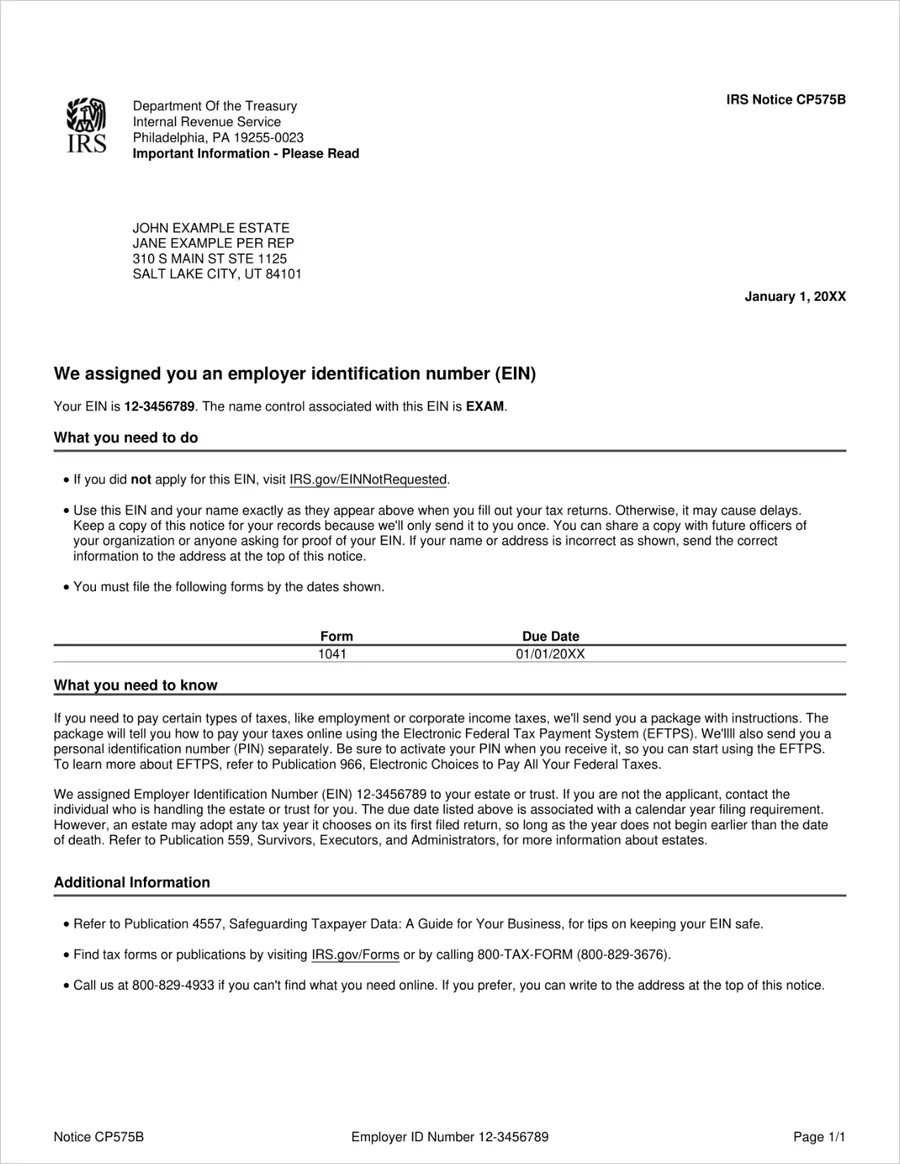
In the sample estate letter, the name and address block appears near the top left. It uses this format:
JOHN EXAMPLE ESTATE
JANE EXAMPLE PER REP
310 S MAIN ST STE 1125
SALT LAKE CITY, UT 84101
The first line names the estate. The second line names the person acting for the estate. In this example, "PER REP" means personal representative. A real IRS letter may show a different authority label, such as ADM for administrator or EXEC for executor.
The most important practical point is to use the estate name exactly as the IRS printed it. If a bank, tax preparer, or software system asks for the legal name tied to the EIN, small differences can cause a mismatch. For example, "John Example Estate" and "Estate of John Example" may look close to a person, but an automated system may treat them as different names.
A bank may also compare this IRS letter with the court document that names the executor or personal representative. The court document may have different wording, but the IRS EIN letter shows the tax identity that was created for the estate.
Trust EIN letter example
Here is the sample trust EIN letter (PDF). It shows how a CP575B looks for a trust after death, with the trust name, trust date, trustee line, mailing address, EIN, and name control.
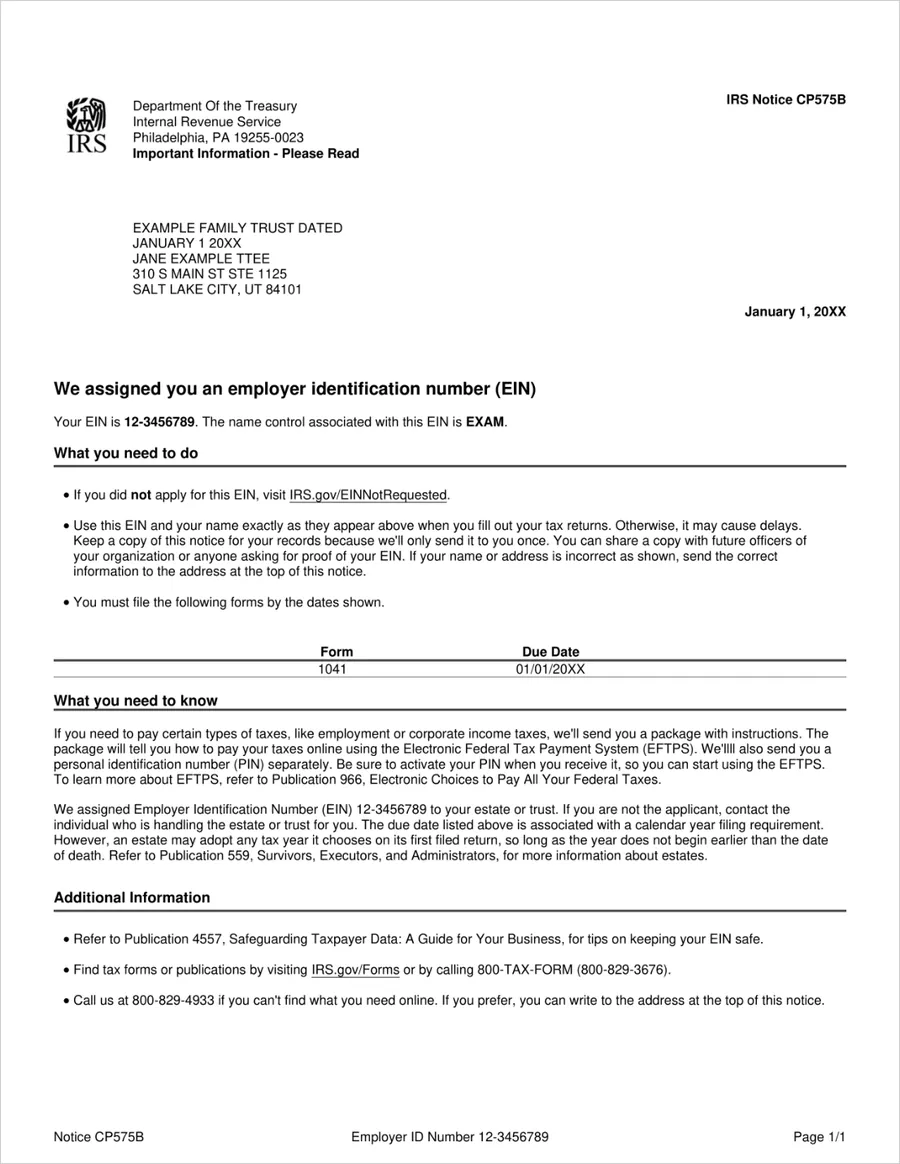
In the sample trust letter, the name and address block appears in this format:
EXAMPLE FAMILY TRUST DATED
JANUARY 1 20XX
JANE EXAMPLE TTEE
310 S MAIN ST STE 1125
SALT LAKE CITY, UT 84101
The first two lines identify the trust and the trust date. The third line names the trustee. "TTEE" is a common abbreviation for trustee.
A revocable trust becomes irrevocable at death and needs its own EIN. This is separate from the deceased's Social Security number. A trust bank account or brokerage account may require the trust's EIN confirmation letter before assets can be moved or retitled into the trust's post-death administration account.
If you are handling a trust after a death, Sunset has a separate guide to irrevocable trust bank accounts after death. The EIN letter is one part of that paperwork stack.
Walkthrough of each part of CP575B
Although estate and trust letters have different name blocks, the rest of Notice CP575B follows the same basic order from top to bottom.
1. IRS header and notice title
At the top, the notice identifies the IRS office and the notice type. The header reads "IRS Notice CP575B." This tells you the letter is the original EIN confirmation notice, not a later transcript or replacement letter.
The mailing address in the header is:
Department of the Treasury
Internal Revenue Service
Philadelphia, PA 19255-0023
If a bank asks for the CP575B, this is the notice it means.
2. Name and mailing address block
The first main block shows the estate or trust name and mailing address the IRS has on file. For an estate, the sample name block is:
JOHN EXAMPLE ESTATE
JANE EXAMPLE PER REP
address
For a trust, the sample name block is:
EXAMPLE FAMILY TRUST DATED
JANUARY 1 20XX
JANE EXAMPLE TTEE
address
This block matters because it is the IRS version of the account holder's name. Banks, brokerages, insurers, and tax software may require an exact match. If you type the name into a form, copy it from the letter and preserve the order of the lines as much as the form allows.
3. Notice date
The notice date appears near the top of the letter. It shows when the IRS issued the EIN confirmation.
This date is different from the date of death, the date a court appointed the executor, or the date a trustee began acting. It is simply the date of the IRS notice.
You may be asked for the notice date when organizing records, uploading documents, or responding to a tax-related request. It is also useful for your estate settlement file because it helps show when the tax ID was created.
4. The EIN itself
The EIN appears prominently in the letter. In the samples, the placeholder EIN is 12-3456789.
An estate or trust needs its own EIN to open an estate or trust bank account, whether with Sunset or with any other bank. The deceased's Social Security number can no longer be used for new accounts.
Treat the EIN like sensitive tax information. Share it only with parties that have a real need for it, such as banks, brokerages, insurers paying the estate, and tax preparers filing Form 1041.
5. Name control
The name control is a four-letter code the IRS ties to the EIN. It may look small, but it can matter when a bank or tax software checks the EIN against IRS records.
For an estate, the name control usually comes from the deceased's last name. In the sample estate letter, the name control is EXAM because the deceased's last name is Example.
For a trust, the name control comes from the trust's name. In the sample trust letter, the name control is also EXAM, taken from EXAMPLE FAMILY TRUST.
If a form asks for the name control, use the code exactly as shown. If a form asks for the legal name, use the estate or trust name exactly as shown on the CP575B.
6. Form 1041 filing table
The notice includes a table that says, "You must file the following forms by the dates shown." For estates and trusts, that table lists Form 1041 and a due date.
Form 1041 is the U.S. income tax return for estates and trusts. The due date shown on CP575B reflects a calendar-year filing requirement. The letter itself says an estate may adopt any tax year on its first filed return, as long as that tax year does not begin before the date of death.
The right tax year depends on the estate or trust, so talk it through with a qualified tax professional before the first return is filed.
7. "What you need to know" section
The "What you need to know" section gives general IRS instructions about the EIN and future filing obligations. It is not written for grieving families, so it can feel dry and formal.
Read this section, but do not panic if it mentions forms or dates you have not handled yet. The letter is a confirmation notice and a general reminder. It does not mean something is already late.
If you are also managing IRS identity records for the estate, you may want to read Sunset's guide to IRS Form 56, estate EINs, and tax transcripts. Form 56 is separate from CP575B, but both can come up during estate administration.
8. EIN repeated in the footer
At the bottom of the notice, the EIN appears again as "Employer ID Number." This footer repeat helps identify the notice if pages are separated or scanned.
If you upload or send the letter, include the full page so the recipient can see the header, body, and footer. Do not crop it down to only the EIN unless the recipient requests that format.
Who may ask to see the estate or trust EIN letter?
The CP575B is often requested by organizations that need to verify the tax identity of the estate or trust. Common examples include:
- Banks opening an estate or trust account
- Brokerages retitling or transferring assets
- Insurers paying proceeds to the estate
- Tax preparers filing Form 1041
A bank may ask for the EIN letter along with letters testamentary, letters of administration, a trust certificate, the trust document, a death certificate, or identification for the executor or trustee. Requirements vary by institution.
If you are opening an account for estate administration, Sunset's guide to how to open an estate bank account explains the common paperwork and why the account is separate from personal funds.
The EIN letter is one part of a larger file. Many executors start with assets and liabilities first: what the estate owns, what it owes, where cash needs to be collected, and what account will receive deposits and pay expenses. That same file often grows to include probate paperwork, account statements, insurance notices, tax forms, and records of transfers to beneficiaries.
How to keep the CP575B safe
The IRS sends the CP575B once. If you apply online, the letter appears as a digital PDF at the end of the online session. Download and save it right away.
A simple storage plan can prevent extra calls later:
- Save the PDF on your computer in an estate or trust folder.
- Save a second copy in cloud storage.
- Email a copy to yourself with a clear subject line.
- Print a copy for the estate binder or trust binder.
- If a tax preparer is helping, ask how they prefer to receive it.
Do not post the letter in shared family chats or open folders unless everyone with access has a real role in the estate or trust administration. The notice contains the EIN and identifying details for the estate or trust.
If you scan a paper copy, scan the entire page. Use a clear file name such as "Estate EIN Letter CP575B" or "Trust EIN Letter CP575B." If you manage more than one estate or trust, include the name in the file name to avoid mix-ups.
What if the EIN letter is lost?
If the original CP575B is lost, the IRS can confirm an existing EIN with Letter 147C. This is not the same as the original CP575B, but it can confirm the EIN and IRS records for the entity.
To request Letter 147C, call the IRS Business and Specialty Tax Line at 800-829-4933. The IRS will need to verify that the caller is authorized to receive the information.
Before calling, check the estate binder, the trustee file, tax preparer emails, downloads, cloud storage, and any documents used to open the bank account. Many people download the PDF during the IRS online session and forget where it was saved.
Getting an EIN on your own
The IRS updated its online EIN application recently, and it is now easier to get an EIN for an estate or trust on your own. If you go that route, apply only on IRS.gov. There is no IRS fee for an EIN, and lookalike sites charge for it.
When the application finishes, the IRS shows the CP575B as a digital PDF. Save it before you close the browser, and keep copies in more than one place: your computer, cloud storage, an email to yourself, and a printed copy in the estate or trust binder. If the PDF is lost, you are left calling the IRS for Letter 147C.
How Sunset gets or verifies an EIN
Sunset helps families with estate settlement, including work that often touches tax identity, probate paperwork, estate or trust accounts, and transfers. Sunset has helped 15,000+ families.
Sunset is a Circular 230 IRS tax professional firm. If a Sunset user does not have an EIN yet, Sunset obtains the EIN from the IRS for them, and the CP575B goes straight into the estate or trust file in Sunset.
If you already have an EIN letter, you can upload the CP575B in Sunset, and Sunset verifies it. There is no need to apply again.
Once the estate or trust is verified and its EIN is on file, the estate or trust account can be opened. Partner bank approval is next day. Each estate account and trust account is FDIC insured.
This is true whether the account is for an estate or for a trust. An estate or trust needs its own EIN to open the account, and the deceased's Social Security number can no longer be used for new accounts.
Common mistakes to avoid
The CP575B is short, but errors around it can slow down banks, brokerages, and tax work.
One common mistake is using the deceased's Social Security number for a new estate or trust account. After death, a new estate or irrevocable trust account should use the EIN for that estate or trust.
Another mistake is typing the name differently from the IRS letter. If the letter says "JOHN EXAMPLE ESTATE," do not change it to another wording unless a professional or institution tells you to. If the trust letter includes a date line, include that detail where the form allows it.
A third mistake is losing the online PDF. The IRS may show the CP575B only at the end of the online EIN session. Save it before closing the browser.
A fourth mistake is paying a lookalike website for an EIN. The IRS does not charge for one, and the real application lives on IRS.gov.
FAQ
What does an EIN letter example look like?
An EIN letter example for an estate or trust looks like IRS Notice CP575B. It includes the IRS header, the estate or trust name and mailing address, the notice date, the EIN, the name control, a Form 1041 filing table, a "What you need to know" section, and the EIN repeated in the footer.
Is CP575B the same as an EIN confirmation letter?
Yes. CP575B is the IRS notice that confirms a new EIN for an estate or trust. Banks and tax preparers may call it the EIN confirmation letter, estate EIN letter, trust EIN letter, or EIN assignment notice.
Do I need an EIN letter to open an estate bank account?
Banks commonly ask for proof of the estate's EIN when opening an estate account. An estate or trust needs its own EIN for a new account, whether the account is opened with Sunset or with another bank.
What is the name control on an estate EIN letter?
The name control is a four-letter code the IRS ties to the EIN. For an estate, it comes from the deceased's last name. For a trust, it comes from the trust name. Banks and tax software may ask for it.
Can I get another CP575B if I lost the first one?
The IRS sends CP575B once. If the original letter is lost, the IRS can confirm an existing EIN with Letter 147C. Call the IRS Business and Specialty Tax Line at 800-829-4933 to request it.
Get help with the estate or trust EIN
If you are gathering paperwork now, save the sample estate EIN letter (PDF) and the sample trust EIN letter (PDF) as references. They can help you recognize the real IRS CP575B when you see it.
Sunset can obtain an EIN from the IRS for users who do not have one yet. If you already have the CP575B, you can upload it in Sunset, and Sunset verifies it. Once the estate or trust is verified and its EIN is on file, the estate or trust account can be opened.
Start with Sunset to get the EIN or upload the letter you already have.