How Sunset Verifies Death and Authority (2026)
Before any search, Sunset verifies death, your identity, and your authority to act for the estate. See each check and why it exists.
October 15, 2026
By Stephen Walter, Attorney and CEO
*Part 2 of 10: How Sunset Works*
Short answer
Before Sunset searches for accounts, property, or records, it verifies three things separately: that the person died, who you are, and that you have authority to act for the estate. These checks exist because institutions and the IRS need proof before they release information, and because estate fraud prevention starts with making sure the right person is asking.
At a glance
| Step | Who does it | Typical timing | What you get |
|---|---|---|---|
| Enter three details about the person who died | You | Varies | A quick matching search |
| Confirm the match | You | Varies | Recent addresses, family members, and other names to review |
| Upload the death certificate | You | Varies | A certificate cross-checked against records and checked for tampering |
| Verify the death | Sunset | Varies | A check against the Social Security Death Master File |
| Confirm your phone number | You | Varies | A one-time text code, with SIM swap protection and carrier data analysis |
| Check your identity | Sunset | Varies | A match against identity records or a review flag |
| Identify your authority | You | Varies | A stated basis for who can act for an estate |
| Sign authority paperwork | You | Varies | An Authorization of Agent and a Certificate of Estate used with institutions |
Step 1: You enter three details, and Sunset finds the match
The first step is a matching step, not an account search. Sunset asks for only three details about the person who died: full name, phone number, and date of death.
With those three details, Sunset runs a quick matching search and shows you the results:
- Addresses where the person lived in the last few years
- Family members
- Possible other names, including aliases and maiden names
You review those results and confirm that Sunset has connected to the right person. Many people share a name, and the addresses and relatives are details you are likely to recognize, so you are the best check on whether the match is correct.
If the quick search cannot find the right person with those three details, Sunset asks for more: date of birth, Social Security number, or a recent address. You do not need the Social Security number to start.
The confirmed results also matter later. Accounts are often under a maiden name or nickname, so the other names help searches find them. Past addresses matter because unclaimed property is searched state by state, and probate is filed by county.
Estate settlement depends on accurate matches. A search is only useful if it is tied to the right person.
Step 2: You upload the death certificate, and Sunset verifies the death
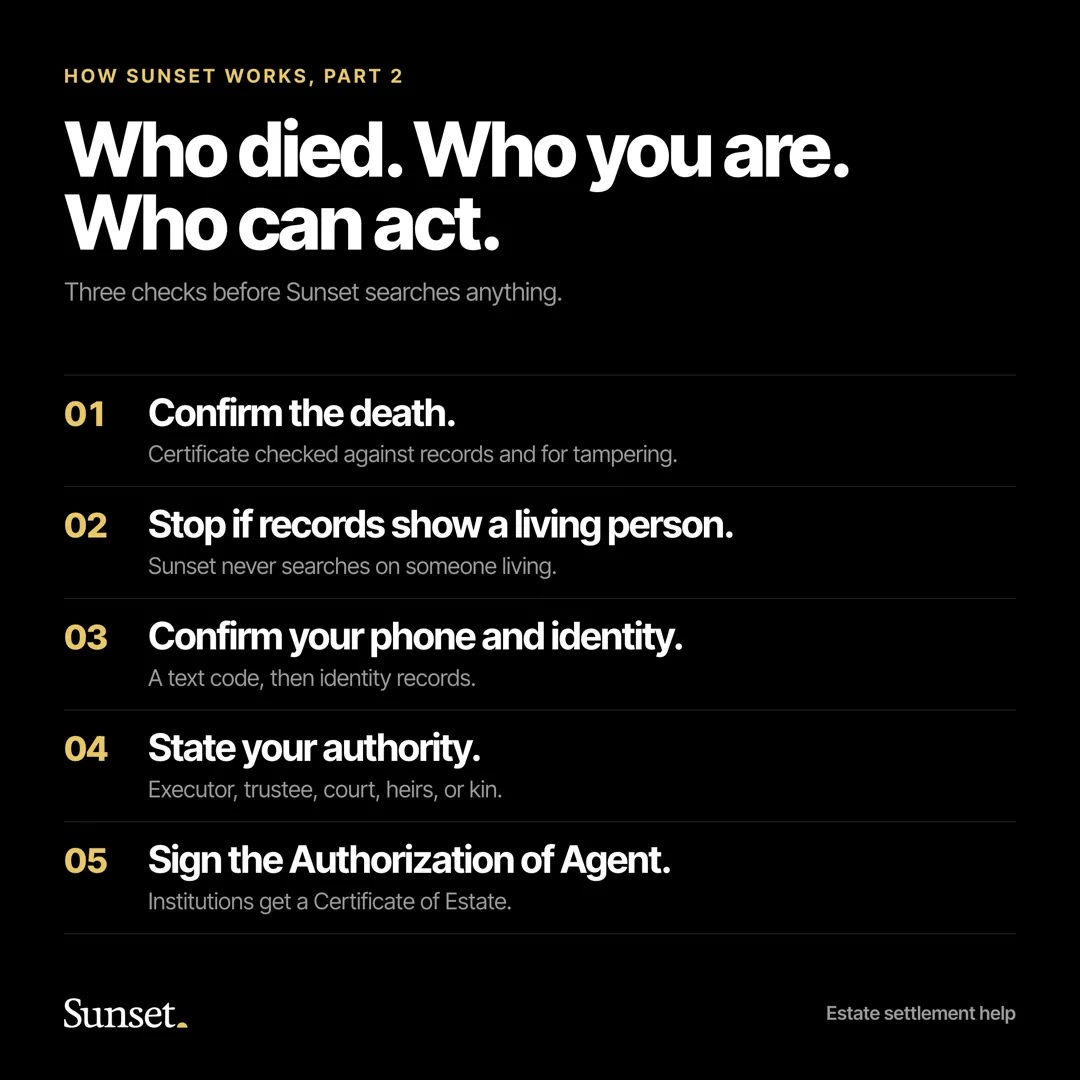
Next, you upload a copy of the death certificate. Sunset does not take the document at face value. All of the information on the certificate is cross-checked against public and private records about the person who died, and the image is analyzed for signs of AI tampering or photo editing.
Sunset also checks the Social Security Death Master File. Sunset is a certified subscriber to the Limited Access Death Master File.
If the records show the person may be living, Sunset stops. It will not search on a living person.
That stop matters. Searches tied to estates can involve private information. Institutions need to know that the request is being made after a death and in the context of estate administration. Sunset's death verification step helps protect living people from improper searches and helps protect the estate from requests that should not be made.
The certificate review and the Death Master File check work together. One tests the document you provide, and the other checks an outside record. Together they answer the first question any institution is likely to ask: has this person died?
If you are also worried about misuse of the deceased person's information, Sunset has a related guide on deceased identity theft protection. That topic is broader than this verification step, but the concern is similar: after a death, information should be handled carefully and by the right people.
Step 3: You confirm your phone number
Sunset confirms your phone number with a one-time text code. It also has SIM swap protection and runs carrier data analysis on the number.
A text code alone is not enough, because a phone number can be stolen. In a SIM swap, someone moves another person's number onto a new SIM card so the codes go to them. Checking the number with carrier data helps catch that before it becomes a way into an estate.
The phone code does not prove that you are executor. It also does not prove that you are next of kin. It is one piece of the verification process, not the whole process.
That distinction is important. Families often ask, "If I can answer questions about the person who died, is that enough?" Usually, no. Knowing family details does not automatically prove authority. Sunset separates contact confirmation, identity checking, death verification, and authority review so each question is answered on its own.
Step 4: Sunset checks your identity against identity records
After confirming death and contact information, Sunset checks who you are. The user's identity is checked against identity records. Your name, Social Security number or date of birth, and address must match. High-risk results are flagged for review.
This is the heart of executor identity verification. Sunset is checking whether the person using Sunset is who they say they are.
This protects the estate. If someone falsely claims to be a child, spouse, executor, trustee, or heir, the estate may be exposed to bad requests. A false claim could also cause institutions to waste time or send information to the wrong person.
If a result is high-risk, Sunset flags it for review. The facts of a family situation can be messy. People move, names change, and addresses may not line up neatly. Review flags help prevent the process from treating a risky or unclear match as routine.
Step 5: You state the basis for your authority
Next, Sunset asks which authority basis applies. This step is about who can act for an estate.
Sunset accepts these bases and asks you to identify which one applies:
- Named as executor in the will
- Trustee of the deceased person's trust
- Appointed by a court
- Held power of attorney
- Next of kin
- Holding signed waivers from the other heirs
Each basis points to a different document, record, or family role.
If you were named as executor in the will, the will is the document that names you. If you are trustee of the deceased person's trust, the trust is the source of that role. If a court appointed you, the court appointment is the record that shows your authority. If you are next of kin, your family relationship is the starting point. If other heirs signed waivers, those waivers show that other people with potential claims have signed off in some way.
Sunset's role at this stage is to ask which basis applies and to connect your answer to the estate request. This is part of how to prove authority as executor or as another person allowed to act.
This article is informational, not legal advice. Whether a given document is enough for a certain institution or a court can depend on the estate and the rules that apply. The point here is that Sunset does not treat authority as an afterthought. It asks about authority before searches begin.
If you are still trying to understand executor duties more broadly, Sunset's step-by-step overview of how Sunset works for estate settlement explains where this verification step fits in the larger process.
Step 6: You sign an Authorization of Agent
After the authority basis is identified, the user signs an Authorization of Agent. This lets Sunset act on the estate's behalf with institutions.
The key word is "authorization." Institutions need a reason to talk to a third party about estate matters. The Authorization of Agent is the document that tells an institution Sunset is allowed to make requests on behalf of the estate.
This is also why Sunset verifies death, identity, and authority before it searches anything. Without those checks, an institution may have no reason to release information. With those checks and the signed authorization, Sunset can present a clearer request.
Sunset has a separate guide to limited power of attorney in estate settlement, which may help if you are trying to understand how authorization documents work in this setting.
Step 7: Sunset issues a Certificate of Estate for institutions
Sunset issues a Certificate of Estate that institutions receive with requests.
The Certificate of Estate is not the same thing as the death certificate. The death certificate shows that the person died. The Certificate of Estate is used with institutions as part of Sunset's request package. It helps present the estate information and authority context in a form the institution can receive with the request.
Sunset has a full article on what a Certificate of Estate is if you want more detail on that document. In this part of the series, the main point is that Sunset issues it after the earlier checks, not before.
The order matters:
- Confirm the person died.
- Confirm who the user is.
- Identify the user's authority to act for the estate.
- Use signed authorization and the Certificate of Estate with institutions.
That order supports estate fraud prevention. It also gives institutions a clearer basis for responding to Sunset's requests.
Why Sunset separates death, identity, and authority
These checks answer different questions.
Death verification asks: did the person die?
Identity verification asks: is the user who they claim to be?
Authority review asks: does the user have a basis to act for the estate?
Those questions may sound similar, but they are not interchangeable. A person can be a real relative and still not be the person appointed by a court. A person can have a copy of a death certificate and still not have authority to request information. A person can be named in a will, but an institution may still need proof of death and identity before it responds.
Sunset verifies all three separately because institutions and the IRS need enough proof to release information to Sunset. The same process also protects the estate from someone falsely claiming to represent it.
What you do and what Sunset does
What you do:
- Enter the full name, phone number, and date of death of the person who died.
- Confirm that the quick search found the right person, and add date of birth, Social Security number, or a recent address if Sunset asks.
- Upload the death certificate.
- Confirm your phone number with a one-time text code.
- State the basis for your authority, such as executor, trustee, court appointee, next of kin, power of attorney holder, or signed waivers from other heirs.
- Sign the Authorization of Agent.
What Sunset does:
- Runs a quick matching search and shows you recent addresses, family members, and other names.
- Cross-checks the death certificate against public and private records and analyzes it for tampering.
- Checks the Social Security Death Master File.
- Stops if records show the person may be living.
- Protects against SIM swaps and analyzes carrier data on your phone number.
- Checks your identity against identity records.
- Flags high-risk identity results for review.
- Uses the Authorization of Agent to act on the estate's behalf with institutions.
- Issues a Certificate of Estate that institutions receive with requests.
What Sunset does not do at this stage
At this stage, Sunset does not search on a living person. If the records show the person may be living, Sunset stops.
Sunset also does not skip identity review because someone knows family details. Phone confirmation, identity matching, death verification, and authority review are separate checks.
Sunset does not treat one document as answering every question. A death certificate shows death. It does not, by itself, prove who you are or that you can act for the estate. A will may name an executor, but Sunset still checks identity and death before searches begin.
Sunset also does not turn this verification step into legal advice. If you are unsure whether you can serve, whether a court appointment is needed, or whether family waivers are enough in your situation, you may need guidance from a qualified professional in your state.
What to ask any estate settlement service
If you are comparing estate settlement services, ask direct questions before you share sensitive information:
- What do you verify before you search for accounts or records?
- How do you confirm that the person died?
- How do you check the identity of the person making the request?
- What documents or authority bases do you accept from an executor, trustee, next of kin, or court appointee?
- What do institutions receive when you contact them for estate information?
- What happens if records suggest the person may still be living or the user's identity check is high-risk?
Good answers should be plain. You should understand what is being checked, why it is being checked, and what document or record supports the request.
How Sunset Works, in 10 parts
- How Sunset settles an estate, step by step
- How Sunset verifies death, your identity, and your authority (you are here)
- How Sunset uses IRS records to find accounts
- What Sunset searches for after a death
- How Sunset finds the right department at each institution
- Opening an estate or trust bank account
- How Sunset notifies institutions and closes accounts
- What you can pay and manage from the estate account
- How Sunset prepares probate documents by county
- Security, people, and what Sunset does not do
FAQ
What is executor identity verification?
Executor identity verification is the process of checking that the person claiming to act for an estate is who they say they are. In Sunset's process, the user's name, Social Security number or date of birth, and address must match identity records, and high-risk results are flagged for review.
How do I prove authority as executor?
Authority can come from different places. Sunset asks which basis applies, including being named as executor in the will, acting as trustee of the deceased person's trust, being appointed by a court, holding power of attorney, being next of kin, or holding signed waivers from the other heirs. This article is informational and is not legal advice about whether a court or institution will accept a document in your situation.
Who can act for an estate before searches begin?
Sunset asks the user to identify the basis for acting for the estate before any search. Accepted bases include executor named in the will, trustee, court appointee, power of attorney holder, next of kin, or someone holding signed waivers from the other heirs.
What does Sunset need to know about the person who died?
To start, only the full name, phone number, and date of death. Sunset runs a quick matching search and shows recent addresses, family members, and other names so you can confirm it found the right person. If it cannot, Sunset asks for date of birth, Social Security number, or a recent address.
What happens if Sunset's records show the person may be living?
Sunset stops. It will not search on a living person. That rule helps protect privacy and reduces the risk of someone using estate tools to look for information about a living person.
If you are ready to begin with verified death, identity, and authority checks, get started with Sunset.