How Sunset Uses IRS Records to Find Accounts (2026)
Sunset uses IRS Wage and Income transcripts to find accounts after a death. See which tax forms point to which kinds of accounts.
October 16, 2026
By Stephen Walter, Attorney and CEO
*Part 3 of 10: How Sunset Works*
Short answer
IRS records can show where the deceased had money because banks, brokerages, employers, retirement plans, and insurers file information returns with the IRS when they pay someone. Sunset uses the executor's authorization to find accounts from IRS transcripts, read payer names, match them to institutions, and create a list of accounts to confirm and close. It is the part of estate settlement that catches what paper mail and family memory miss.
At a glance
| Step | Who does it | Typical timing | What you get |
|---|---|---|---|
| Sign IRS authorization forms | You | Varies | IRS Form 8821 and Form 56 ready to file |
| Request Wage and Income transcripts | Sunset | Varies | IRS transcript records for the deceased |
| File information returns with the IRS | The institution | Varies | Payer names from banks, brokerages, employers, plans, and insurers |
| Read and match return types | Sunset | Varies | Institution records tied to possible accounts |
| Create account leads for follow-up | Sunset | Varies | Accounts to confirm and close in a later step |
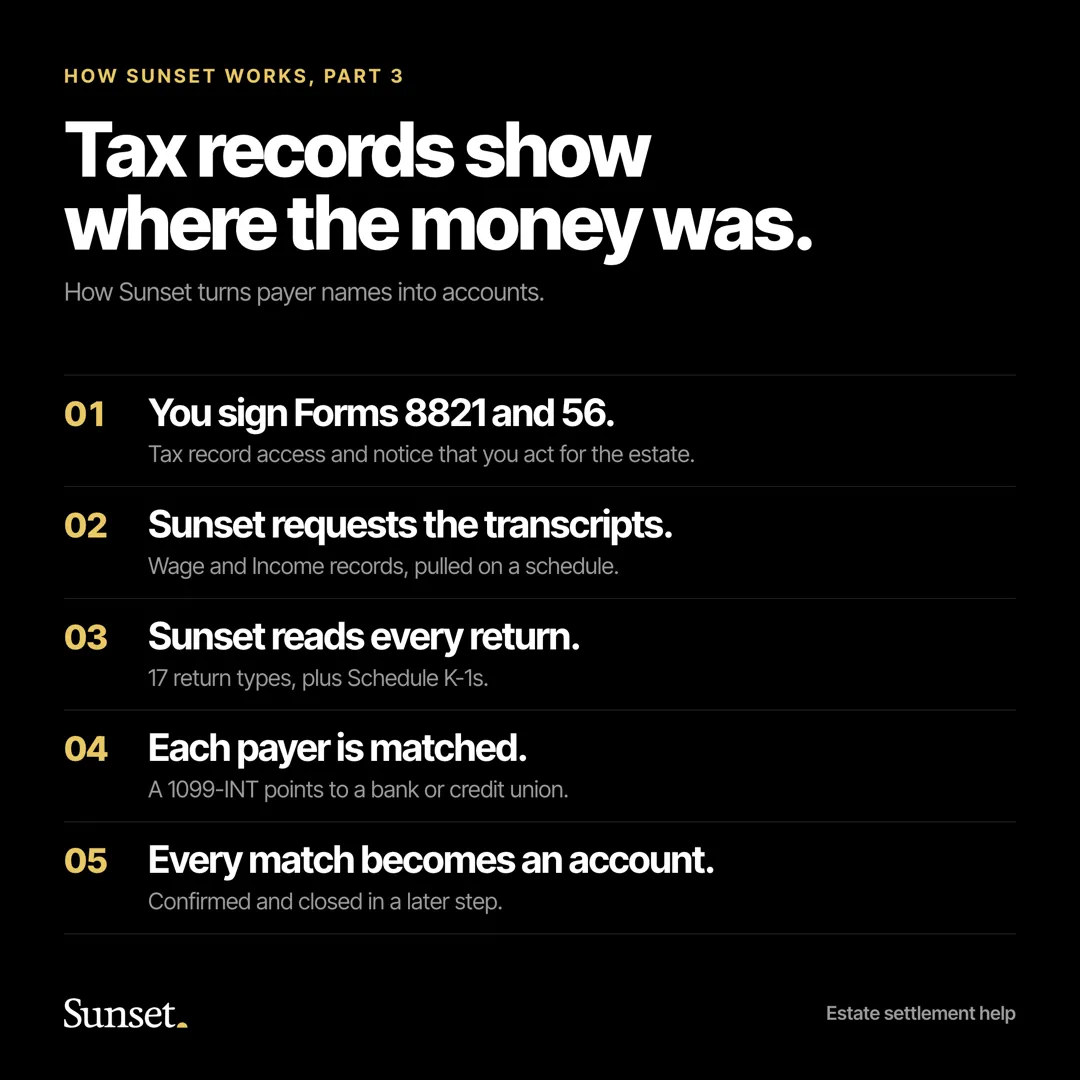
Step 1: You sign IRS Form 8821 and Form 56
The first step is authorization. The executor signs IRS Form 8821, tax information authorization, and Form 56, notice of fiduciary relationship. Those forms tell the IRS that Sunset may request tax information for the deceased and that the executor is acting in a fiduciary role.
For many executors, these form names are new. Form 8821 is about access to tax records. Form 56 is about notifying the IRS that someone is acting for the deceased person's estate. Together, they create the record Sunset needs before transcript requests can begin.
This step exists because IRS tax records are private. Even if you are named executor, Sunset cannot request the deceased person's Wage and Income transcripts without the right authorization on file. The forms are the bridge between your authority and the IRS transcript system.
If you want more background on Form 56 and estate tax transcripts, Sunset has a separate guide to IRS Form 56, estate EINs, and tax transcripts. This post focuses on how those records help reveal where accounts may exist.
The document involved here is not a bank statement or a probate filing. It is an IRS authorization record. That matters because the information Sunset is looking for comes from tax reporting by institutions, not from a drawer of old mail.
Step 2: Sunset requests Wage and Income transcripts
After the authorization forms are on file, Sunset uses its IRS CAF number to request the deceased person's Wage and Income transcripts through the IRS Transcript Delivery System. Once the forms are on file, Sunset pulls transcripts automatically on a schedule.
A Wage and Income transcript is an IRS record made from information returns. It is not a single list titled accounts. It is a tax transcript showing forms that payers sent to the IRS.
That distinction matters. The IRS does not send a neat household balance sheet. It receives information returns from institutions that paid the deceased money. Sunset reads those returns for the payer names and return types that point toward accounts, benefits, investments, or debts that may need estate follow-up.
This step exists because the executor often starts with incomplete records. The deceased may have gone paperless. Statements may have stopped. Mail may be forwarded, delayed, thrown away, or split among addresses. Online accounts may be locked behind passwords. IRS Wage and Income transcripts can catch activity that the family never saw in the mail.
For example, a dormant savings account might still report a small amount of interest each year. A brokerage account may issue tax forms even when no paper statement arrives at the house. A retirement account may leave a tax trail through a distribution or rollover record. These are not guesses from memory. They are payer names drawn from IRS reporting.
Step 3: Institutions file information returns with the IRS
The reason this method works is simple: every bank, brokerage, employer, retirement plan, and insurer that paid the deceased money files an information return with the IRS. Those returns name the payer. That makes IRS records one of the most complete lists of where someone had money.
The record involved at this step is the information return. The payer files it with the IRS, and the taxpayer usually receives a copy. After a death, however, copies may be hard to find. The mail may not reach the executor. The deceased may have used electronic delivery. The executor may not know which email address or online portal was used.
Sunset uses the IRS transcript because it gathers many of those payer reports in one place. It can point to institutions that would otherwise remain hidden until a notice arrives, a beneficiary calls, or money sits untouched.
This is why a 1099 can help find bank accounts after a death. A 1099 is not a bank account search tool by itself, but certain 1099 forms can point to the payer that issued them. If the payer is a bank or credit union, that name may lead to an account to confirm.
The same idea applies outside banking. An employer name may point to final wages, a retirement plan, or group life insurance. A brokerage payer name may point to investments. A mortgage lender may appear through mortgage interest reporting. Each payer name gives the executor a place to look next.
This method is useful because the estate can only deal with assets and debts it knows about. Before accounts can be closed or transferred, the executor needs a working inventory. IRS records help build that inventory from institutional reporting, not just family memory.
Step 4: Sunset reads 17 types of information returns plus Schedule K-1s
Sunset reads 17 types of information returns plus Schedule K-1s. The goal is to turn tax form data into accounts to follow up on. A form type tells Sunset what kind of institution may be involved and what kind of account or benefit may need attention.
Here are common examples and what each can point to:
| IRS record | What it can point to |
|---|---|
| W-2 | An employer, which can mean a 401(k) or pension, final pay, or group life insurance |
| 1099-INT | A bank or credit union account, a CD, or savings bonds interest |
| 1099-DIV | A brokerage or mutual fund account |
| 1099-B | A brokerage or mutual fund account |
| 1099-R | A pension, IRA, 401(k), or annuity distribution |
| 5498 | An IRA that received contributions or rollovers |
| 1098 | A mortgage lender |
| SSA-1099 | Social Security benefits |
| Schedule K-1 | An ownership interest in a partnership, S corporation, estate, or trust |
This step exists because a payer name alone may be too vague. A name on a transcript becomes more useful when it is paired with the return type. If the record is a 1099-INT, the estate may need to confirm a deposit account, certificate of deposit, or savings bonds interest. If the record is a 1099-DIV or 1099-B, the estate may need to look for a brokerage or mutual fund account.
The form type can also help avoid false assumptions. A W-2 does not prove there is a retirement account, but it gives the executor an employer to check. That employer may be connected to a 401(k), pension, final pay, or group life insurance. A 1099-R may point to a pension, IRA, 401(k), or annuity distribution, but the next step is still confirmation with the institution.
Schedule K-1s deserve special attention because they can point to ownership interests that are easy for families to miss. A K-1 may relate to a partnership, S corporation, estate, or trust. Those records may not look like ordinary bank or brokerage statements, yet they may matter for the estate.
If the estate has also received IRS mail, that can be part of the same paper trail. Sunset's guide to IRS letters after a death explains common notice and transcript issues that may come up after someone dies.
Step 5: Each payer name becomes an account to confirm and close
After Sunset reads the transcript records, each payer name is matched to an institution record. It then becomes an account to confirm and close in a later part of the process.
This is a key limit of the transcript step. A payer name is a lead. It may point to a bank, brokerage, employer, retirement plan, insurer, mortgage lender, government benefit, or ownership interest. It does not, by itself, settle the account. The institution still has to confirm what exists, what documents it needs, and what should happen next.
For an executor, that difference matters. The transcript helps answer the question, Where should I look? It does not always answer, What is the balance today? Who is the beneficiary? Has the account already been closed? Those questions belong to the account follow-up stage.
Still, the payer list can change the executor's work. Instead of calling institutions at random or relying only on old statements, the executor can work from records that show who reported payments to the IRS. That is why Sunset treats transcript data as an asset discovery input, not as the final word.
If you are also doing your own search, Sunset's guide on how to find a deceased person's bank accounts explains other places to check, including mail, records, and direct institution contact. IRS transcript work is one of the stronger sources because it is based on payer reporting.
Why tax records catch what paper misses
Paper records can fail for ordinary reasons. The deceased may have chosen electronic statements years ago. A bank may send tax forms to an old address. A dormant account can still report interest every year.
IRS records help because many institutions must report payments even when the family never sees a current statement. The payer name stays in the tax record. That name may be enough to identify an institution that needs a claim, closure, transfer, or other follow-up.
This is especially helpful when the executor did not manage the deceased person's finances before death. Many people have a main checking account that family members know about, plus older accounts that were opened for a job, a retirement rollover, a CD, a brokerage account, or a life change. Those older accounts can fall out of view.
What you do and what Sunset does
What you do:
- Act as the executor or fiduciary for the estate.
- Sign IRS Form 8821 and Form 56 so transcript requests can be made.
- Review account leads with the understanding that institutions still need to confirm details.
- Use the results as part of the estate's asset and liability picture.
What Sunset does:
- Uses its IRS CAF number to request the deceased person's Wage and Income transcripts through the IRS Transcript Delivery System.
- Pulls transcripts automatically on a schedule once the forms are on file.
- Reads 17 types of information returns plus Schedule K-1s.
- Matches payer names to institution records.
- Turns those payer names into accounts to confirm and close in a later step.
What Sunset does not do at this stage
At this stage, Sunset is finding and organizing account leads from IRS records. It is not yet the account confirmation and closure step. Each payer name still has to be checked with the institution.
Sunset also does not treat a transcript as a final account inventory. IRS records show payers that filed information returns for money paid to the deceased. They are one of the most complete lists of where someone had money, but the estate may still need other records and institution responses to finish the picture.
A transcript also may not tell you every fact an executor wants to know. It may show a payer name and return type without answering all balance, beneficiary, or closure questions. Those questions are handled through follow-up with the institution.
This post is for general information. Executors with legal or tax questions about an estate should speak with a qualified professional.
What to ask any estate settlement service
Before you choose help with estate settlement work, ask direct questions about how account discovery works:
- Do you use IRS Wage and Income transcripts to find institutions that paid the deceased?
- Which authorization forms do you need from the executor before requesting IRS records?
- How do you match payer names to banks, brokerages, employers, retirement plans, and insurers?
- Do you read Schedule K-1s as well as information returns such as W-2s, 1099s, 1098s, and 5498s?
- How do you separate a payer lead from a confirmed account?
- What happens after an account lead is found?
Good answers should make the process understandable. You should know what document is being used, who is doing each step, and what still has to be confirmed.
How Sunset Works, in 10 parts
- How Sunset settles an estate, step by step
- How Sunset verifies death, your identity, and your authority
- How Sunset uses IRS records to find accounts (you are here)
- What Sunset searches for after a death
- How Sunset finds the right department at each institution
- Opening an estate or trust bank account
- How Sunset notifies institutions and closes accounts
- What you can pay and manage from the estate account
- How Sunset prepares probate documents by county
- Security, people, and what Sunset does not do
FAQ
How can IRS transcripts help find accounts after death?
IRS transcripts can help because institutions that paid the deceased money file information returns with the IRS. Those returns name the payer. Sunset reads those payer names and return types to identify institutions that may hold accounts, benefits, investments, or debt records.
What is a Wage and Income transcript for a deceased person?
A Wage and Income transcript is an IRS record made from information returns filed by employers, banks, brokerages, retirement plans, insurers, and other payers. For an estate, it can show who reported wages, interest, dividends, distributions, mortgage interest, Social Security benefits, and certain ownership interests.
Can a 1099 find bank accounts after death?
A 1099 can point to a bank account after death if the payer is a bank or credit union and the form type suggests account activity. For example, a 1099-INT may point to a bank account, credit union account, CD, or savings bonds interest. The institution still has to confirm the account.
How does IRS Form 8821 work for an estate?
IRS Form 8821 lets the executor authorize access to tax information. In Sunset's process, the executor signs Form 8821 and Form 56. Sunset then uses its IRS CAF number to request the deceased person's Wage and Income transcripts through the IRS Transcript Delivery System.
Do IRS records close the accounts for the estate?
No. IRS records help identify payer names and possible accounts. Sunset matches each payer name to an institution record so it can become an account to confirm and close in a later step.
If you are settling an estate and want help finding accounts from IRS records, get started with Sunset.