How Sunset Notifies and Closes Accounts (2026)
How Sunset sends death notices, tracks every reply, follows up after 5 days, and closes about 90% of accounts with no phone call.
October 29, 2026
By Stephen Walter, Attorney and CEO
*Part 7 of 10: How Sunset Works*
Short answer
Sunset helps close accounts after death by sending each institution a death notice through the channel that institution accepts, such as email, web form, fax, or phone. Sunset then tracks replies, creates a follow-up if an institution does not respond within 5 days, and handles the closure steps that the institution requires.
For a surviving spouse, the goal is to reduce the number of separate calls, forms, and loose emails you have to manage while the estate settlement moves forward.
At a glance
| Step | Who does it | Typical timing | What you get |
|---|---|---|---|
| Send the death notice | Sunset | Varies | A notice sent through the channel the institution accepts |
| Route and file replies | Sunset | Varies | Institution replies kept in one estate record |
| Notify credit bureaus | Sunset | Varies | Mailed letters to Experian, Equifax, and TransUnion with the death certificate enclosed |
| Create follow-ups | Sunset | 5 days | A follow-up when an institution has not responded |
| Fill out institution forms | Sunset | ||
| Review and sign forms | You | Varies | Prefilled forms for your signature, with online notarization where required |
| Handle closure or claim steps | Sunset | Varies | A clear owner for the next step on each account |
| Move proceeds to the estate or trust account | The institution | Varies | Funds deposited into the estate or trust account from Part 6 when available |
Step 1: Sunset sends the death notice through the right channel
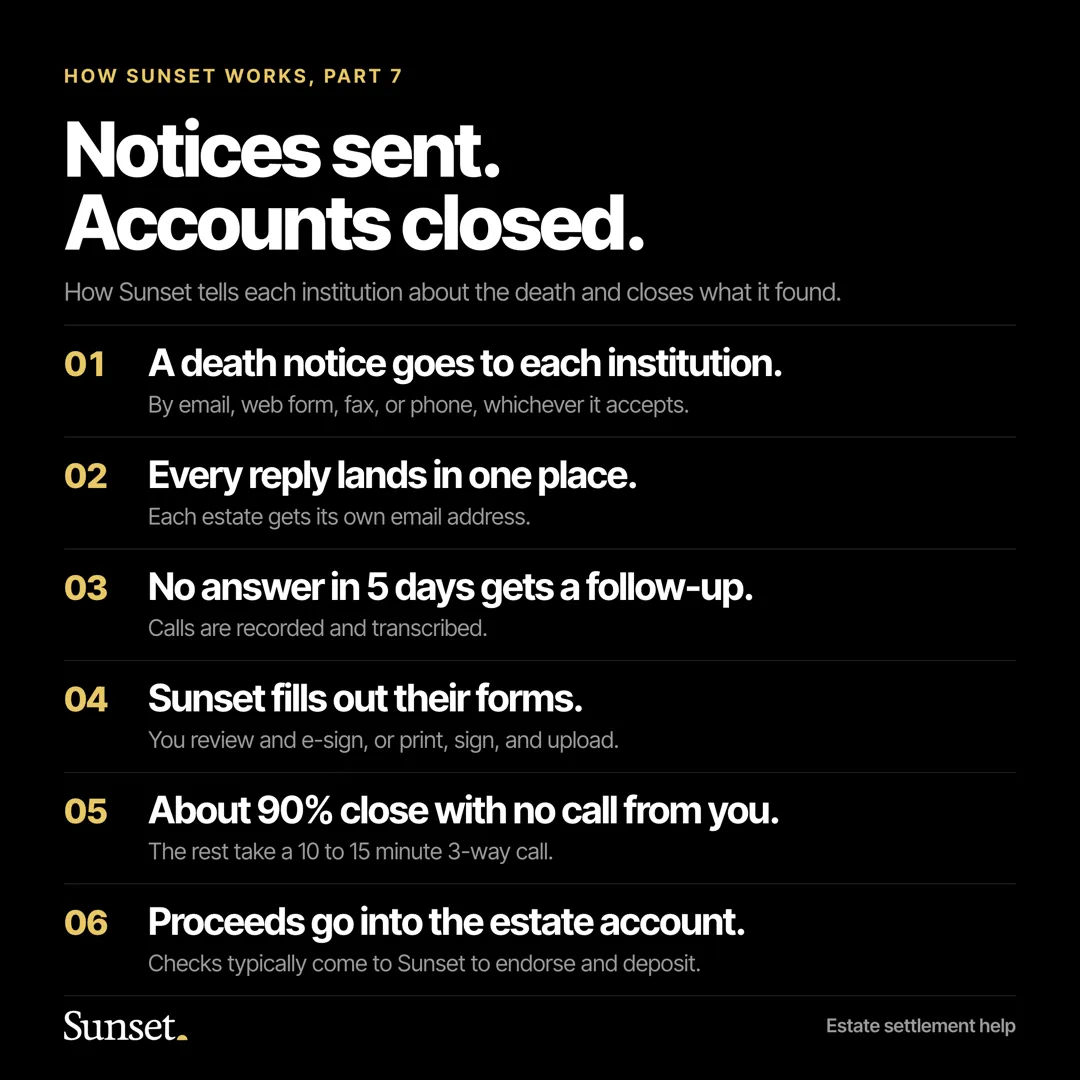
The first step is to tell each institution that the person who died is deceased. Sunset sends each institution a death notice through the channel that institution accepts. That may be email, a web form, fax, or phone.
This matters because institutions do not all take death notices the same way. Sunset uses the channel each institution accepts, so the notice goes where the institution expects to receive it.
The record involved here is the death notice. Depending on the account type and institution process, the notice may be paired with supporting estate paperwork. This step exists because many account closures cannot begin until the institution has been told about the death and has opened its own estate, claims, or bereavement process.
If you are handling some accounts yourself, Sunset also has a separate guide on how to close accounts and subscriptions after death.
Step 2: Sunset uses a dedicated email address for the estate
Each estate gets its own email address. Every institution reply lands in one place tied to the estate.
That is important because replies can arrive at different times and in different formats. One institution may send a short confirmation. Another may ask for a form. Another may ask for a death certificate, authority document, or claim packet. If those replies are mixed into a personal inbox, it is easy to miss a request or lose track of who answered.
The record involved here is the estate communication record. Calls to institutions are recorded and transcribed. Every reply from an institution is read and filed to the estate.
This step exists so the estate has one record of what each institution said, what it asked for, and who owns the next action. As a surviving spouse, you may already be managing funeral bills, household mail, family questions, and day-to-day finances. A central record helps keep the account closure work from turning into a pile of disconnected messages.
Step 3: Sunset uses the right cover letter for the account type
Sunset does not use one generic cover letter for every account. The cover letter changes by account type. Deposit accounts, debts, mortgages, auto loans, and insurance each get their own.
The document involved here is the account-specific cover letter. A deposit account notice is not the same as a debt notice. A mortgage is not the same as a life insurance claim. The institution needs to know what kind of account is involved and what action Sunset is requesting.
This step exists because different account types go to different teams inside an institution. A cover letter that matches the account type helps the institution route the request to the right team.
If a bank account is part of the work, this related guide explains more about how long it can take to close a bank account after death.
Step 4: Sunset notifies the three credit bureaus by mailed letter
Credit bureau notification is its own step. Sunset notifies the three credit bureaus by mailed letter with the death certificate enclosed. The three bureaus are Experian, Equifax, and TransUnion.
The document involved here is a mailed credit bureau notice with the death certificate enclosed. This step exists because the credit bureaus are part of the financial record after a death. Notifying them can be one part of protecting the deceased person's credit file and reducing the chance that new activity is tied to that person.
Anyone can use Sunset's free credit bureau notification tool. Sunset also has a full guide on how to report a death to the credit bureaus.
Credit bureau notices are separate from notifying banks, lenders, and insurance companies. A credit bureau notice does not close a bank account. A bank notice does not replace a credit bureau notice. They are different notices sent to different organizations for different reasons.
Step 5: Sunset creates a follow-up if there is no response within 5 days
After the first notice goes out, Sunset watches for the institution response. If an institution does not respond within 5 days, a follow-up is created.
The record involved here is the follow-up task. This step exists because silence from an institution does not mean the account is closed. It may mean the notice is still waiting in a queue, the institution wants a different channel, or the request needs another push.
Sunset tracks which institutions have replied and which have not, then creates the next follow-up when the 5 day mark is reached.
This is also where account ownership of the next step matters. Every account shows who owns the next step: the user, Sunset, or the institution. If the institution needs to review a document, the institution owns that step. If you need to sign a form, you own that step. If Sunset is waiting to send or file something, Sunset owns that step.
That status is meant to answer a basic question: what happens next, and who is responsible for it?
Step 6: Sunset fills out institution forms for your signature
Some institutions reply to the death notice with a form of their own that needs more information and a signature, sometimes a notarized one. When that happens, Sunset fills out the full form. You then review it and sign it electronically through DocuSign. If the institution requires notarization, the form is notarized online.
Some institutions require a wet signature, meaning ink on paper. In that case you print the form, sign it, and upload it back to Sunset, and Sunset sends it on to the institution.
The document involved here is the institution's own form. This step exists because many institutions will not accept a request in place of their own paperwork, and the signature has to be yours as the executor or trustee. Sunset's role is to fill in everything it can, so your part is a review and a signature, and then to keep the account moving once the signed form is back.
Step 7: Sunset handles most closures without a user call
Automated Closure handles bank accounts, retirement accounts, brokerage accounts, and life insurance claims. About 90% of closures need no call between the user and the institution.
The records involved may include the death notice, institution reply, claim form, signature record, call transcript, or closure confirmation, depending on what the institution requires. This step exists to close or claim the account according to the institution's process while keeping the estate record updated.
The remaining 10% or so are different. Some banks and retirement plan providers have an internal compliance policy that requires the executor or trustee to confirm two things by voice on a recorded line: that they accept responsibility for the account, and that they approve Sunset managing the closure on their behalf. This is the institution's own internal requirement.
That distinction matters. The call is not required because Sunset wants to add a step. It is required because the institution has its own policy.
Step 8: Sunset runs the 3-way call when an institution requires it
When an institution requires voice confirmation, Sunset runs a 3-way call with the user and a Sunset closure expert.
First, the user books the call in the Sunset web app at a time that suits them. Sunset books 30 minutes. Most calls last 10 to 15 minutes.
Next, the Sunset closure expert calls the user first. The expert goes over the goals of the call and answers questions before dialing the institution.
Then the expert calls the institution, usually the direct line of its estate services team, and guides the call. The user answers a few questions, such as their name and whose account they are working on. The institution may ask something like, "Do you give Sunset Estate Services permission to manage the closure process for this account?" The user says yes and can simply listen to the rest of the call.
Calls are recorded and transcribed, and Sunset continues the closure after the call.
The record involved here is the recorded and transcribed call. This step exists to satisfy the institution's internal requirement while keeping the burden on the user as limited as the institution allows. You are present for the part that requires your voice, but the Sunset closure expert guides the process.
Step 9: Proceeds go into the estate or trust account
When an account is closed or a claim is paid, proceeds go into the estate or trust account from Part 6. When an institution pays by check, the check is typically mailed to Sunset, and Sunset endorses and deposits it, so the user never handles it.
The record involved here is the deposit or payment record tied to the estate or trust account. This step exists because estate money should be kept separate from personal funds during administration. The estate or trust account is where account proceeds can be collected before later estate steps.
Instant Inheritance can move an eligible account's balance into the estate account directly.
What you do and what Sunset does
What you may do:
- Review account tasks in the Sunset web app.
- Review and sign institution forms electronically, or print, sign, and upload them when an institution requires a wet signature.
- Join a 3-way call if an institution requires your voice confirmation.
- Answer basic identity and account questions on that call.
- Watch who owns the next step on each account: you, Sunset, or the institution.
What Sunset does:
- Sends death notices through the channel each institution accepts.
- Uses account-specific cover letters for deposit accounts, debts, mortgages, auto loans, and insurance.
- Gives the estate its own email address so institution replies land in one place.
- Reads and files every institution reply to the estate.
- Records and transcribes calls to institutions.
- Creates a follow-up if an institution does not respond within 5 days.
- Fills out institution forms in full and sends them to you to review and sign.
- Continues closure work after any required 3-way call.
- Helps get proceeds into the estate or trust account when available.
What Sunset does not do at this stage
Sunset does not make every institution follow the same process. Each institution may accept notices through a different channel, and Sunset sends notices through the channel that institution accepts.
Sunset does not remove every need for user involvement. About 90% of closures need no call between the user and the institution, but the other 10% or so may require a recorded voice confirmation because of the institution's internal compliance policy.
Sunset does not replace an institution's form with its own, and it cannot sign for you. Sunset fills out the institution's form; you review and sign it electronically, or print, sign, and upload it when the institution requires a wet signature.
Sunset is not required. You can notify institutions and close accounts entirely on your own. Sunset is there to take that work off your plate if you want it to.
Sunset does not control how quickly an institution reviews its own requests. If there is no response within 5 days, Sunset creates a follow-up, but the institution still controls its internal review.
What to ask any estate settlement service
Before choosing help with account closure, ask direct questions about how the service manages institution notices and replies:
- How do you notify banks of death, and do you use the channel each institution accepts?
- How do you notify creditors of death, and how are replies saved to the estate record?
- If an institution does not respond, when do you create a follow-up?
- Who reads institution replies, and where are those replies filed?
- What happens if a bank or retirement plan requires the executor or trustee to confirm permission by voice?
- If an institution sends its own form, who fills it out, how do I sign it, and what happens if it requires a notarized or wet signature?
The answers should make clear who owns each step, what documents are involved, and what happens when an institution does not answer.
How Sunset Works, in 10 parts
- How Sunset settles an estate, step by step
- How Sunset verifies the death, your identity, and your authority
- How Sunset uses IRS records to find accounts
- What Sunset searches for after a death
- How Sunset finds the right department at each institution
- Opening an estate or trust bank account
- How Sunset notifies institutions and closes accounts (you are here)
- What you can pay and manage from the estate account
- How Sunset prepares probate documents by county
- Security, people, and what Sunset does not do
FAQ
How does Sunset close accounts after death?
Sunset sends each institution a death notice through the channel that institution accepts, tracks the reply, and handles the closure or claim steps the institution requires. Automated Closure handles bank accounts, retirement accounts, brokerage accounts, and life insurance claims.
Will I have to call every bank myself?
About 90% of closures need no call between the user and the institution. For the other 10% or so, some banks and retirement plan providers require the executor or trustee to confirm responsibility and permission by voice on a recorded line. Sunset runs that 3-way call with a closure expert.
How does Sunset notify creditors of death?
Sunset sends death notices through the channel each institution accepts. The cover letter changes by account type, including debts, mortgages, and auto loans, so the notice is framed for the type of account involved.
How are credit bureaus notified after a death?
Sunset notifies Experian, Equifax, and TransUnion by mailed letter with the death certificate enclosed. Anyone can also use Sunset's free credit bureau notification tool.
Do I have to use Sunset to close accounts?
No. You can notify institutions and close accounts entirely on your own; Sunset is never required for this. If you want help, Sunset sends the notices, fills out the institution forms, tracks the replies, and follows up.
Where do the funds go after an account is closed?
Proceeds go into the estate or trust account from Part 6. If an institution pays by check, the check is typically mailed to Sunset, and Sunset endorses and deposits it, so the user does not have to handle it.
If you are ready to get help notifying institutions and closing accounts after a death, get started with Sunset.