How Sunset Settles an Estate, Step by Step (2026)
How does Sunset work? See the seven stages, from verification and asset searches to account closure, bill payment, and heir payouts.
October 13, 2026
By Stephen Walter, Attorney and CEO
Part 1 of 10: How Sunset Works
Short answer
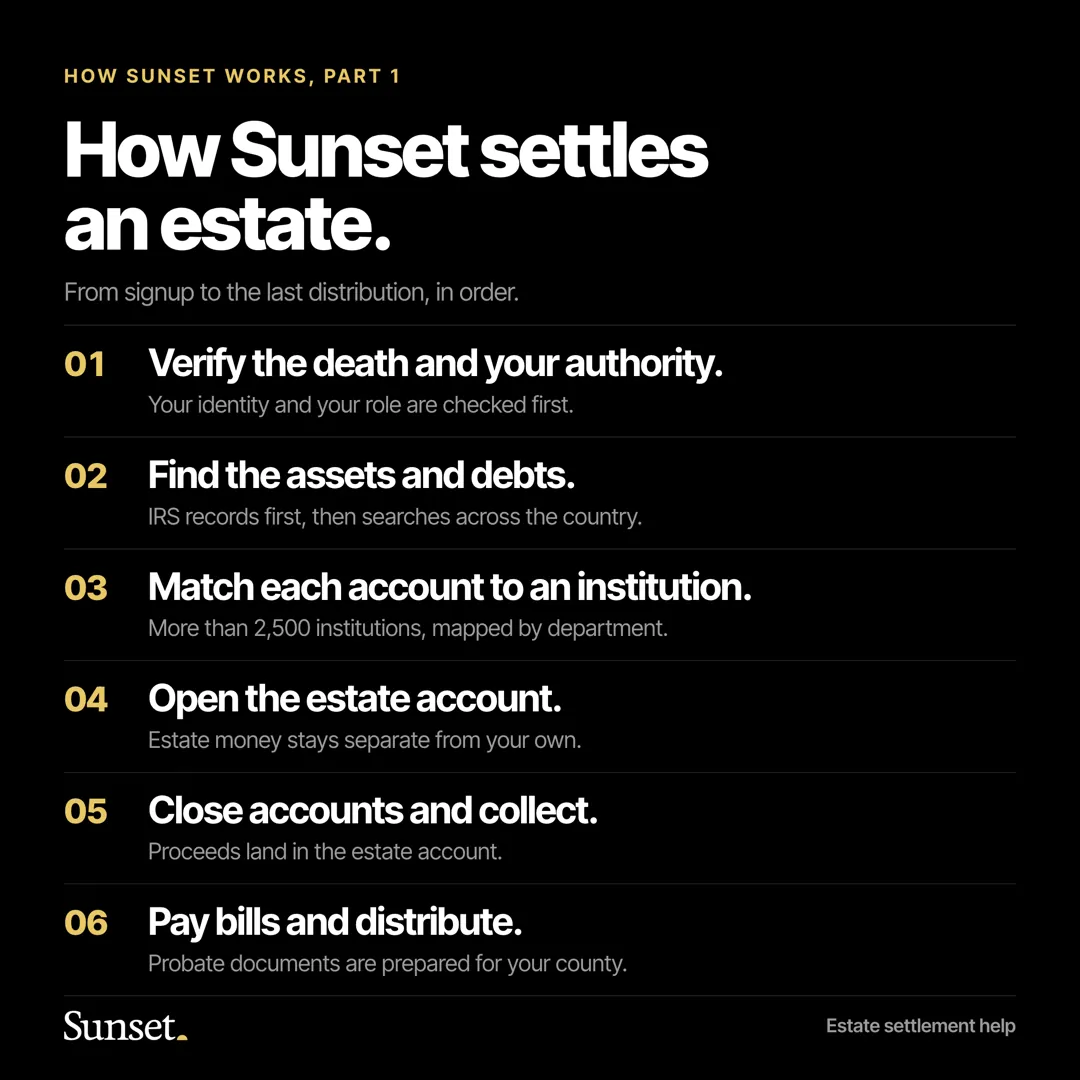
How does Sunset work? Sunset settles an estate in seven stages: verification, discovery from IRS records, discovery searches, institution mapping, opening an estate or trust bank account, closing accounts, and a final stage for paying bills, distributing to heirs, and preparing probate documents for the county.
At each stage, tasks are assigned either to you or to Sunset, so you can see who owns the next step. Sunset is an estate settlement platform that has helped 15,000+ families, with a team that includes licensed attorneys and estate settlement specialists.
At a glance
| Step | Who does it | Typical timing | What you get |
|---|---|---|---|
| 1. Verification | Sunset | Varies | Confirmation of the death, your identity, and your authority to act |
| 2. Discovery from IRS records | Sunset | Varies | IRS Wage and Income transcript review and a list of information returns filed about the deceased |
| 3. Discovery searches | Sunset | Instant to 14 calendar days, depending on search | Searches for accounts, debts, real estate, vehicles, business ownership, life insurance, unclaimed property, and other records |
| 4. Institution mapping | Sunset | Varies | Each account found is matched to the right department and contact channel |
| 5. Estate or trust bank account | You | Varies | An estate or trust bank account opened inside Sunset |
| 6. Notify and close accounts | Sunset | Varies | Institutions are notified, accounts are closed, and proceeds land in the estate account |
| 7. Pay bills, distribute, and prepare probate documents | Sunset | Varies | Bills are paid, heirs receive distributions, and probate documents are prepared for the county |
Step 1: Verification
The first stage is verification. Sunset confirms three things before moving deeper into the estate: the death, your identity, and your authority to act.
The records involved can include the death record, identity information, and documents showing your role. If you are the executor, administrator, trustee, or another person with authority, this step helps tie your role to the work ahead.
This stage exists because banks, insurers, credit bureaus, government offices, and courts usually will not speak with just anyone about the deceased. Before accounts can be searched, closed, or transferred, the person acting for the estate needs to be identified. Verification is the gate that helps keep the process tied to the correct estate and the correct person.
For many executors, this is also when the work starts to feel more organized. Instead of a pile of calls and forms, the estate is broken into assigned tasks. Every task in Sunset is assigned either to you or to Sunset, so you can see who owns the next step.
If you are still in the first few days after the death, Sunset also has a practical first-week guide here: First week executor checklist.
Step 2: Discovery from IRS records
After verification, Sunset requests the deceased's IRS Wage and Income transcripts. Sunset then reads every information return filed about the person who died.
The document involved here is the IRS Wage and Income transcript. It can point to records tied to wages, retirement income, brokerage activity, bank interest reporting, mortgage interest, and other reported financial activity. One transcript will not settle the estate by itself, but it can reveal institutions and income sources that need follow-up.
This step exists because many estates begin with incomplete information. The executor may know about the main checking account and the house, but not an old retirement plan, a brokerage account, or a financial institution that sent tax forms in a prior year. IRS records can help build a more complete starting map.
Sunset does not promise that every asset will be found. No estate settlement service should promise that. But using IRS records early gives the search a document-based foundation instead of relying only on memory, mail, or family guesses.
Step 3: Discovery searches
The third stage is broader discovery. Sunset searches across many record sources for assets, debts, and other estate items.
The searches in this stage include a national bank-account database search, credit report, Social Security Death Master File, unclaimed property in every state where the deceased had an address, real estate in all 50 states, vehicle titles, business ownership, a life insurance policy locator, and institution-specific searches.
The records involved vary by search. For example, a credit report can help show debts and creditor names. Real estate records can help identify property. Vehicle title searches can point to cars or other titled vehicles. Unclaimed property searches can show funds held by state programs. Life insurance searches can help find policy leads.
Timing depends on the search type. Business ownership results are instant. Debts, property records, vehicle titles, and unclaimed property come back within hours. Life insurance takes about 1 business day or less. Retirement and brokerage accounts take 4 to 10 calendar days. Bank accounts take 7 to 14 calendar days.
This stage exists because an executor is expected to deal with the estate's assets and debts, but the executor may not know what exists. Discovery puts the assets-and-liabilities-first approach into practice: find what the estate owns and what it may owe before trying to close, pay, or distribute.
For a wider view of how long estate work can take, see Sunset's guide to the estate settlement timeline.
Step 4: Institution mapping
Finding an account is only part of the work. The next stage is institution mapping. Sunset matches each account found to the right department and contact channel at the right institution.
The record involved is the account lead or account record found during discovery. Sunset compares that to its database of more than 2,500 financial institutions. The goal is to figure out exactly where the request should go.
This step exists because large institutions often have separate teams for estate claims, beneficiary claims, trust accounts, credit cards, mortgages, retirement plans, and brokerage accounts. Sending the right document to the wrong place can slow the work. Sending the wrong document to the right place can also create delays.
Institution mapping is one reason executor help online can be useful. You may still need to make choices as executor, but you are not starting from a blank search bar or a customer service phone tree. Sunset turns account leads into institution-specific next steps.
Step 5: Opening an estate or trust bank account inside Sunset
Once the estate has been verified and the work is moving, the next stage is opening an estate or trust bank account inside Sunset.
The record involved is the estate or trust account itself. This account is where estate proceeds can land after institutions close accounts or process claims. It is also the account used later for paying estate bills and distributing funds to heirs.
This step exists because estate money should be kept separate from personal money. Executors often need a dedicated place to receive proceeds, pay bills, document payments, and later show what was distributed. Mixing estate funds with a personal checking account can make the paper trail harder to explain.
Sunset Assistance also matters here. You choose, setting by setting, whether Sunset handles a step or you do it. There are 23 settings across four groups: searches, selling or managing assets, closing accounts and filing claims, and setup items such as probate, EIN, and bank account. That means the estate account step can be part of a larger set of choices about how much help you want.
If you are comparing an online platform with other options, Sunset has a guide on Sunset vs. probate attorney vs. DIY.
Step 6: Notifying institutions and closing accounts
After the estate account is in place and accounts have been mapped, Sunset helps notify institutions and close accounts. Proceeds from closed accounts land in the estate account.
The records involved can include death records, authority documents, institution forms, claim forms, and account records. The exact paperwork depends on the institution and the type of account. A bank account, brokerage account, retirement account, credit card, mortgage, vehicle title, and insurance policy may each have different steps.
This stage exists because institutions usually need formal notice before they will close, transfer, or pay out an account. An executor may have to prove the death, prove authority, complete the institution's forms, and keep track of what has been sent.
The practical problem is follow-through. One estate can involve many institutions, each with its own process. Sunset's role is to turn the list of accounts into assigned closing and claim tasks. If Sunset owns the task, Sunset handles it. If you own the task, it is visible as your next step.
This is also where the difference between discovery and settlement becomes clear. Finding an account tells you that work exists. Closing it, collecting the proceeds, and recording the result moves the estate forward.
Step 7: Paying bills, distributing to heirs, and preparing probate documents
The final stage in this overview covers estate payments, distributions, and probate document preparation. Bills are paid from the estate account, heirs receive distributions, and Sunset prepares probate documents for the county.
The records involved can include bills, creditor information, payment records, heir distribution records, and probate documents. These records matter because the executor may need to show what came into the estate, what went out, and why.
This stage exists because an estate is not settled just because assets have been found. The estate must also deal with expenses and debts before final distributions. Then funds need to be distributed to the right heirs or beneficiaries, with records showing what was paid.
Sunset can help organize this stage, but the right order can depend on the estate, the county, the will or trust, the type of assets, and creditor rules. This article is informational and is not legal advice. If you have questions about your personal duties, ask a qualified professional.
Cost is also a common executor question. Sunset's current pricing is here: Sunset pricing. Any Sunset fee counts as an estate administration expense the executor can reimburse from the estate.
What you do and what Sunset does
You do not have to choose between doing every task yourself and handing over every task. Sunset Assistance lets you choose, setting by setting, whether Sunset handles a step or you do it.
You can choose across 23 settings in four groups:
- Searches
- Selling or managing assets
- Closing accounts and filing claims
- Setup items, including probate, EIN, and bank account
What you do:
- Provide information and documents needed to verify your role
- Make choices about which tasks Sunset handles and which tasks you handle
- Review assigned tasks so you know what is waiting on you
- Make executor decisions for the estate when needed
- Keep personal and estate money separate
What Sunset does:
- Confirms the death, your identity, and your authority to act
- Requests and reviews IRS Wage and Income transcripts
- Runs discovery searches for accounts, debts, property, vehicles, insurance, business ownership, unclaimed property, and other records
- Maps account leads to the right institution contact channel using a database of more than 2,500 financial institutions
- Helps open an estate or trust bank account inside Sunset
- Notifies institutions, closes accounts, and sends proceeds to the estate account
- Helps pay bills, distribute to heirs, and prepare probate documents for the county
The key idea is task ownership. Every task in an estate is assigned either to you or to Sunset, so the next step is clear.
What Sunset does not do at this stage
A plain explanation of how estate settlement works should also include limits.
Sunset does not promise that every asset will be found. It uses IRS records and discovery searches, but no provider can guarantee that every account, policy, debt, or property interest will appear.
Sunset does not give one overall timeline for every estate. The facts support timing for certain searches: business ownership is instant, debts and several property-related records come back within hours, life insurance takes about 1 business day or less, retirement and brokerage accounts take 4 to 10 calendar days, and bank accounts take 7 to 14 calendar days. Other steps vary.
Sunset does not make every choice for you. With Sunset Assistance, you choose whether Sunset handles each setting or you do it. That choice is part of the product.
This article also is not legal advice. Estate rules can depend on state law, county practice, the will or trust, creditor claims, beneficiary designations, and family facts.
What to ask any estate settlement service
Before you choose an estate settlement service, ask direct questions. Good answers should make the work easier to understand.
- How do you verify the death, my identity, and my authority to act?
- What records do you use to search for assets and debts?
- Do you search IRS Wage and Income transcripts, bank accounts, credit reports, real estate, vehicles, life insurance, business ownership, and unclaimed property?
- When an account is found, how do you know which department or contact channel to use?
- Can I choose which tasks I handle and which tasks you handle?
- How are estate funds received, bills paid, and heir distributions recorded?
These questions help you compare process, task ownership, and records. They also help you avoid vague promises.
How Sunset Works, in 10 parts
- How Sunset settles an estate, step by step (you are here)
- How Sunset verifies the death, your identity, and your authority
- How Sunset uses IRS records to find accounts
- What Sunset searches for after a death
- How Sunset finds the right department at each institution
- Opening an estate or trust bank account
- How Sunset notifies institutions and closes accounts
- What you can pay and manage from the estate account
- How Sunset prepares probate documents by county
- Security, people, and what Sunset does not do
FAQ
How does Sunset work for an executor?
Sunset turns estate work into assigned tasks across seven stages: verification, IRS transcript review, discovery searches, institution mapping, estate or trust bank account setup, account closure, and a final stage covering bill payment, distributions, and probate documents. Each task is assigned either to you or to Sunset.
Is Sunset an estate settlement service?
Yes. Sunset is an estate settlement platform that helps families work through the financial and administrative steps after someone died. It has helped 15,000+ families, and its team includes licensed attorneys and estate settlement specialists.
How long does Sunset take to find accounts?
It depends on the search. Business ownership results are instant. Debts, property records, vehicle titles, and unclaimed property come back within hours. Life insurance takes about 1 business day or less. Retirement and brokerage accounts take 4 to 10 calendar days. Bank accounts take 7 to 14 calendar days.
Does Sunset handle every executor task for me?
Not automatically. With Sunset Assistance, you choose, setting by setting, whether Sunset handles a step or you do it. There are 23 settings across searches, selling or managing assets, closing accounts and filing claims, and setup items.
Does Sunset prepare probate documents?
Yes. In the seven-stage process, Sunset prepares probate documents for the county. Probate needs can vary by estate, so this article should be treated as general information, not legal advice.
If you are ready to see what Sunset can help with in your estate, get started with Sunset.