What Sunset Searches For After a Death (2026)
Learn how to find all assets of a deceased person, what Sunset searches, and how bank accounts, debts, real estate, and insurance appear.
October 20, 2026
By Stephen Walter, Attorney and CEO
*Part 4 of 10: How Sunset Works*
Short answer
If you are wondering how to find all assets of a deceased person, Sunset searches for financial accounts, insurance, debts, real estate, vehicles, business ownership, and unclaimed property using records tied to the deceased. Sunset checks more than 2,500 financial institutions, confirms the death through the Social Security Death Master File, and keeps the results on the estate record so the executor can show what was searched and what turned up.
This part of estate settlement is about discovery. It helps turn scattered clues into account records the executor can review, close, claim, transfer, or use for the next step.
At a glance
| Step | Who does it | Typical timing | What you get |
|---|---|---|---|
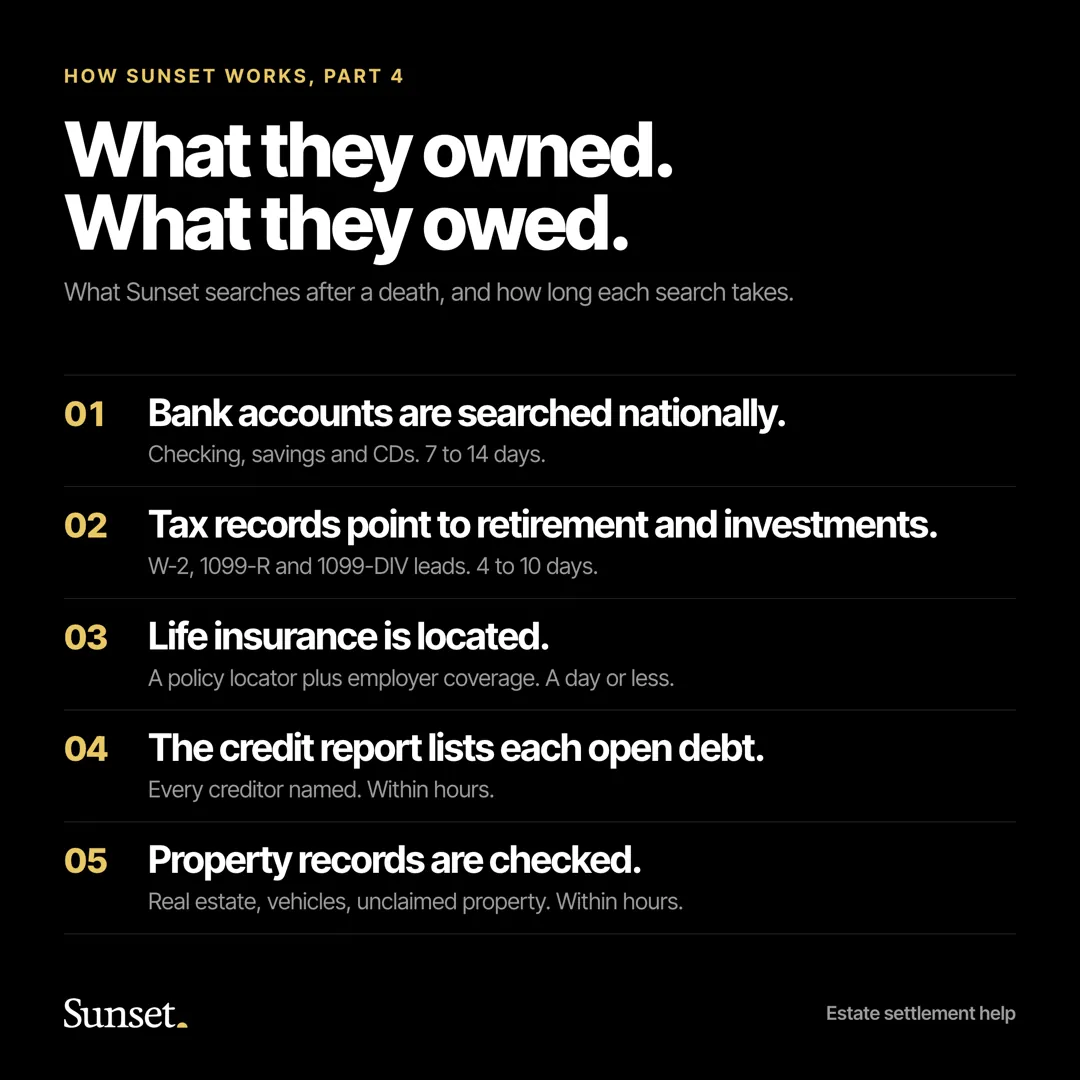
| Bank accounts | Sunset | 7 to 14 calendar days | Checking, savings, CD, and money market leads grouped into account records |
| Retirement accounts | Sunset | 4 to 10 calendar days | 401(k), 403(b), IRA, Roth IRA, SEP, pension, and annuity leads |
| Investment accounts | Sunset | 4 to 10 calendar days | Brokerage, stock, bond, and mutual fund account leads |
| Life insurance | Sunset | About 1 business day or less | Possible term, whole, universal, funeral, or employer group coverage |
| Debts | Sunset | Within hours | Open debts and the creditor behind each one |
| Real estate | Sunset | Within hours | Property record matches in all 50 states |
| Vehicles | Sunset | Within hours | Vehicle title record matches |
| Business ownership | Sunset | Instant | Business record and Schedule K-1 leads |
| Unclaimed property | Sunset | Within hours | State-held property matches tied to the deceased's addresses |
Bank accounts
Bank accounts are often the first place an adult child looks after a parent dies. But the obvious bank branch, old checkbook, or app on a phone may not tell the whole story. The deceased may have had a savings account opened years ago, a certificate of deposit, a money market account, or an account at an institution the family does not know about.
Sunset searches for checking, savings, CDs, and money market accounts through a national bank-account database search. That search is sent with a signed request packet that includes authorization and the Certificate of Estate. The Certificate of Estate is the summary document used in Sunset's process to help institutions understand the estate request. If you want more background on that document, Sunset has a separate guide to the Certificate of Estate.
Sunset also uses IRS interest records from Part 3 of this series and institution-specific searches. Interest records can point to a bank that paid interest to the deceased. That clue does not by itself finish the job. It tells Sunset where to confirm the account with the institution.
The typical timing for bank-account discovery is 7 to 14 calendar days.
A bank search does not guarantee every account will be found. It gives the executor a broader starting point than paper statements and memory alone. For a fuller manual checklist, see Sunset's guide on how to find all assets of a deceased person.
Retirement accounts
Retirement accounts can be easy to miss because they may be tied to an old employer, an account custodian, or a plan name that never appeared in the deceased's everyday banking. Common examples include 401(k), 403(b), IRA, Roth IRA, SEP, pension, and annuity accounts.
Sunset looks for retirement accounts using IRS records such as W-2, 1099-R, and 5498 forms. These records can point to an employer plan or custodian. Once there is a lead, Sunset confirms the account with the institution.
The record involved matters. A W-2 can suggest an employer relationship. A 1099-R can show retirement distributions. A 5498 can point to IRA activity. These records do not always show the current balance or the full beneficiary outcome, but they can show where an account may exist.
The typical timing for retirement account discovery is 4 to 10 calendar days. Results are grouped into retirement account records for review. The purpose is to give the executor a clearer list of institutions to contact, documents to gather, and next steps to track.
Investment accounts
Investment accounts can include brokerage accounts, stocks, bonds, and mutual funds. Some families already know about these accounts because monthly statements arrive by mail or email. Other accounts may be old, paperless, or held at an institution the family does not recognize.
Sunset searches for investment accounts using IRS records such as 1099-DIV and 1099-B, then confirms the lead with the institution. A 1099-DIV can point to dividends or distributions. A 1099-B can point to sales of securities. These forms can act like signposts. They do not replace institution confirmation.
This step exists because investment accounts may be part of the estate inventory or may pass outside probate depending on ownership and beneficiary setup. Either way, the executor often needs to know that the account exists before deciding what paperwork is needed.
The typical timing for investment account discovery is 4 to 10 calendar days. Sunset groups the results into investment account records so they can be reviewed alongside bank and retirement leads.
Life insurance
Life insurance is one of the most common assets families worry about missing. A policy may be term, whole, universal, or a funeral policy. Coverage can also come through an employer group plan.
Sunset searches for life insurance through its own policy locator, which Sunset built in house. The locator sends the search to insurers so each one can check its records for a policy on the deceased. Sunset also looks at employer group coverage suggested by W-2 records. If a W-2 points to an employer, that can create a lead to check whether group coverage existed.
The typical timing for this search is about 1 business day or less. This does not mean a claim is paid in that time. It means the locator process can produce a response path quickly.
This is the one discovery step that differs from the others in how institutions learn about the death. Discovery generally does not tell institutions about the death. The exception is Sunset's life insurance locator, which notifies insurers so they can respond.
Life insurance can be handled outside the estate if a beneficiary is named, but the executor still may need to know whether a policy exists. If there is no clear beneficiary information, the insurer may request estate documents. Sunset's role at this stage is to help identify the possible policy and organize the result.
Debts
Finding debts is just as important as finding assets. For an adult child acting as executor, the debt search can reduce guesswork about credit cards, mortgages, HELOCs, auto loans, and other loans.
Sunset searches for debts through the deceased's credit report. The report lists each open debt and the creditor behind it. The typical timing is within hours.
One thing to know about credit reports: most creditors report to all three nationwide credit bureaus, Equifax, Experian, and TransUnion, but not all of them do. A debt can show up on one bureau's file and be missing from another. The most thorough debt search means requesting the deceased's credit file from all three bureaus.
This debts after death search helps answer basic questions: Which creditors appear? Is there a mortgage? Is there an auto loan? Are there open credit cards? The answer can affect what the executor handles first, including notices, account closing, sale planning, and cash planning.
If debt collectors are already calling, you may also want to read Sunset's guide on debt collectors calling after a death. For broader debt payment questions, Sunset has a guide on which debts must be paid after a death.
Real estate
Real estate can be the largest estate asset, and it is not always limited to the home everyone knows about. The deceased may have owned land, a rental property, a prior residence, or a fractional interest in property in another state.
Sunset searches property records in all 50 states. The typical timing is within hours. These records can show property matches tied to the deceased, which gives the executor a place to begin review.
The document or record involved is the public property record. A property record may help identify the address, owner name, or other ownership details. It may not answer every question about liens, title condition, probate requirements, or trust ownership. Those questions can require further review.
This step exists because real estate affects many parts of estate administration. The executor may need to secure the property, pay expenses, coordinate insurance, gather title documents, or plan for sale or transfer. Finding the property is the first administrative step.
Vehicles
Vehicles may include cars, trucks, motorcycles, trailers, or other titled vehicles. Families often know about the vehicle in the driveway, but title records can matter when there is an old vehicle, a jointly used vehicle, or a car with a loan.
Sunset searches vehicle title records. The typical timing is within hours. The title record is the key record because it points to ownership. If the deceased owned a vehicle, the executor may need that information to sell it, transfer it, insure it, store it, or address a related loan.
Title records also connect to other results. If a credit report shows an auto loan and a title record shows a vehicle, the executor can match the debt lead to the asset lead.
Sunset does not decide who should receive the vehicle or whether a transfer can happen without probate. The search is meant to show the record and keep it in the estate file for review.
Business ownership
Business interests can be hard for families to identify from household records. The deceased may have owned part of an LLC, partnership, or closely held business. They may also have received tax forms tied to business ownership.
Sunset searches business records and Schedule K-1s from IRS records. The typical timing is instant. A Schedule K-1 can point to partnership, S corporation, estate, or trust income connected to the deceased. Business records can add another source of ownership clues.
This step exists because a business interest may require action by the executor. There may be operating documents, buy-sell terms, tax filings, or a contact at the business. The discovery result gives the executor a place to start asking the right questions.
The result is a lead, not a valuation or legal conclusion. Sunset does not determine the value of the business interest at this stage. It also does not decide who receives it. It records the match so the estate can follow up.
Unclaimed property
Unclaimed property is money or property held by a state when an institution could not return it to the owner. Common examples can include old account balances, refunds, checks, or other amounts turned over under state rules.
Sunset searches every state where the deceased had an address. The typical timing is within hours. Address history matters because unclaimed property is handled state by state, and a person may have lived in several places over a lifetime.
The record involved is the state unclaimed property record. If there is a match, the executor may need to make a claim with the state and provide documents showing authority. The Sunset result helps point to the state and property lead.
This step exists because unclaimed property is easy to overlook. A family may not know about an old address, closed account, or refund from years earlier. If you want more detail, read Sunset's guide on how to find unclaimed property for a deceased person.
What you do and what Sunset does
What you do:
- Provide the information Sunset needs to start the estate record.
- Review grouped results for bank, investment, retirement, insurance, and debt records.
- Decide which results need follow-up, which can be marked closed, and which can be archived.
- Use the results to prepare for institution calls, claims, transfers, and the rest of the estate work.
What Sunset does:
- Checks more than 2,500 financial institutions.
- Confirms the death through the Social Security Death Master File.
- Runs the searches described above using the records tied to each asset or debt type.
- Groups results for review and turns them into account records.
- Keeps the search history on the estate record unless the user formally asks Sunset to delete the account.
What Sunset does not do at this stage
Sunset does not promise that every asset will be found. Discovery is built to widen the search and organize results, but no search can guarantee a perfect list in every estate.
Sunset does not give an overall time to find everything. Different searches have different timing. Bank-account discovery may take 7 to 14 calendar days, while other records can come back within hours or instantly.
Sunset does not tell institutions about the death during general discovery. The exception is Sunset's life insurance locator, which notifies insurers so they can respond.
Sunset does not erase search history just because a user archives a result, marks an account closed, or clears it from the to-do list. Results stay on the estate record so the executor can show what was searched and what turned up. Results are deleted only if the user formally asks Sunset to delete the account.
What to ask any estate settlement service
Before you choose an estate settlement service, ask practical questions about discovery and records:
- What types of assets and debts do you search for after a death?
- Which records do you use for bank, retirement, investment, insurance, and debt searches?
- Do you tell institutions about the death during discovery, and are there any exceptions?
- How are results stored, and can the executor later show what was searched?
- Can users archive results or mark accounts closed without losing the record?
- What timing is typical for each type of search?
These questions can help you compare process, recordkeeping, and expectations without relying on vague promises.
How Sunset Works, in 10 parts
- How Sunset settles an estate, step by step
- How Sunset verifies the death, your identity, and your authority
- How Sunset uses IRS records to find accounts
- What Sunset searches for after a death (you are here)
- How Sunset finds the right department at each institution
- Opening an estate or trust bank account
- How Sunset notifies institutions and closes accounts
- What you can pay and manage from the estate account
- How Sunset prepares probate documents by county
- Security, people, and what Sunset does not do
FAQ
How does Sunset find accounts after death?
Sunset uses records tied to the account type. For bank accounts, that includes a national bank-account database search with a signed request packet, IRS interest records, and institution-specific searches. For retirement and investment accounts, IRS records can point to the employer plan, custodian, or institution, and Sunset then confirms the account with the institution.
Does Sunset search for debts after death?
Yes. Sunset searches the deceased's credit report for open debts, including credit cards, mortgages, HELOCs, auto loans, and other loans. The report lists each open debt and the creditor behind it, usually within hours.
Will Sunset tell banks and creditors that the person died?
General discovery does not tell institutions about the death. The exception is Sunset's life insurance locator, which notifies insurers so they can respond.
What happens to a search result if it turns out to be closed?
The user can mark an account closed, archive the result, or clear it from the to-do list. Sunset still keeps the result on the estate record, so the executor can show what was searched and what turned up. Results are deleted only if the user formally asks Sunset to delete the account.
Is an asset search the same as settling the whole estate?
No. An asset search is one part of estate settlement. It helps identify accounts, property, insurance, debts, and other records so the executor can work through the next steps with better information.
If you are ready to start organizing an estate after a death, Sunset can help you search for assets and debts, keep records together, and move from discovery to the next steps. Get started with Sunset.