Is Sunset Safe? Security and Limits (2026)
Is Sunset legit? See how Sunset protects estate records, who on staff can see them, and what Sunset does not do for an estate.
November 11, 2026
By Stephen Walter, Attorney and CEO
*Part 10 of 10: How Sunset Works*
Short answer
Yes. Sunset Software, Inc. holds a SOC 2 Type II report, is a certified subscriber to the Limited Access Death Master File, is authorized to request IRS transcripts through the IRS Transcript Delivery System, and has credentialed access to Equifax, Experian, and TransUnion. Sunset is not a law firm, does not give legal advice, and does not replace a CPA or tax preparer.
At a glance
| Step | Who does it | Typical timing | What you get |
|---|---|---|---|
| Review the security posture | You | Varies | A clearer view of Sunset Software, Inc.'s SOC 2 Type II report, employee background checks, and access logging |
| Verify death data sources | Sunset | Varies | Use of Sunset's certified subscriber status for the Limited Access Death Master File |
| Request IRS transcript records | Sunset | Varies | Requests through the IRS Transcript Delivery System when applicable |
| Search credit bureau records | Sunset | Varies | Credentialed access to Equifax, Experian, and TransUnion |
| Preserve estate search results | Sunset | Varies | Search results kept on the estate's record unless you formally ask Sunset to delete your account |
| Get human support with audit trails | Sunset | Varies | Help from estate settlement specialists and licensed attorneys, with staff account access logged |
| Know the limits | You | Varies | A practical line between Sunset, courts, attorneys, CPAs, benefit agencies, and digital account providers |
Step 1: Review the security posture
Security is usually the first concern for an executor comparing estate tools. You may be entering information about the person who died, the estate, financial accounts, heirs, and court paperwork. Asking whether Sunset is safe is a fair first question.
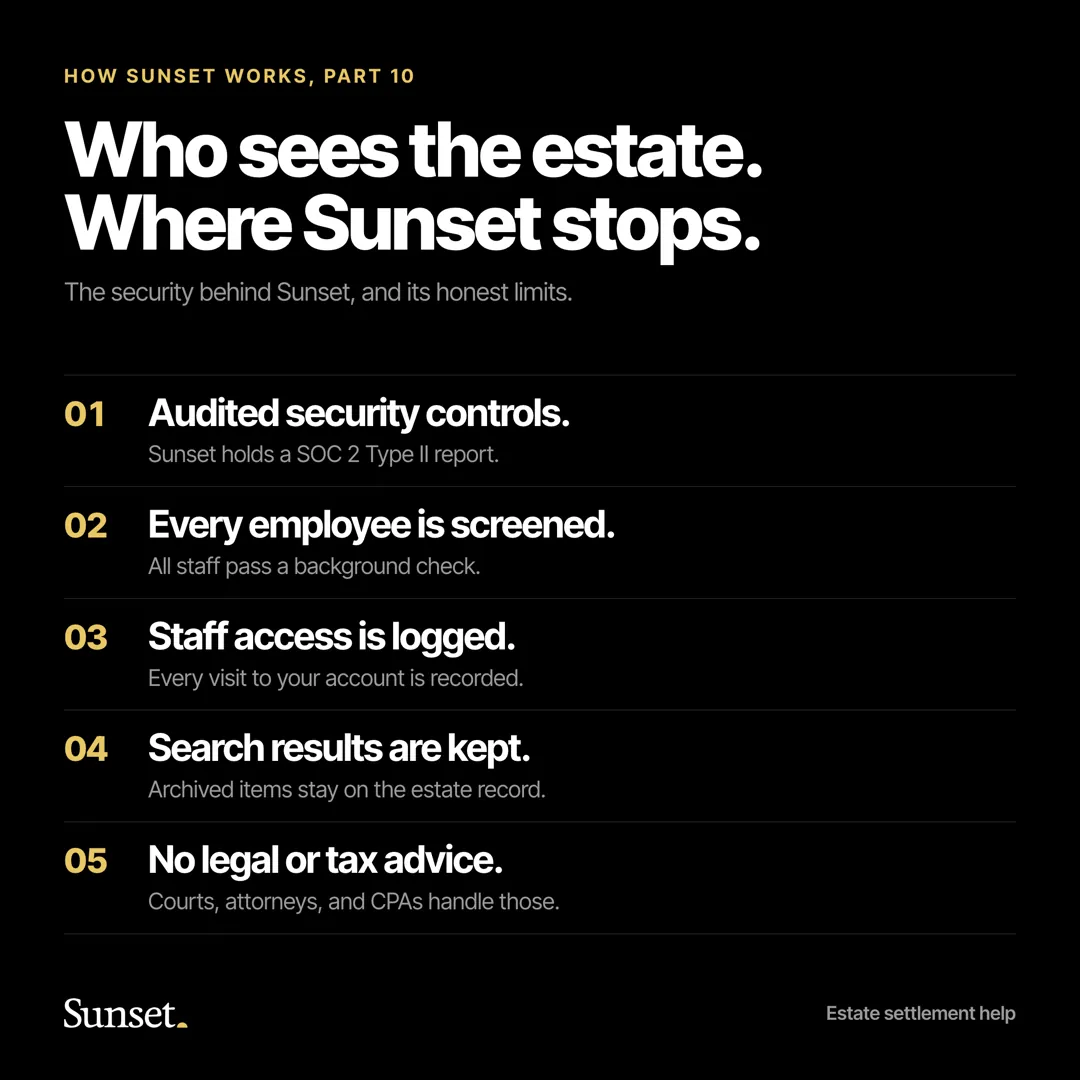
Sunset Software, Inc. holds a SOC 2 Type II report. In plain English, that means Sunset has gone through an outside review of controls over a period of time. For an executor, the report is outside evidence that the controls Sunset describes are actually in place.
Sunset also requires every employee to pass a background check. If Sunset staff access a user's account to help, that access is logged. The record involved here is the account access log, which ties every staff visit to a person and a time.
This step exists because executors need to know who may see estate information and under what conditions. It does not mean you should share more than is needed. It means you can ask direct questions about how staff access works, what records are kept, and what happens when you ask for help.
Step 2: Verify death data sources
Sunset is a certified subscriber to the Limited Access Death Master File. This matters because death data is sensitive. It is not the same as a public web search, and access to limited death data is controlled.
The record involved is the death record data available through the Limited Access Death Master File. Sunset's certified subscriber status means it can use that source where appropriate in its estate settlement work.
This step exists to reduce guesswork. After a death, financial institutions, government agencies, and estate service providers often need to rely on records that show the person has died. Sunset's role is still limited. It does not issue death certificates, and it does not replace any court or agency process that requires separate proof.
If you want a deeper discussion of identity risk after a death, Sunset has a separate guide on deceased identity theft protection.
Step 3: Request IRS transcript records
Sunset is authorized to request IRS transcripts through the IRS Transcript Delivery System. IRS transcript records can be relevant because tax records may help an executor understand what records exist for the person who died or the estate.
The document involved is the IRS transcript. Sunset's authorization to request transcripts through the IRS Transcript Delivery System is different from preparing a tax return. Sunset does not prepare or file the deceased's final income tax return, the estate's Form 1041, or estate tax returns.
This step exists because executors often need to build a reliable picture of the estate before they can act with confidence. Tax records can be one part of that picture. If tax preparation is needed, use a CPA or tax preparer. If you want more background on this part of the process, see How Sunset Uses IRS Records to Find Accounts.
Step 4: Search credit bureau records
Sunset has credentialed access to Equifax, Experian, and TransUnion. For an executor, that matters because credit bureau records can help identify financial relationships connected to the person who died.
The records involved are credit bureau records and the search results tied to the estate's record inside Sunset. Credit bureau access does not mean Sunset makes legal decisions for the estate. It means the search starts from the bureaus themselves instead of from whatever paperwork the family happens to find.
This step exists because an executor may not know where every account or debt is held. Families often find paperwork in drawers, email inboxes, mail, or old files, but those sources can be incomplete.
Sunset's related guide, What Sunset Searches For After a Death, covers the asset and account search process in more detail.
Step 5: Preserve estate search results
Search results stay on the estate's record in Sunset. The user can archive a result, mark an account closed, or clear it from the to-do list, and the record is still kept. Results are deleted only if the user formally asks Sunset to delete the account.
The record involved is the estate's record in Sunset. That record can show what was searched and what turned up. For an executor, this matters because estate work often requires proof of what was done, even when the answer is that nothing further was found or an account was already closed.
This step exists because estate administration is partly about recordkeeping. Executors may need to explain decisions to heirs, institutions, tax preparers, attorneys, or a court. A result that has been archived or cleared from a task list may still be relevant later. Keeping the search history tied to the estate record helps preserve that work unless the user asks Sunset to delete the account.
Step 6: Get human support with audit trails
Sunset's team includes licensed attorneys and estate settlement specialists. That does not make Sunset a law firm, and it does not mean Sunset gives legal advice. It does mean the support team includes people with estate experience.
When Sunset staff access a user's account to help, that access is logged. The record involved is the staff access log.
This step exists because estate work is not just data entry. Executors have questions about what to do next, which record matters, and which task belongs to a court, a tax preparer, an institution, or the family. Sunset support can help explain the product and the process, while staying within its limits.
When an attorney is needed, Sunset support can refer the user to one on request, often a law firm that already uses Sunset Pro, in the county where the estate will be probated. Sunset Pro serves attorneys, paralegals, and fiduciaries who settle estates for clients. A contested estate, an estate that does not qualify for a simplified process, or a county that requires counsel are examples of times to bring in an attorney.
For a broader comparison of when software, an attorney, or a do-it-yourself path may fit, read Sunset vs. Probate Attorney vs. DIY.
Step 7: Know the limits
The safest estate tool is clear about what it does not do. Sunset is not a law firm and does not give legal advice. Sunset does not issue letters testamentary. Courts do.
The documents involved may include letters testamentary, tax returns, survivor benefit applications, and digital account records. Those records sit with different parties. Courts handle court authority. CPAs and tax preparers handle tax returns. The Social Security Administration and the VA handle their own benefit processes. Email, social media, and password manager providers control their own digital account processes.
This step exists to keep the executor from assuming one service handles every estate task. Sunset helps with many parts of estate settlement, but some decisions and filings belong somewhere else. Knowing that line early can save time and prevent the executor from sending the wrong document to the wrong place.
What you do and what Sunset does
What you do:
- Decide whether Sunset fits the estate's needs.
- Provide information about the person who died and the estate when needed.
- Review search results, archive results, mark accounts closed, or clear items from the to-do list.
- Bring in an attorney when the estate is contested, does not qualify for a simplified process, or the county requires counsel.
- Bring in a CPA or tax preparer for final income tax returns and estate tax returns.
What Sunset does:
- Maintains security controls reflected in a SOC 2 Type II report.
- Uses certified subscriber status for the Limited Access Death Master File.
- Requests IRS transcripts through the IRS Transcript Delivery System when applicable.
- Uses credentialed access to Equifax, Experian, and TransUnion.
- Keeps search results on the estate's record unless you formally ask Sunset to delete your account.
- Logs staff access when Sunset staff enter a user's account to help.
What Sunset does not do at this stage
Sunset is not a law firm and does not give legal advice. If legal advice is needed, you should work with an attorney. Sunset support can refer you to an attorney on request, often a law firm that already uses Sunset Pro, in the county where the estate will be probated.
Sunset does not issue letters testamentary. Courts issue letters testamentary.
Sunset does not prepare or file tax returns. That includes the deceased's final income tax return, the estate's Form 1041, and estate tax returns. Use a CPA or tax preparer.
Sunset does not report the death to Social Security. Sunset also does not claim Social Security or VA survivor benefits. The family contacts the Social Security Administration and the VA directly.
Sunset does not close digital accounts such as email, social media, or password managers.
What to ask any estate settlement service
Before you trust any provider with estate information, ask plain questions and expect plain answers:
- Do you hold a SOC 2 Type II report?
- Do all employees pass background checks?
- When staff access a user's account to help, is that access logged?
- What happens to search results after I archive a result, mark an account closed, or clear it from my task list?
- Are you authorized to request IRS transcripts through the IRS Transcript Delivery System?
- Are you clear about what you do not do, including legal advice, tax return preparation, benefit claims, and digital account closure?
These questions are also useful when reading Sunset estate settlement reviews. Reviews can show how a service felt to another executor, but security, records, and limits should be checked against the provider's own answers.
Recap: the full How Sunset Works series
Part 1, How Sunset Settles an Estate, Step by Step, explains the overall order of work after someone dies. It is the best starting point if you want to see how the estate process fits together before looking at any single task.
Part 2, How Sunset Verifies Death and Authority, covers identity, death, and authority checks. It is useful for executors who are trying to understand why institutions ask for proof before discussing accounts.
Part 3, How Sunset Uses IRS Records to Find Accounts, focuses on IRS records. It explains why tax records can matter when building the estate file.
Part 4, What Sunset Searches For After a Death, looks at search work after someone dies. It is aimed at executors who are trying to identify assets, accounts, and liabilities.
Part 5, How Sunset Finds the Right Bank Department, explains why contacting the right department matters. It can help if you have ever called a general customer service number and been sent in circles.
Part 6, Open an Estate or Trust Account With Sunset, covers estate and trust account setup. It is for executors who need to understand how estate money should be separated from personal money.
Part 7, How Sunset Notifies and Closes Accounts, discusses account notices and closures. It is for the stage when you know an account exists and need to work with the institution.
Part 8, Paying Estate Bills From a Sunset Account, focuses on estate bills. It is useful when the executor is trying to track payments connected to administration of the estate.
Part 9, How Sunset Builds Probate Papers by County, explains county-based probate paperwork. It is for executors who want to understand why local court rules and document formats matter.
Part 10 is this guide. It closes the series with the security controls behind all of the above and the places where Sunset's role stops.
FAQ
Is Sunset legit?
Sunset Software, Inc. holds a SOC 2 Type II report, is a certified subscriber to the Limited Access Death Master File, is authorized to request IRS transcripts through the IRS Transcript Delivery System, and has credentialed access to Equifax, Experian, and TransUnion. Sunset is still not a law firm and does not give legal advice.
Is Sunset safe for a deceased person's information?
Sunset has security and access controls that include a SOC 2 Type II report, employee background checks, and logged staff access when staff enter a user's account to help. As with any estate service, you should share information carefully and ask questions before uploading records.
What does estate settlement software security mean?
It means looking at how the service protects estate information, who can access it, whether access is logged, what outside records it is authorized to use, and what happens to search results. For Sunset, search results stay on the estate's record unless the user formally asks Sunset to delete the account.
Can Sunset replace a probate attorney or CPA?
No. Sunset is not a law firm, does not give legal advice, and does not issue letters testamentary. Sunset also does not prepare or file tax returns, so use a CPA or tax preparer for the deceased's final income tax return, the estate's Form 1041, and estate tax returns.
Does Sunset close digital accounts or claim survivor benefits?
No. Sunset does not close digital accounts such as email, social media, or password managers. Sunset also does not report the death to Social Security or claim Social Security or VA survivor benefits, so the family contacts those agencies directly.
If you are ready to see whether Sunset fits the estate you are handling, get started with Sunset.