Certificate of Estate: One-Page Estate Summary (2026)
Learn what a certificate of estate is, the five things it states, what it does not replace, and how Sunset prepares one free for families.
September 21, 2026

A certificate of estate is a one-page signed summary that identifies the estate, the person who died, and the personal representative handling estate matters. It is not a court order, and it does not replace letters testamentary, letters of administration, or a small estate affidavit. Most banks, insurers, agencies, and title companies will still ask for a certified death certificate, photo ID, and the underlying estate authority documents.
Sunset prepares a certificate of estate so families have one clear page to send with the rest of the estate paperwork. Think of it like a certification of trust, which trustees often give to institutions instead of handing over the full trust document. A certificate of estate does a similar organizing job for an estate: it answers the questions institutions ask again and again, without pretending to be more than it is.
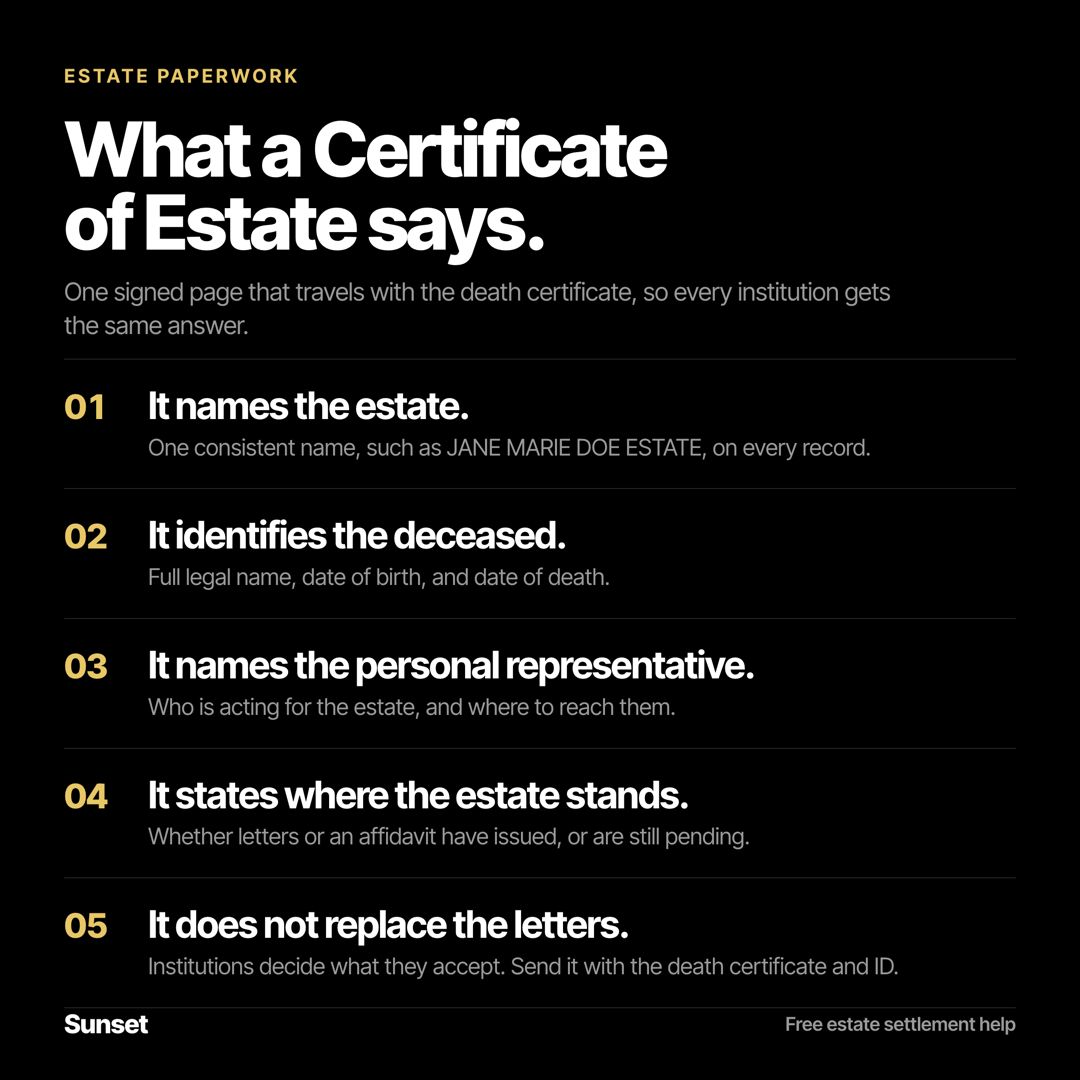
What a certificate of estate says
Sunset's certificate of estate is designed to be short. It has five sections, followed by the personal representative's signature and date.
The goal is not to tell the whole story of the estate. The goal is to give a bank, insurer, transfer agent, title company, or agency a reliable cover page that says who died, who is acting, what authority exists or is pending, and how to contact the person handling the estate.
I. Estate Name
The first section states the name of the estate.
For registration, recordation, and other official dealings, the estate may be known by a consistent name, such as:
JANE MARIE DOE ESTATE
That may sound small, but consistency matters. One institution might type the name as Estate of Jane Doe. Another might use Jane M. Doe Estate. A title company might ask for a registration name. An estate account may need the same name on bank records and tax records.
Using one estate name across documents cuts down on that confusion.
II. Decedent Information
The second section identifies the person who died. It includes:
- Full legal name
- Date of birth
- Date of death
These details help an institution match the certificate to its own records. A bank, insurer, or transfer agent may have more than one customer with a similar name. Dates help confirm the right person.
Most institutions will still want a certified death certificate. The certificate of estate does not take the place of that record. It simply puts the core identifying facts on the same page as the representative's information.
III. Personal Representative
The third section identifies who is acting for the estate. Depending on the state and the court process, that person may be called an executor, administrator, personal representative, or another similar term.
This section includes the representative's name, address, the date they took on the role, and a statement that they act under the probate code of the state.
This is the section institutions look to when they are asking, in plain English, "Who is allowed to speak for this estate?" It may help with proof of authority to act for an estate, but it is usually only one piece of the full packet.
If you are wondering how to prove you are the executor to a bank, expect the bank to ask for more than this one page: a certified death certificate, letters testamentary or letters of administration if issued, photo ID, and its own forms.
For more on who has authority and when, see Sunset's guide to executor authority, EINs, and estate accounts.
IV. Estate Administration Status
The fourth section says where the estate process stands.
It may state whether letters testamentary, letters of administration, or a small estate affidavit have issued. It may also state that those papers remain pending. In that case, the certificate can truthfully show that letters testamentary are pending, without suggesting that they already exist.
This distinction matters. Early in the estate process, families often need to contact institutions before the court has issued letters. They may be trying to find assets, freeze accounts, stop fraud, collect account information, or start probate paperwork. A certificate can help explain why the representative is reaching out, while still being honest about the status of formal authority.
This section also states that no final accounting or distribution has been filed, which tells the reader the estate is still being administered.
V. Reliance by Third Parties
The fifth section explains why the certificate is being offered.
It says the certificate is intended to give third parties, such as banks, insurers, title companies, transfer agents, and agencies such as the IRS, one page confirming who the personal representative is and in what capacity they are acting.
This does not force any third party to accept it. Institutions decide what they require. A bank may still say, "We need certified letters." An insurer may ask for its own claim form. A title company may need court filings. The IRS may ask for tax forms, transcripts, or other proof depending on the issue.
The certificate simply gives them a starting point.
What a certificate of estate does not do
It is not a court order. It is not issued by a probate court. It is not certified by a court. It does not replace letters testamentary, letters of administration, a small estate affidavit, a death certificate, or photo ID.
That should be clear before you hand it to anyone.
If a court has issued letters testamentary or letters of administration, those letters are often the main proof that an executor or administrator has authority. If a small estate affidavit is allowed in your situation, that affidavit may be the document an institution reviews. If no authority document has issued yet, the certificate can state that status, but it does not create authority by itself.
That means a certificate of estate should travel with the rest of the estate packet. A typical packet may include:
- Certified death certificate
- Letters testamentary, letters of administration, or small estate affidavit, if available
- Personal representative's photo ID
- Any institution-required forms
- Signed authorization naming Sunset, if Sunset is contacting the institution for the estate
- Certificate of estate as the one-page summary
This article is general information, not legal advice. Requirements vary by state, county, court, and institution. If legal counsel is needed, Sunset can refer families to a local probate attorney.
When you would use a certificate of estate
A certificate of estate is most useful in the parts of estate settlement where the same facts get repeated from place to place.
Every institution tends to ask the same questions:
- Who died?
- When did they die?
- Who is handling the estate?
- What authority does that person have?
- Where does the estate process stand?
- How can the representative be reached?
Without a certificate, families may answer those questions from scratch each time. One bank gets one version. An insurer gets another. A transfer agent asks for a fax cover sheet. A government agency needs a written explanation. The certificate gives one consistent answer.
Early days before letters issue
Many families need to act before probate letters are issued. They may be collecting bills, listing assets and debts, finding accounts, or trying to stop payments from leaving accounts.
During this period, a certificate can say that letters testamentary are pending or that the administration status is still in process. That helps avoid a misunderstanding. The representative is not claiming to hold court-issued letters if those letters have not been issued yet.
Some institutions will still wait for formal authority before sharing details or making changes. Others may accept limited information, note the death, or tell the family what documents will be needed next.
Opening the estate account
An estate bank account often needs a clear estate name, taxpayer information, a death certificate, and proof of the representative's authority. The certificate can help keep the estate name and representative information consistent across the account-opening file.
Sunset can help families open an FDIC-insured estate account through its bank partnership. For a deeper walk-through of that process, see Sunset's guide to how to open an estate bank account.
Contacting insurers, transfer agents, and financial institutions
Life insurers, transfer agents, banks, credit unions, and retirement plan custodians each have their own process, and each asks for its own packet.
A certificate of estate can sit on top of the packet so the reviewer quickly sees who is writing and why. This can be useful when Sunset contacts institutions on the estate's behalf. Sunset attaches the certificate along with the death certificate and the signed authorization naming Sunset, so the institution understands the request.
Sunset also searches 2,300+ financial institutions to find accounts and assets, so the packet goes to every institution that needs it.
Dealing with the IRS or state agencies
Tax agencies may need to know who is authorized to communicate about the estate. The certificate can provide a short identification page, but it does not replace IRS forms or state tax forms.
For example, the IRS may require its own authorization, notices, transcript requests, or fiduciary forms depending on the situation. Sunset's guide to hearing from the IRS after a death explains common letters and next steps.
How Sunset prepares a certificate of estate
Sunset builds the certificate of estate from details the family has already entered. That usually includes the decedent's legal name, dates of birth and death, the personal representative's information, and the state connected to the administration.
Sunset then prepares the one-page certificate for the personal representative to review. If the details look right, the representative signs and dates it. The signed certificate goes into the estate document packet with the death certificate and the authority document, if one has issued.
Sunset also generates state- and county-specific probate packets when probate is needed. The certificate is not a substitute for those filings. It is an organizing page that helps the paperwork travel together.
Sunset is free to families. The family product is funded through Sunset's bank partnership. The estate does not pay Sunset, and all assets go to the beneficiaries and heirs.
Sunset has helped 15,000+ families settle estates, starting with a plain inventory of assets and liabilities, then probate paperwork, an estate account, account closures, and transfers to heirs.
FAQ about certificates of estate
Is a certificate of estate a legal document?
It is a signed estate document, but it is not a court order and it is not court-certified. It summarizes key facts about the estate and the personal representative. It should be read with the death certificate and any authority document, such as letters testamentary, letters of administration, or a small estate affidavit.
Does a bank have to accept a certificate of estate?
No. A bank does not have to accept a certificate of estate. Each bank sets its own review process, and many banks will still require certified letters, a certified death certificate, photo ID, and bank forms. The certificate can help the bank understand the request, but it does not control the bank's rules.
Do I still need letters testamentary?
Often, yes. If probate is required and the court issues letters testamentary or letters of administration, institutions commonly treat those letters as the main proof of authority. A certificate of estate can summarize the status, including that letters are pending, but it does not replace court-issued letters.
How is a certificate of estate different from a certification of trust?
A certification of trust is used by trustees to give institutions a short summary of trust facts, instead of providing the full trust agreement. A certificate of estate serves a similar organizing purpose for an estate. It gives a short summary of the estate name, decedent, representative, administration status, and reliance language for third parties.
How do I get a certificate of estate?
Sunset prepares one for families using the information already provided during the estate process. The personal representative reviews, signs, and dates it. The certificate is then included in the estate document packet with the death certificate and authority document.
How Sunset can help
A certificate of estate is a cover page for the estate. It answers the same questions in the same way every time, and it says plainly what authority has issued and what is still pending.
Sunset can help you find assets, prepare probate paperwork, open an FDIC-insured estate account, contact institutions, and organize transfers. If legal counsel is needed, Sunset can refer you to a local probate attorney. You can also read Sunset's help center article on legal authority in estate administration for more background on who can act and when.