Which States Have the Simplest Probate Process? (2026)
Learn which states have the simplest probate process in 2026. Compare small estate thresholds, UPC states, and timelines to skip formal court proceedings.
June 9, 2026

Some families settle an estate in six weeks with a single affidavit. Others spend eighteen months managing court filings and creditor notices for estates half the size. The state where the deceased lived sets the rules, and those rules vary wildly. High small estate thresholds, simplified procedures for surviving spouses, and adoption of the Uniform Probate Code all make probate faster and cheaper. Knowing which states have the simplest probate process helps you understand what you're walking into and whether you can avoid formal court proceedings altogether.
TLDR:
- California, Iowa, and Florida set the highest small estate thresholds at $208,850, $200,000, and $150,000, letting most families skip formal probate with an affidavit.
- 15 states adopted the Uniform Probate Code and allow informal probate where you act without ongoing court supervision.
- Small estate affidavits close in 40 days to six months and cost under $25 in notary fees, compared to 18+ months and thousands in attorney fees for formal probate.
- Use joint tenancy, POD/TOD designations, and living trusts to move assets outside probate in any state.
- Sunset searches thousands of financial institutions in all 50 states to find bank accounts, retirement accounts, and life insurance policies for free.
Understanding Probate and How State Laws Differ
Probate is the legal process courts use to validate a will, settle debts, and transfer a deceased person's assets to heirs. Every state has its own rules governing how that process works, which means the timeline, cost, and paperwork burden vary widely depending on where the deceased lived.
Some states require court appearances and months of oversight. Others let small estates skip probate entirely through simplified affidavit procedures. A few have adopted faster summary administration tracks that resolve straightforward estates in weeks instead of years.
The differences come down to a handful of factors: estate size thresholds for simplified procedures, whether the state has adopted the Uniform Probate Code, how courts handle creditor notice periods, and whether joint property or beneficiary designations can move assets outside probate altogether.
Small Estate Affidavit Thresholds by State
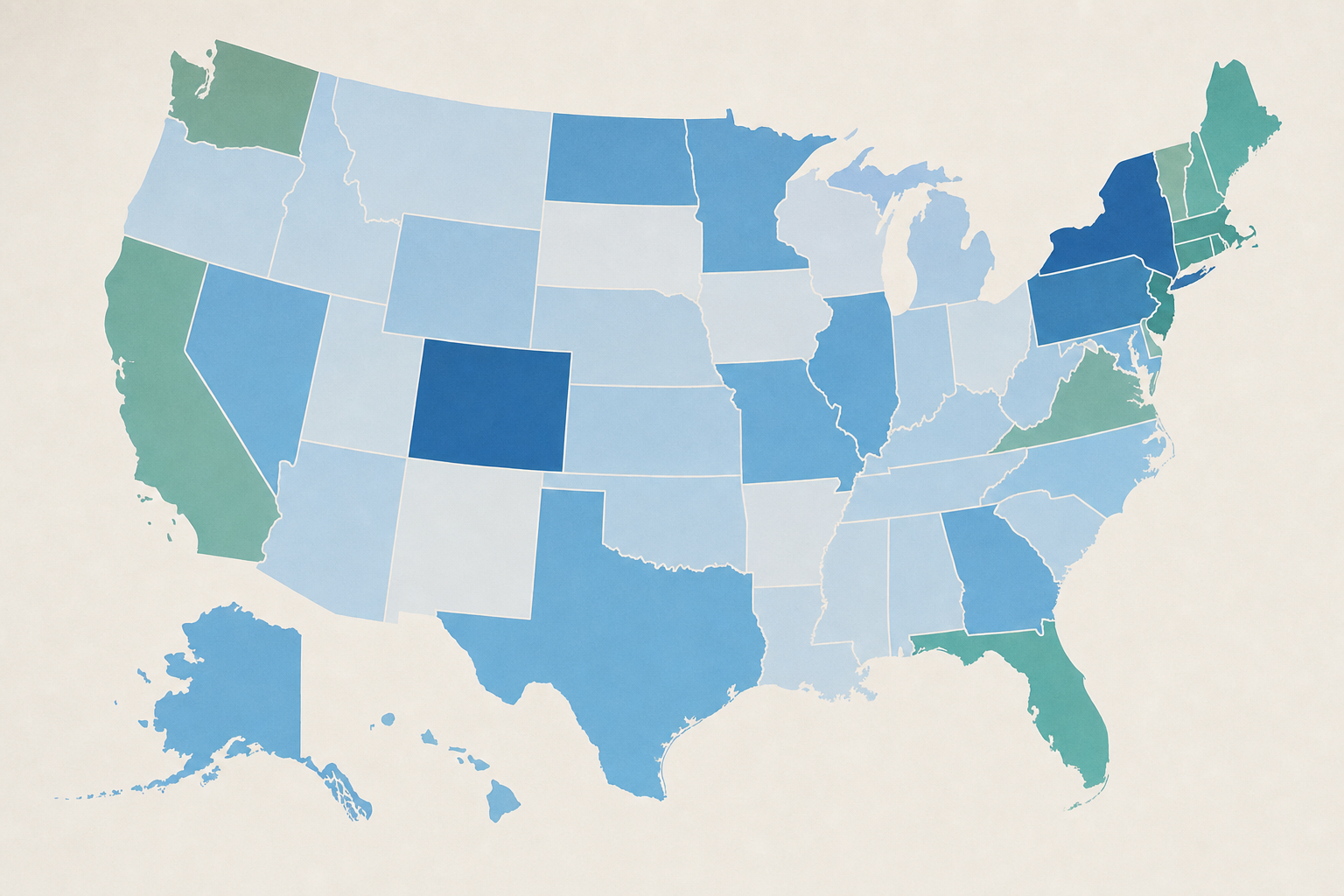
One of the most useful shortcuts in probate is the small estate affidavit, which lets heirs collect assets without opening a full court case. Every state sets its own dollar threshold for eligibility, and those numbers vary widely.
How thresholds work
If the gross value of the estate's probate assets falls below a state's limit, an heir can often present a signed affidavit directly to a bank or title company instead of going through the courts. Some states also require a waiting period after death before the affidavit can be used.
| State | Small Estate Threshold | Waiting Period |
|---|---|---|
| California | $184,500 | 40 days |
| Texas | $75,000 | 30 days |
| Florida | $75,000 | None |
| New York | $50,000 | 30 days |
| Colorado | $82,000 | 10 days |
| Arizona | $75,000 | 30 days |
| Nevada | $25,000 | 40 days |
| Wisconsin | $50,000 | 30 days |
These thresholds apply only to probate assets, so accounts with named beneficiaries or jointly held property typically don't count toward the limit.
States With the Highest Small Estate Thresholds
A few states set their limits high enough that the majority of estates skip formal probate entirely.
- California: $208,850 for general probate assets, plus a separate $750,000 threshold for primary residences (effective April 2025)
- Iowa: $200,000
- Florida: $150,000, updated as of July 2026
- Illinois: $150,000 for personal property, though vehicles are excluded from this calculation
- Idaho: $100,000
The practical effect is straightforward: more estates qualify for the affidavit route, fewer families need attorneys, and the process wraps up in weeks instead of months. California's residential carve-out is worth noting in particular. Even if a home's value would push the estate over the general limit, it may still qualify under the separate real property rule, keeping the entire estate out of court.
Uniform Probate Code States
Several states have adopted the Uniform Probate Code (UPC), a standardized legal framework designed to make probate more predictable and less burdensome. States that follow the UPC tend to offer simpler procedures, lower court involvement, and faster timelines compared to non-UPC states.
UPC states worth knowing
The states that have adopted the UPC in full or substantial form include Alaska, Arizona, Colorado, Hawaii, Idaho, Maine, Michigan, Minnesota, Montana, Nebraska, New Mexico, North Dakota, South Carolina, South Dakota, and Utah.
In these states, families often have access to informal probate administration, which means a court-appointed personal representative can act without ongoing judicial supervision. Smaller estates may also qualify for simplified affidavit procedures that bypass formal probate entirely.
How Small Estate Affidavits Work
The process follows roughly the same path regardless of state, once you've confirmed eligibility.
- Verify that the estate's probate assets fall below your state's threshold.
- Wait the required period after death, often 30 to 45 days, though some states require none.
- Complete your state's affidavit form, swearing under penalty of perjury that you meet the eligibility requirements.
- Have the form notarized.
- Present it alongside a certified death certificate directly to each bank or institution holding assets.
The whole process typically takes 40 days to six months, compared to a year or more for formal probate. Costs stay minimal, mostly notary fees running $10 to $25 per signature.
What Counts Toward the Threshold
Qualifying for a small estate affidavit hinges on which assets actually count toward the limit. Jointly owned property, accounts with named beneficiaries, life insurance, retirement accounts, and trust assets are typically excluded since they pass outside probate on their own, which is why the threshold can feel more generous than it looks on paper.
What does count: solely owned bank and investment accounts, personal property, and vehicles without a beneficiary designation.
One more thing trips families up: most states measure gross value, not net. Debts don't reduce the number. A $70,000 estate with $40,000 in outstanding loans still counts as $70,000 for threshold purposes. Pennsylvania and New York exclude real estate from small estate procedures entirely, and some states apply separate thresholds for real property versus personal property, so the same estate can qualify under one category while still requiring court involvement for another.
Probate Avoidance Tools That Work in Most States
Even without moving to a simplified-probate state, several legal tools can keep an estate out of court entirely.

- Revocable living trusts pass assets directly to beneficiaries without probate, regardless of which state you're in. The catch is they require setup before death and ongoing maintenance to stay effective.
- Payable-on-death (POD) and transfer-on-death (TOD) designations on bank and brokerage accounts bypass probate automatically. No court involvement, no waiting period.
- Joint tenancy with right of survivorship works similarly for real estate and some financial accounts, transferring ownership to the surviving co-owner at death.
- Beneficiary designations on retirement accounts and life insurance policies never go through probate at all, as long as a living beneficiary is named.
None of these replace a will or an attorney for complex estates, but for many families, combining two or three of them can sidestep probate regardless of state law.
States With Simplified Probate for Surviving Spouses
Surviving spouses often qualify for a separate track that bypasses standard thresholds entirely. In community property states like California, Arizona, and Nevada, a spousal property petition lets the surviving spouse confirm ownership of community property through court without opening formal probate. California's version typically resolves in two to three months, far shorter than the formal probate timeline.
Several other states allow affidavit procedures for surviving spouses regardless of estate size, or let spouses skip court altogether when all property was held jointly or titled in both names. The key distinction from standard small estate rules: the spouse's relationship to the deceased matters more than the estate's total value when determining eligibility.
Real Estate and Probate Complexity
Real estate often drives probate complexity. States with high homeownership rates or large property portfolios tend to generate longer, more contested proceedings, because real property must pass through formal court supervision before title can transfer to heirs.
States like California, New York, and Florida combine high property values with detailed procedural requirements, which pushes average timelines and costs upward. Simpler probate states tend to have either lower average estate values, more accessible small-estate thresholds, or streamlined court procedures that reduce the burden on executors managing property.
When real estate skips probate entirely
Some ownership structures sidestep the process regardless of which state you're in:
- Joint tenancy with right of survivorship passes property directly to the surviving owner without court involvement, making it one of the most common ways families avoid probate on a primary home.
- Revocable living trusts hold title to real property during the owner's lifetime, so after death the successor trustee can transfer the asset without filing in probate court.
- Transfer-on-death deeds, available in roughly 30 states, let owners name a beneficiary directly on the deed so the property transfers automatically at death.
If the deceased owned real estate solely in their own name with no beneficiary designation, probate is almost always required, regardless of how simple the state's general process is.
Timeline Differences Across States
Probate timelines vary widely by state, and the difference can mean months of extra work for an executor. In states like California, full probate can take 18 to 24 months or longer when the court docket is backed up. Compare that to states with streamlined processes, where estates can close in as little as three to six months.
A few factors drive these gaps:
- Court backlog and staffing levels vary county by county, so even within a single state, timelines can shift depending on where the deceased lived.
- The size and complexity of the estate matters, but so does the state's threshold for what requires full probate versus a simplified procedure.
- States with mandatory creditor waiting periods bake delays into the process by law, regardless of how quickly everything else moves.
| State | Typical Probate Timeline |
|---|---|
| California | 18-24+ months |
| Texas | 6-9 months |
| Florida | 6-12 months |
| Wisconsin | 3-6 months |
| Colorado | 3-6 months |
These ranges reflect uncontested cases with no unusual complications. Contested wills, missing assets, or out-of-state property can extend any of them.
How Sunset helps families with estate settlement across all 50 states
Regardless of which state you're in, settling an estate means tracking down accounts, notifying institutions, and closing out a person's financial life — often while grieving. Sunset is a free service built to help families do exactly that. You can search across thousands of financial institutions, find accounts and life insurance policies, all without hiring a professional to manage the search. Nothing moves forward without your approval, and Sunset works in all 50 states.
Final Thoughts on State Probate Differences
Every state handles probate differently, but the underlying challenge is the same: figuring out what accounts exist and getting them transferred. Whether you're in a state with high thresholds and fast timelines or one that requires months of court oversight, Sunset searches accounts nationwide so you know what you're dealing with before you start filing paperwork. Once you have that list, you can decide whether a small estate affidavit will work or if you need to open a full probate case.
FAQ
Which states have the simplest probate process?
States with the highest small estate thresholds and UPC adoption tend to be simplest: California ($208,850 threshold), Iowa ($200,000), Florida ($150,000), and Illinois ($150,000) let most estates skip formal probate entirely. Colorado, Wisconsin, and other UPC states offer faster procedures that close in 3 to 6 months instead of 18 to 24.
How do I know if my state requires probate?
If the deceased owned accounts solely in their name without beneficiary designations, probate is usually required. Jointly owned property, accounts with POD/TOD designations, life insurance, retirement accounts with named beneficiaries, and trust assets all skip probate regardless of state.
What counts toward a small estate threshold?
Solely owned bank and investment accounts, personal property, and vehicles without beneficiary designations count toward the limit. Jointly owned property, accounts with named beneficiaries, life insurance, retirement accounts, and trust assets are excluded since they pass outside probate. Most states measure gross value, so debts don't reduce the threshold.
Can jointly owned real estate avoid probate?
Yes. Property held in joint tenancy with right of survivorship passes directly to the surviving owner without court involvement, regardless of which state you're in. Transfer-on-death deeds, available in roughly 30 states, work the same way.
Is there a service that finds all financial accounts in your name?
Sunset searches every bank, credit union, retirement brokerage, and investment brokerage in the country to find accounts left behind by a deceased person. The service is free and works in all 50 states, returning results in about two weeks.