How Probate Actually Works: A Plain-English Guide for Families (2026)
Learn how probate actually works with this plain-English guide for families. Step-by-step process, timelines, costs, and what to expect.
May 15, 2026

Your mom had a will, so you assume probate will be straightforward, but the bank just told you the account is frozen until you get court authority. Here's how probate works: a will doesn't bypass the process, it just tells the court where things should go once debts are paid. What matters more is whether accounts had beneficiaries, whether property was jointly owned, and whether anything was titled in her name alone. This guide walks through the entire sequence, from filing the petition to closing the estate, so you know what's coming.
TLDR:
- Probate is required only for assets titled solely in the deceased's name without beneficiaries
- Small estate affidavits let you skip full probate if assets fall below your state's threshold
- Most probate takes 6-12 months and costs 3-7% of the estate value in fees and expenses
- Sunset generates court-ready probate documents for all 50 states and closes accounts
- 98% of estates don't require a probate lawyer when using Sunset
What Probate Is and Why It Exists
Probate is the legal process courts use to wrap up a person's financial life after they die. When someone passes away, their debts still exist, their accounts are frozen, and their property can't simply change hands on a handshake. Probate creates a supervised, orderly way to pay what's owed and transfer what remains to the right people.
The process has roots in centuries of property law. Courts got involved because disputes over inheritances were common, and someone needed authority to sort them out.
When Probate Is Actually Required (And When It's Not)
Whether probate is required depends less on whether there's a will and more on how assets are titled. A will doesn't bypass probate. It tells the court where things should go, but the court still supervises the process.
Three outcomes are possible depending on what the deceased owned and how it was held:
| Situation | Likely outcome |
|---|---|
| Every asset has a named beneficiary, is jointly held, or sits in a trust | No probate needed |
| Total probate assets fall below your state's threshold | Small estate shortcut available |
| Assets are solely titled with no beneficiary designation | Full probate required |
The most common trigger is a bank account or property titled only in the deceased's name with no POD (payable on death), TOD (transfer on death), or joint owner attached. That single account can pull an entire estate into court, even if everything else transfers cleanly.
The Two Paths: Probate With a Will vs. Without a Will
When someone dies with a valid will, the estate is called "testate." The will names an executor to carry out its instructions, the court confirms that appointment, issues letters testamentary, and the executor gains legal authority to act on behalf of the estate.
Without a will, the estate is "intestate." The court appoints an administrator instead, usually a surviving spouse or adult child, and issues letters of administration. The paperwork looks nearly identical. The real difference shows up in distribution.
With a will, assets go where the deceased directed. Without one, state intestacy laws follow a fixed hierarchy: spouse first, then children, then parents, then siblings. That formula doesn't accommodate personal wishes or complicated family dynamics. It's the state's best guess at what most people would want.
The Step by Step Probate Process
The probate process follows a fairly predictable sequence, though timelines vary by state and estate complexity.
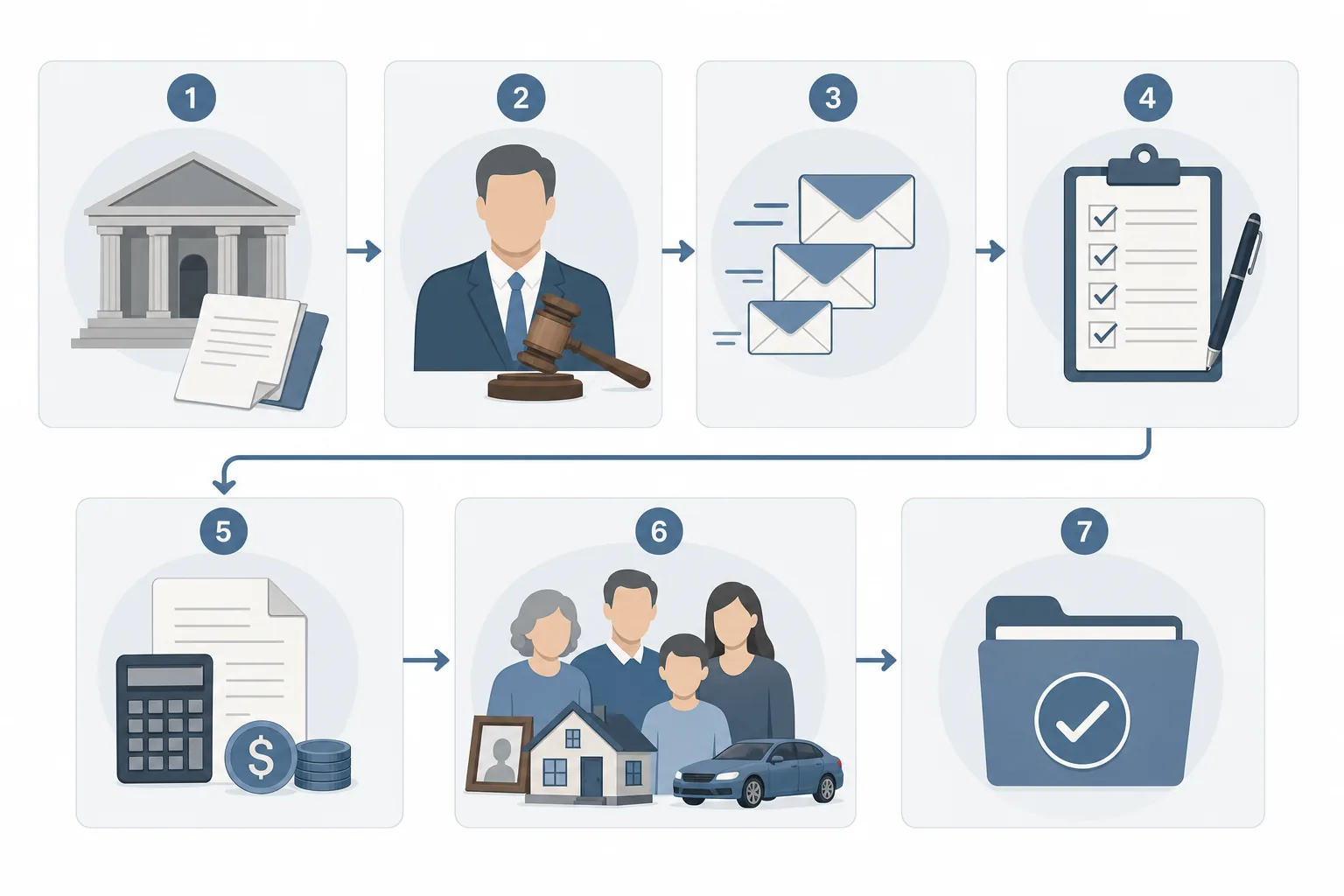
- File a petition with the probate court in the county where the deceased lived, along with the original will and death certificate. The court then officially opens the estate.
- The court appoints an executor (or administrator if there's no will) to manage the estate.
- The executor notifies creditors and beneficiaries, typically by mail and through a public notice in a local newspaper.
- All assets get inventoried and appraised to determine the estate's total value.
- Valid debts, taxes, and final expenses are paid from estate funds before anything goes to beneficiaries.
- Remaining assets are distributed according to the will, or state intestacy laws if no will exists.
- The executor files a final accounting with the court, and the estate is officially closed.
How Long Probate Actually Takes
Most probate takes longer than families expect. A clear, uncontested estate can close in 3-6 months. Most cases land somewhere between 6-12 months once creditor notice periods, court scheduling, and asset transfers are factored in.
Complex estates can stretch well past two years. A few factors drive most of the delays:
- Disputes among heirs or a challenged will
- Real estate in multiple states, where each state requires its own separate ancillary probate proceeding
- Outstanding tax returns or delays waiting on IRS clearance
- Court backlogs, which vary considerably by county
What Probate Costs and Who Pays
Probate costs typically run 3 to 7% of the gross estate value, though some complex estates can reach 10%. On a $500,000 estate, that could mean $15,000 to $35,000 in total fees before anything reaches heirs.
These costs generally fall into a few categories:
- Court filing fees, which vary by state and estate size but often range from a few hundred to over a thousand dollars
- Attorney fees, which some states set by statute as a percentage of the estate
- Executor compensation, which is often similar in scale to attorney fees and comes from the estate itself
- Appraisal and accounting costs for assets that need professional valuation
The estate pays these costs before any distributions go to heirs. If the estate is cash-poor but asset-rich, heirs may need to wait while assets are sold to cover expenses.
Which Assets Go Through Probate (And Which Don't)
Not everything a person owned will go through probate. Whether an asset does depends on how assets were titled.
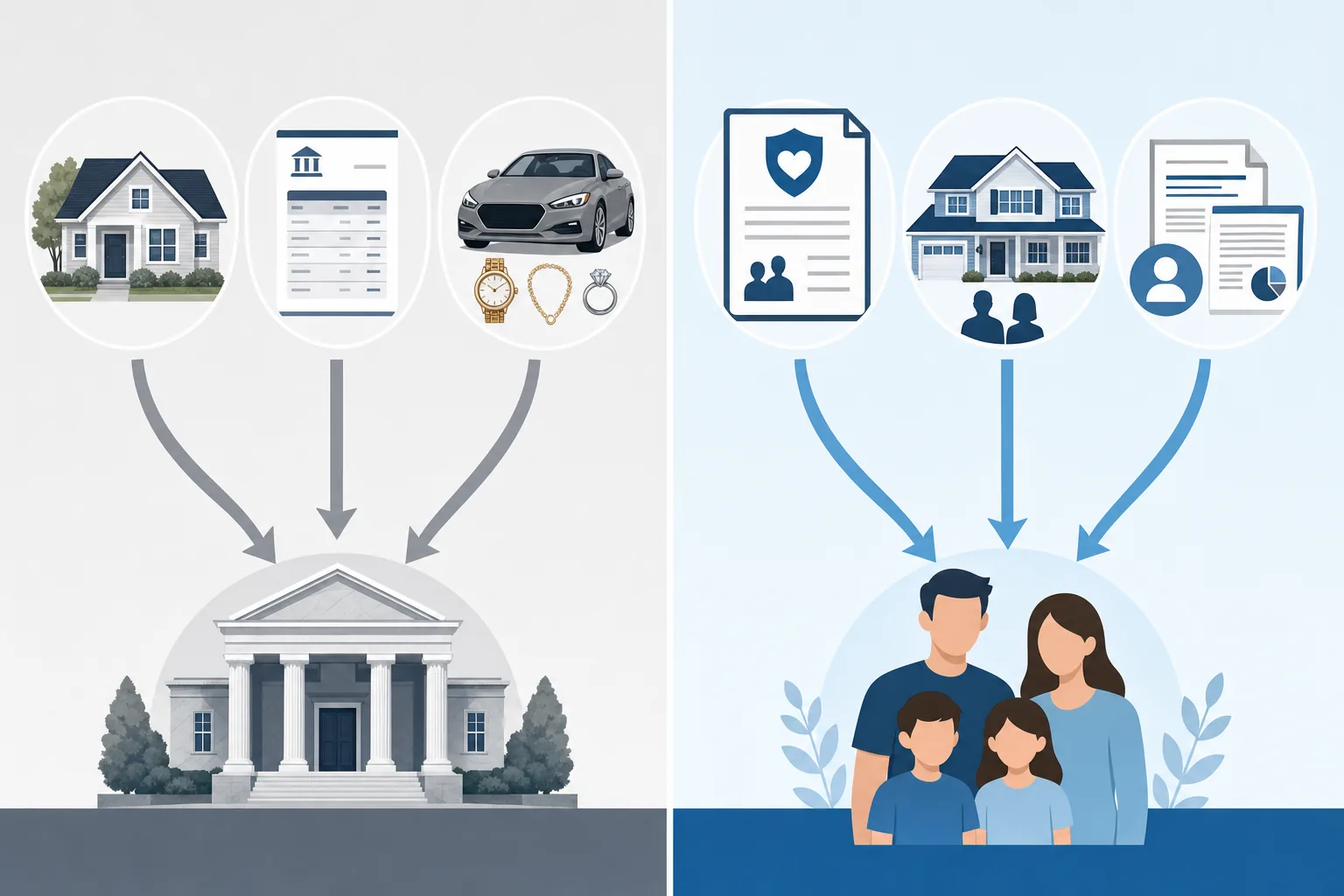
Assets that typically go through probate:
- Property owned solely in the deceased's name, with no joint owner or transfer-on-death designation
- Bank accounts held in the deceased's name only, without a payable-on-death beneficiary
- Personal property like vehicles, jewelry, or furniture that wasn't formally transferred before death
Assets that typically skip probate:
- Retirement accounts and life insurance policies with a named beneficiary pass directly to that person
- Jointly owned property with right of survivorship transfers automatically to the surviving owner
- Accounts with payable-on-death or transfer-on-death designations go straight to the named recipient
In practice, many estates contain a mix of both. A person might have a will, a 401(k) with a named beneficiary, and a checking account in their name alone. The 401(k) bypasses probate entirely. The checking account doesn't.
Small Estate Shortcuts That Save Time and Money
Most states offer simplified procedures for smaller estates that let families skip the full probate process entirely.
Summary administration
If the estate falls below your state's asset threshold (often between $50,000 and $150,000, though it varies), many states allow summary or simplified administration. This is a shorter court process with fewer filings and faster timelines.
Small estate affidavit
Some states let heirs collect assets by signing a sworn affidavit instead of opening probate at all. The heir presents the document directly to a bank or institution, which transfers the funds without court involvement.
Spousal shortcuts
Many states have additional protections that let a surviving spouse claim certain assets outright, bypassing probate regardless of estate size.
How Families Can Find All the Assets
Many families don't know where to start when finding a deceased person's assets. A few practical steps can help you build a complete picture.
- Check for a will or trust documents, which often list major accounts and property.
- Look through physical mail and email for bank statements, brokerage confirmations, and insurance notices.
- Review tax returns from the past few years, which typically show interest income, dividends, and retirement distributions that point to financial accounts.
- Contact the deceased's employer or former employers about pension benefits or unclaimed 401(k) accounts.
- Search your state's unclaimed property database, where dormant accounts are often turned over after years of inactivity.
Starting with these steps gives you a foundation, but gaps are common. Financial lives are spread across many institutions, and paper trails go cold.
How Sunset Handles Probate for Families
Knowing the probate process is one thing. Getting through it without losing months or thousands of dollars is another.
Sunset handles the three tasks that typically stall families: searching across 2,500+ financial institutions to build a complete asset picture; generating court-ready documents for all 3,000+ U.S. counties so you can open probate without hiring an attorney; and closing accounts through a structured workflow that moves funds toward distribution.
98% of estates don't require a probate lawyer when using Sunset. The entire process lives in one place.
Final Thoughts on What Probate Actually Involves
Once you understand how probate works, the biggest shock isn't the court process. It's how much time gets eaten by searching for accounts, filling out forms wrong, and waiting on institutions that don't move quickly on estate cases. Sunset collapses those delays by automating the search across 2,500+ institutions, generating the exact documents your county court needs, and handling account closures through one workflow. Most families using Sunset never talk to a lawyer, and you can see if your estate qualifies in under five minutes.
FAQ
How probate actually works simple explanation?
Probate is the court process that wraps up a person's financial life after death by supervising debt payments and asset transfers. The court appoints an executor (if there's a will) or administrator (if not), who then inventories assets, pays creditors, and distributes what remains to the right people.
Can I skip probate if there's a will?
No. A will tells the court where assets should go, but it doesn't bypass probate. Whether probate is required depends on how assets were titled—if everything has a named beneficiary, is jointly held, or sits in a trust, probate isn't needed regardless of whether a will exists.
Small estate affidavit vs full probate?
Small estate affidavits let heirs collect assets by signing a sworn document without opening probate, saving months and thousands in costs. Full probate requires court supervision, attorney fees, and 6-12 months minimum. Most states set asset thresholds between $50,000 and $150,000 for small estate shortcuts.
How long does probate take in most cases?
Most probate cases close in 6 to 12 months. Simple, uncontested estates can wrap up in 3 to 6 months, while complex situations involving disputes, multiple states, or tax issues can stretch past two years. Court backlogs vary significantly by county and add unpredictable delays.
What's the fastest way to find all of a deceased person's accounts?
Start with their mail, email, and recent tax returns to identify major accounts, then search state unclaimed property databases for dormant assets. Sunset searches 2,500+ financial institutions at once and reports both what it found and what it didn't, completing most discoveries within 5-6 days.