What Is a Payable on Death Bank Account? How POD Accounts Work (2026)
Learn what payable on death (POD) bank accounts are, how they work, and who can access funds after death. Complete POD account guide for 2026.
May 11, 2026

If you've ever wondered how to set up a POD account, the process itself is simple. Walk into your bank, request a beneficiary designation form, fill in a name and Social Security number, and you're done. What trips people up isn't the setup, it's the fact that POD designations override your will entirely, work only on deposit accounts, and create unintended consequences if you never coordinate them with the rest of your estate plan.
TLDR:
- POD accounts let named beneficiaries claim bank funds with just a death certificate—no probate.
- You can add or change beneficiaries anytime while alive; they have zero access until you die.
- POD only covers deposit accounts; retirement accounts and brokerages use different designations.
- Outdated beneficiary names override your will and can send money to the wrong person.
- Sunset searches 2,500+ institutions to find all accounts and identify which have POD designations.
What Is a Payable on Death Bank Account
A payable on death (POD) account is a regular bank account with one added instruction: when you die, the funds go directly to whoever you named. That person can walk into the bank with a death certificate and claim the money. No court. No waiting. No probate.
You fill out a form at your bank, list one or more beneficiaries, and the account operates exactly as it always did during your lifetime. Your beneficiary has no access to the funds while you're alive. The only thing that changes is what happens after you're gone.
How POD Bank Accounts Work
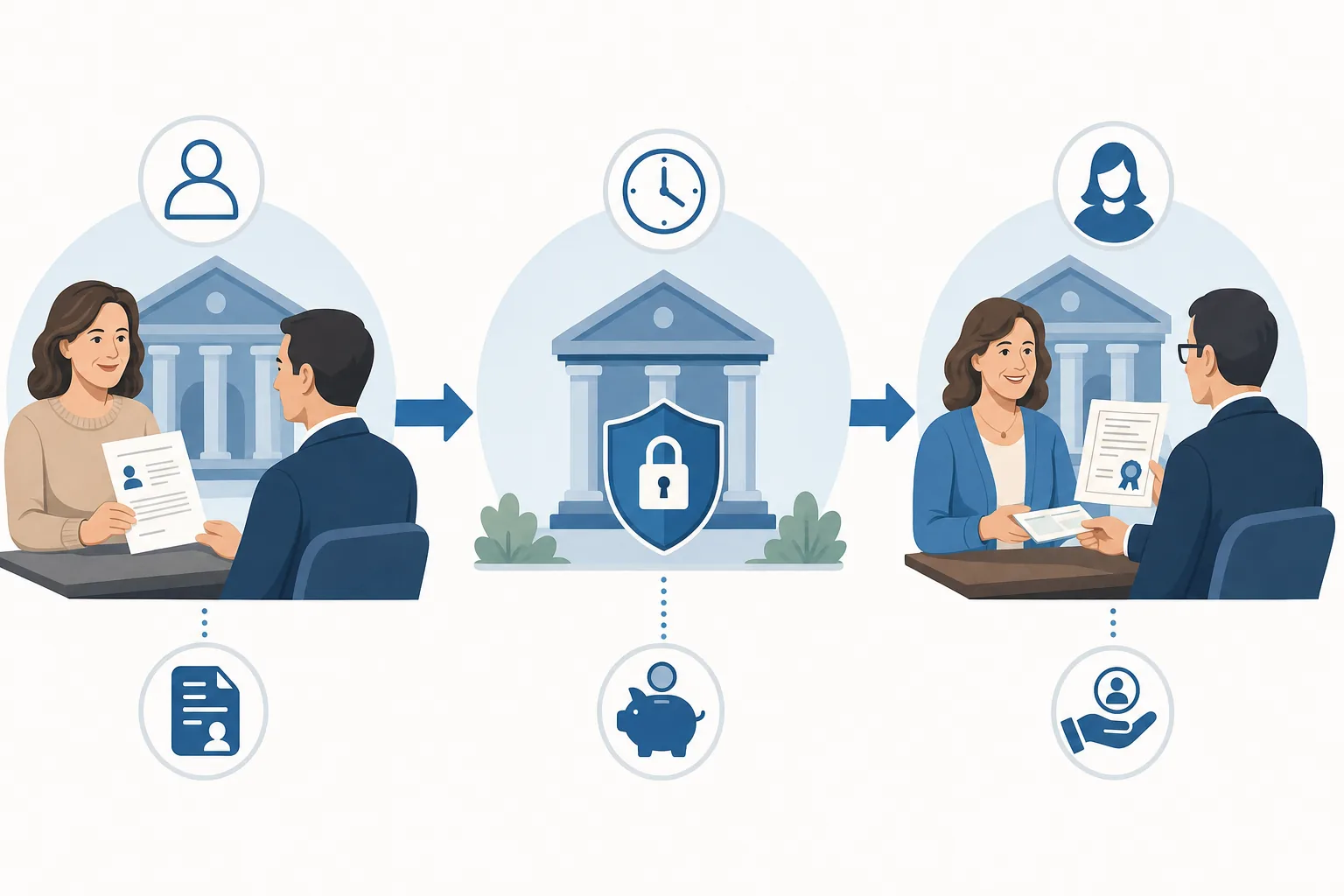
During your lifetime, a POD designation changes nothing. You control the account completely, and you can change or remove the named beneficiary at any time without notifying them or getting their approval. They have no rights to the account while you're alive.
After death, the beneficiary contacts the bank, presents a certified death certificate and valid ID, and the bank verifies the designation on file. If everything checks out, funds are released, typically within a few days to a few weeks depending on the institution.
Types of Accounts That Can Be Payable on Death
Most banks let you add POD designations to a range of deposit accounts. Here is what typically qualifies:
- Checking and savings accounts are the most common candidates, and nearly every major bank supports POD designations on both.
- Money market accounts held at a bank or credit union can usually carry a POD beneficiary as well.
- Certificates of deposit (CDs) are eligible at most institutions, with the designation transferring the balance directly to the beneficiary at maturity or upon death.
Brokerage and investment accounts use a similar but distinct designation called a transfer on death (TOD).
Setting Up a Payable on Death Designation
Setting up a POD designation is simple at most banks. You can do it at account opening, or add one to an existing account anytime by requesting a beneficiary designation form online, by phone, or at a branch.

When filling out the form, expect to provide:
- Beneficiary's full legal name, date of birth, and Social Security number
- Your relationship to them and their contact information
Some institutions require you to sign in front of a bank employee. Once submitted, the designation takes effect right away. Keep a copy somewhere your family can find it.
Payable on Death Bank Accounts Pros and Cons
POD accounts are genuinely useful, but treating them as a complete estate plan on their own is where people run into trouble.
| Pros | Cons |
|---|---|
| Bypasses probate entirely | Only covers deposit accounts, not all asset types |
| Funds transfer in days, not months | An outdated beneficiary name can create serious problems |
| Free and simple to set up at most banks | The designation overrides anything written in a will |
| Beneficiary claims funds with just a death certificate | No conditions on how or when funds are received |
| You can name multiple beneficiaries | Poor coordination with other assets can lead to family disputes |
POD vs Beneficiary Designations (Are They the Same)
POD is technically a type of beneficiary designation, but the term "beneficiary" covers more ground than just bank accounts. The end result looks identical: someone named in advance receives assets directly, without probate. Here is where the terms diverge:
- POD applies specifically to bank deposit accounts (checking, savings, CDs, money market)
- TOD (transfer on death) is the equivalent for brokerage and investment accounts
- Retirement accounts like IRAs and 401(k)s use their own beneficiary designation system, governed by federal law and plan documents
- Life insurance policies carry a separate beneficiary structure tied to the policy itself
A POD form filed with your bank does nothing for your IRA, and vice versa. Covering all your accounts means using the right designation for each type.
POD Bank Account Rules and Common Restrictions
POD rules vary by state. In community property states, you typically can't name a non-spouse as sole beneficiary without written spousal consent, and banks often enforce this at the form stage.
When naming multiple beneficiaries, most institutions require exact percentages rather than vague splits. Leaving the division undefined can create complications when the account is claimed.
Inheritance taxes on POD accounts
5 states (Kentucky, Maryland, Nebraska, New Jersey, and Pennsylvania) impose a state inheritance tax that can apply to POD proceeds. The rate depends on the beneficiary's relationship to the deceased, with close relatives generally paying less than distant ones.
Tax Implications of POD Accounts
POD proceeds aren't taxable as income to the beneficiary since the funds were already taxed when earned. Any interest accruing after the date of death is the exception, reported as ordinary income for that tax year.
Federal estate tax is rarely a concern. POD balances count toward the gross estate, but with the 2026 federal exemption at $15,000,000, most families won't owe anything at the federal level. State inheritance taxes are a separate calculation depending on where the deceased lived and the beneficiary's relationship to them, so confirm your state's rules before assuming the transfer is fully tax-free.
Common POD Account Mistakes and Pitfalls
Even a properly set up POD account can create headaches if the paperwork goes stale or incomplete. Common POD pitfalls include the three oversights that cause the most problems:
- Beneficiary names that were never updated after a divorce, remarriage, or a beneficiary's own death. Outdated designations can ruin even well-planned estates.
- No contingent beneficiary listed, so if your primary beneficiary dies first, funds default to your estate and enter probate anyway
- Designations set at different times across multiple accounts, accidentally leaving heirs with unequal or unintended shares
Review all designations after any major life change.
How POD Accounts Fit Into Overall Estate Planning
POD accounts handle one slice of an estate well. But a bank account with a named beneficiary does nothing for real estate, vehicles, business interests, or retirement accounts. Each asset type needs its own arrangement.
A will still matters. It covers everything a POD designation doesn't, including personal property and any account left without a named beneficiary. A trust goes further for larger estates or situations where you want conditions attached to an inheritance. POD works best inside a coordinated plan, not as a substitute for one.
When POD Accounts May Not Be the Right Choice
POD accounts skip probate, but your estate's creditors don't disappear with it. In some states, POD funds can be clawed back to satisfy debts if the estate itself is insolvent.
A few situations where a trust typically serves better:
- A beneficiary with a disability who receives government benefits like Medicaid or SSI. A direct inheritance can disqualify them from those programs overnight, while a special needs trust preserves eligibility.
- A beneficiary facing creditor judgments, active divorce proceedings, or bankruptcy. POD funds land directly in their hands, fully exposed.
- Minor children named as beneficiaries. Most banks won't release funds to a minor, so a court will appoint a guardian to control the money until adulthood.
If any of these apply, talk to an estate attorney before relying on POD designations alone.
Managing POD Accounts After a Death
Most banks handle POD claims quickly once the beneficiary arrives with documentation. Plan on a certified death certificate and government-issued ID at minimum; some institutions require a completed claim form as well.
A few practical points worth knowing:
- Order multiple certified death certificate copies before you start; banks won't accept photocopies.
- POD funds bypass probate but still count toward the gross estate for tax purposes.
- Document every transfer for estate accounting, even when no court is involved.
- If a joint account owner survived the deceased, POD activates only after that owner also passes.
How Sunset Helps Families Manage Bank Accounts and Estate Settlement
POD accounts help, but most families don't know which accounts have them until after someone has died. Sunset searches across 2,500+ financial institutions, finds every bank account the deceased held, and identifies which ones carry POD designations versus which ones need to move through probate. We handle closure paperwork for both types, coordinate with institutions directly, and can consolidate proceeds into a single FDIC-insured estate account for organized distribution to heirs.
Final Thoughts on Payable on Death Designations
A POD bank account works well when it's part of a broader estate strategy, not a replacement for one. Name contingent beneficiaries, keep your forms current, and confirm your designations match what you wrote in your will. When someone dies, Sunset finds every account they held and tells you which ones already have beneficiaries versus which ones need to go through probate. Most families don't realize how many old accounts are still open, and finding them early prevents months of cleanup work later.
FAQ
What is a payable on death bank account?
A payable on death (POD) bank account is a regular bank account where you name a beneficiary who receives the funds directly when you die. The beneficiary claims the money with a death certificate and ID, bypassing probate completely.
POD vs beneficiary on bank account, are they different?
No. POD is a specific type of beneficiary designation for bank deposit accounts like checking, savings, CDs, and money market accounts. Other accounts use different terminology: TOD for brokerage accounts, or separate beneficiary systems for retirement accounts and life insurance.
Can I set up a payable on death bank account without a lawyer?
Yes. Most banks let you add a POD designation by requesting a beneficiary designation form online, by phone, or at a branch. You fill in your beneficiary's name, date of birth, Social Security number, and relationship to you—no attorney needed.
How do taxes on payable on death bank accounts work?
POD proceeds aren't taxable as income to the beneficiary since the money was already taxed when earned. Interest that accrues after the date of death is reported as ordinary income. Five states (Kentucky, Maryland, Nebraska, New Jersey, and Pennsylvania) impose inheritance taxes based on the beneficiary's relationship to the deceased.
What happens if the person I named on my POD form dies before me?
If you didn't name a contingent beneficiary, the funds default to your estate and go through probate anyway. Review your POD designations after any major life change and always list at least one backup beneficiary to keep the account out of probate.