IRS Letter After Death: Notices and What to Do (2026)
Got an IRS letter after a death? Learn why it came, how to read the common notices, and which ones only need to be kept with the estate records.
September 15, 2026

An IRS letter after a death does not always mean a tax bill, an audit, or a problem. The IRS may be confirming a transcript request, asking about a missing return, sending a refund notice, or updating its records after learning that the taxpayer died. The job for the executor is to work out which kind of letter it is and whether the estate needs to answer.
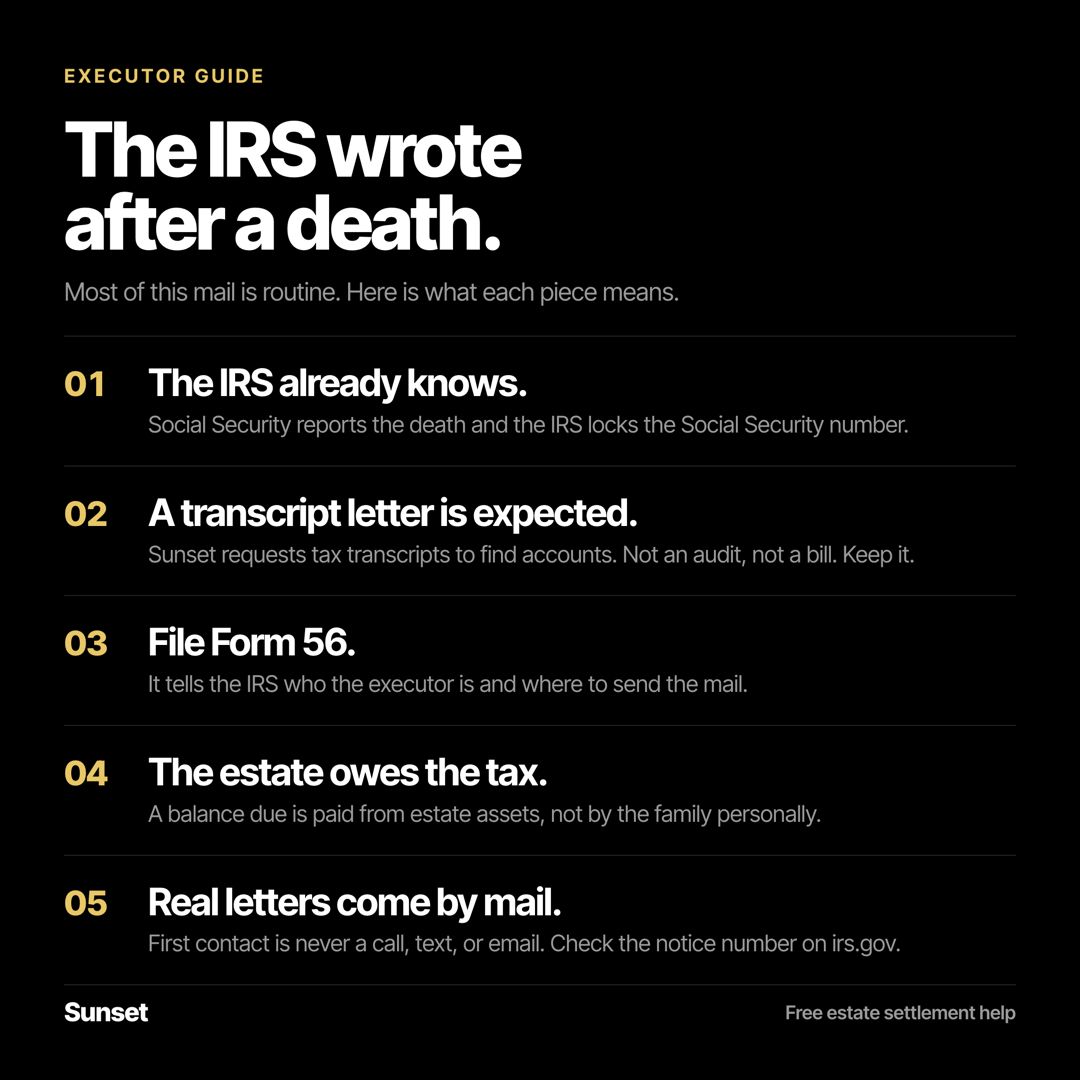
For Sunset families, one letter deserves naming right away. As part of asset discovery, Sunset contacts the IRS on the estate's behalf and requests the deceased person's tax transcripts. If the IRS mails a routine confirmation about that request to the deceased person's address or to your address, it is expected. It is not an audit or a bill, and you do not need to do anything except keep it with the estate records.
This guide explains why IRS mail keeps arriving after a death, what the common notices mean, and when to bring in a CPA or attorney. It is general information, not legal or tax advice.
Why the IRS writes to a family after someone dies
Tax records do not close on the date of death. A final income tax return may be due. A prior return may still be under review. A refund may need to be claimed by the right person. The IRS may also need to confirm who has authority to receive information about the deceased taxpayer or the estate.
The IRS usually learns of a death from the Social Security Administration. Once the death is recorded, the deceased person's Social Security number is locked to reduce identity theft. The lock does not erase past tax duties or stop every automated notice. It means the IRS has marked the taxpayer as deceased and will want proof of authority before releasing information.
A good first step is to sort IRS mail into five groups:
| IRS mail type | What it usually means | First action |
|---|---|---|
| Transcript request letter | Someone with authority requested tax transcripts | Save it with the estate records |
| Balance due notice | A return shows tax owed, or the IRS changed a return | Compare it with the estate tax records |
| Missing return notice | The IRS thinks a return was not filed | Check whether a final or prior-year return is due |
| Refund notice | Money is owed to the deceased taxpayer or the estate | Confirm who can claim it |
| Identity verification letter | The IRS wants to confirm a filing or request is real | Verify the letter, then respond |
If you are also working on the returns themselves, read Sunset's guide to tax filings after death. This article stays on the letters.
The transcript request letter Sunset users may receive
Sunset searches 2,300+ financial institutions to find accounts and assets during estate settlement. One of the most useful tools in that search is the deceased person's IRS wage and income transcript. It lists every institution that reported interest, dividends, retirement income, or brokerage activity under the deceased person's Social Security number. That record often points to accounts the family did not know about.
Because of how the IRS handles these requests, its correspondence about a transcript may go to the deceased person's address of record, or to the Sunset user's address if that is the address on file for the estate.
If you receive one of these letters after using Sunset, the short answer is this. It is expected. It is not an audit. It is not a bill. It is a routine confirmation that a transcript was requested for the estate. You do not need to pay anything or call the IRS. Save it with the estate records, and if the letter asks for extra proof, Sunset will tell you.
For the mechanics of requesting transcripts yourself, including Form 56 and the estate EIN, see Sunset's guide to IRS Form 56, estate EINs, and tax transcripts. This article is about recognizing the mail when it arrives.
What Form 56 does, and why the address matters
Form 56, Notice Concerning Fiduciary Relationship, tells the IRS that a specific person has authority to act for the deceased taxpayer or the estate. Executors often file it after the first piece of IRS mail arrives, because they need future notices to reach the right person.
The IRS will usually ask for proof of that authority: court-issued Letters Testamentary or Letters of Administration, or Form 56 with a copy of the death certificate. A will by itself does not prove that a court appointed you.
Address changes are a separate step. Form 56 identifies the fiduciary, but the IRS uses Form 8822, Change of Address, to move a taxpayer's address of record. If IRS letters are going to an empty house, both forms may be needed so nothing is missed.
Two other forms show up in this area. Form 2848 gives a CPA, attorney, or enrolled agent power to represent the taxpayer before the IRS. Form 8821 only authorizes the IRS to share tax information with the named person. Know which one you signed, because they grant very different things.
Common IRS notices a deceased taxpayer still receives
Start with the notice number in the upper right corner of the letter. It tells you what the IRS system thinks is happening.
A balance due notice means a filed return showed tax owed, the IRS assessed more tax, or penalties and interest were added. Compare it with the filed returns and the payment records. A valid tax debt is a debt of the deceased person or the estate. It is not the personal debt of a child, sibling, or other relative.
A missing return notice means the IRS believes a return was due and never arrived. It may cover the final year of life, an earlier year, or an estate income tax return if the estate earned income after the death. Do not assume the notice is wrong because the person died. Check the tax year it names.
A refund notice means money is owed to the deceased taxpayer. The IRS needs to know who can receive it. Form 1310 is the usual way to claim a refund due to a deceased taxpayer. A surviving spouse filing a joint return does not need it, and neither does a court-appointed personal representative who attaches a copy of the court certificate to the return.
An identity verification letter means the IRS received a return, a transcript request, or another filing and wants proof that it is real. Because the Social Security number is locked after the death, these letters are more common than families expect.
A change notice or math error notice means the IRS adjusted a return. These carry response deadlines. If the estate disagrees, get tax help quickly so the deadline is not missed.
How to respond to an IRS letter for a deceased person
Read the first page and find five things: the notice number, the tax year, the taxpayer name, the response deadline, and the amount, if any. Then decide whether the letter is informational or asks for action. A transcript confirmation only needs to be filed. A missing return, balance due, or identity verification notice needs a response.
Gather the estate file before you answer:
- Death certificate
- Letters Testamentary or Letters of Administration
- Prior returns and any final return already filed
- IRS notices already received
- Proof of payments or refunds
- Form 56, 8822, 2848, 8821, or 4506-T, if any were filed
Answer in writing when the notice asks for a mailed response. Send copies, keep a copy of everything, and use tracked mail when a deadline is involved.
If the letter says tax is due, do not pay it from your own money. Executors pay estate debts from estate assets, in the order state law sets. Sunset's guide to which debts must be paid after a death covers the order. Keep every IRS letter, proof of mailing, and payment record in the estate file, because they belong in the estate accounting the court and the heirs will see.
How to tell a real IRS letter from a scam
Scammers target grieving families because mail, accounts, and deadlines are already hard to keep up with. A real IRS letter arrives by U.S. mail with a notice or letter number, the tax year, the taxpayer's identifying information, and instructions for responding.
The IRS starts contact by mail. It does not start contact by phone, text, or email, and it never demands immediate payment by gift card or wire transfer. To check a letter, go to irs.gov yourself and search the notice number printed on it. If you call the IRS, use the number on irs.gov or on a notice you have verified, not one a caller gave you.
If the letter looks real but the amount seems wrong, treat it as real until proven otherwise. Missing a response deadline creates more work than answering a mistaken notice.
What if a return is missing or a deadline already passed?
Identify the tax year first. A final individual return is usually required for the year of death. Earlier years may still be open. If the estate earned income after the death, an estate income tax return may be required as well.
If a deadline has passed, act now. Late filing and late payment add penalties and interest, and missed response deadlines can cost the estate its appeal rights. A CPA can pull the account transcripts, file what is missing, and ask the IRS to correct a notice built on wrong information. If the estate has limited funds, competing creditor claims, or court deadlines, an attorney should be involved. Sunset refers families to a local probate attorney when counsel is needed.
FAQ
Why did I get an IRS letter after my parent died?
Because an open tax matter, a refund, a missing return, or a transcript request tied to the estate is still on the IRS books. If Sunset requested transcripts to find assets, a confirmation letter is expected and needs no action beyond filing it.
Is an IRS transcript request letter an audit?
No. It confirms that tax records were requested. For Sunset users, those transcripts show which institutions reported income under the deceased person's Social Security number, which is how hidden accounts turn up. Keep the letter with the estate records.
Am I personally responsible for a deceased person's IRS debt?
No. The estate is responsible for valid tax debts, not family members personally. Do not pay estate debts from personal funds, especially if the estate may not have enough to pay every claim.
Do I need Form 1310 to claim a deceased person's refund?
Often, yes. A surviving spouse filing a joint return does not need it. A court-appointed representative who attaches the court certificate to the return does not need it either.
Should I call the IRS when a deceased person gets a notice?
Verify the notice first, read the tax year and deadline, and gather proof of your authority. A transcript confirmation only needs to be filed. A payment demand, a missing return notice, or an identity verification letter deserves a response, ideally with a CPA's help.
How Sunset can help
IRS mail is one piece of a longer estate settlement: finding assets, protecting accounts, preparing probate paperwork, paying valid debts, and transferring what remains to the heirs.
Sunset starts with assets and liabilities. We search 2,300+ financial institutions, request IRS transcripts on the estate's behalf, generate state- and county-specific probate packets, open an FDIC-insured estate account, and handle the transfers to beneficiaries. Sunset has helped 15,000+ families settle estates, and the family product is paid through our bank partnership, so the estate pays nothing and every dollar goes to the heirs. If the IRS letter on your table is one more thing on a long list, Sunset can help you put it where it belongs.