How to Fill Out a W-9 for an Estate or Trust (2026)
See a filled-out W-9 for an estate and for a trust, line by line, with sample PDFs and the right EIN to use after a death.
October 28, 2026
By Stephen Walter, Attorney and CEO
Form W-9 is the IRS form a payer uses to get the correct legal name and taxpayer identification number for someone it may pay and later report on a Form 1099. For an executor, a W-9 for an estate usually means giving a bank, brokerage, insurer, buyer, title company, or other payer the estate name and estate EIN, certified under penalties of perjury.
No money goes to the IRS with a W-9. The form is never filed with the IRS. The top right of the current Form W-9, Rev. March 2024, says: Give form to the requester. Do not send to the IRS. If the W-9 is missing or wrong, the payer may have to withhold 24% of reportable payments as backup withholding and send that money to the IRS.
This guide shows what a completed estate W-9 example and trust W-9 example look like, then walks the form line by line.
Before you fill out the W-9, find the EIN letter
For an estate or trust after death, the W-9 usually copies two things from the IRS EIN letter, also called Notice CP575B: the legal name and the employer identification number. If you are comparing papers, use our companion guide to an estate and trust EIN letter example. That post shows where the IRS prints the name and EIN that usually go on the W-9.
This article does not re-explain how to apply for an EIN. If you still need one, start with how to get an EIN for an estate. Sunset is a Circular 230 IRS tax professional firm, and Sunset obtains the EIN from the IRS for users who do not have one yet.
Sample estate W-9 example
Here is the sample estate W-9 (PDF), a flattened PDF of the official IRS form with placeholder data and a SAMPLE watermark. It is not a real taxpayer document. In this example, the legal name follows the EIN letter, the Trust/estate box is checked, and the EIN goes in the employer identification number boxes.
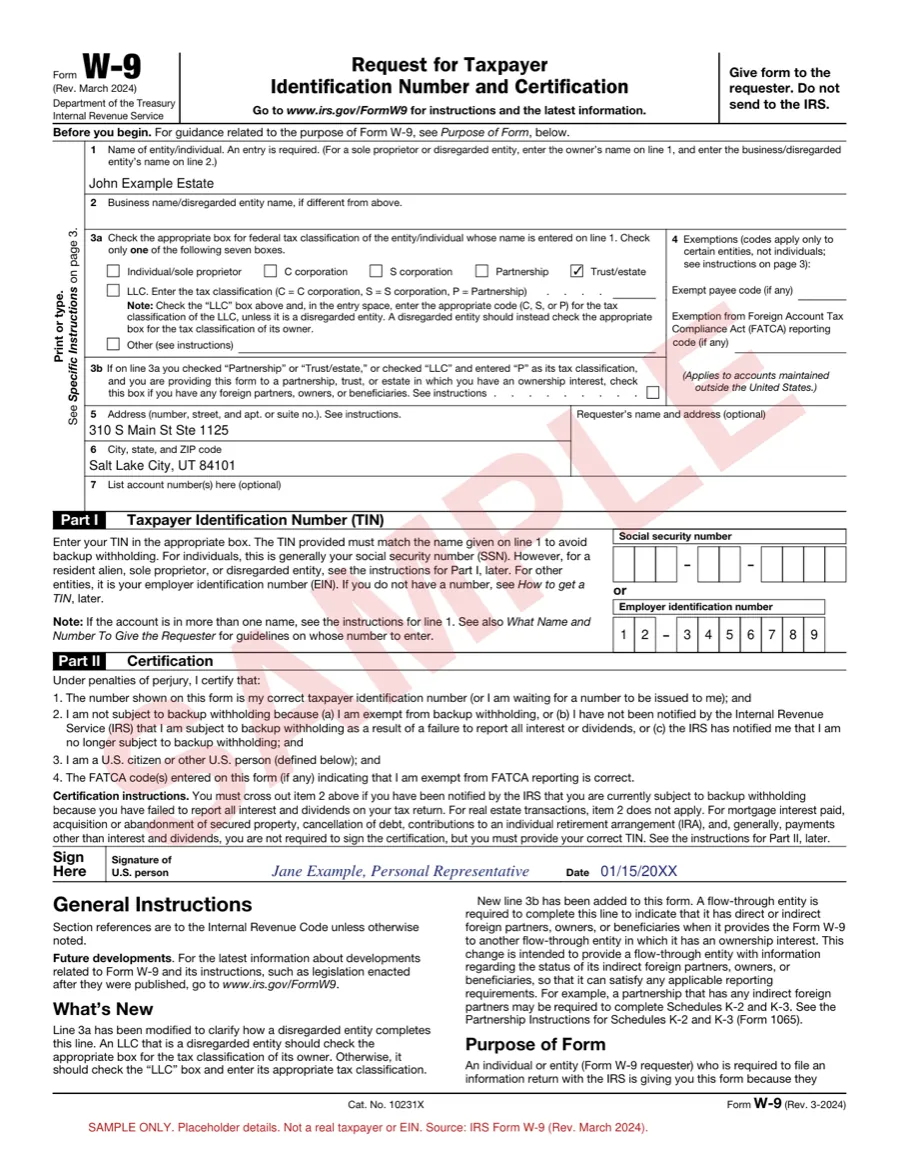
Example estate details used on the sample:
| Form field | Example entry |
|---|---|
| Line 1 | John Example Estate |
| Line 2 | Blank |
| Line 3a | Trust/estate |
| Lines 5 and 6 | 310 S Main St Ste 1125, Salt Lake City, UT 84101 |
| Part I | EIN 12-3456789, placeholder only |
| Part II | Jane Example, Personal Representative |
The estate EIN is the number used for the estate after the person died. Do not put the deceased person's Social Security number in Part I.
Sample trust W-9 example
Here is the sample trust W-9 (PDF), also a flattened PDF of the official IRS form with placeholder data and a SAMPLE watermark. The trust name and EIN should match the IRS EIN letter, not an old W-9 that may have been signed while the grantor was alive.
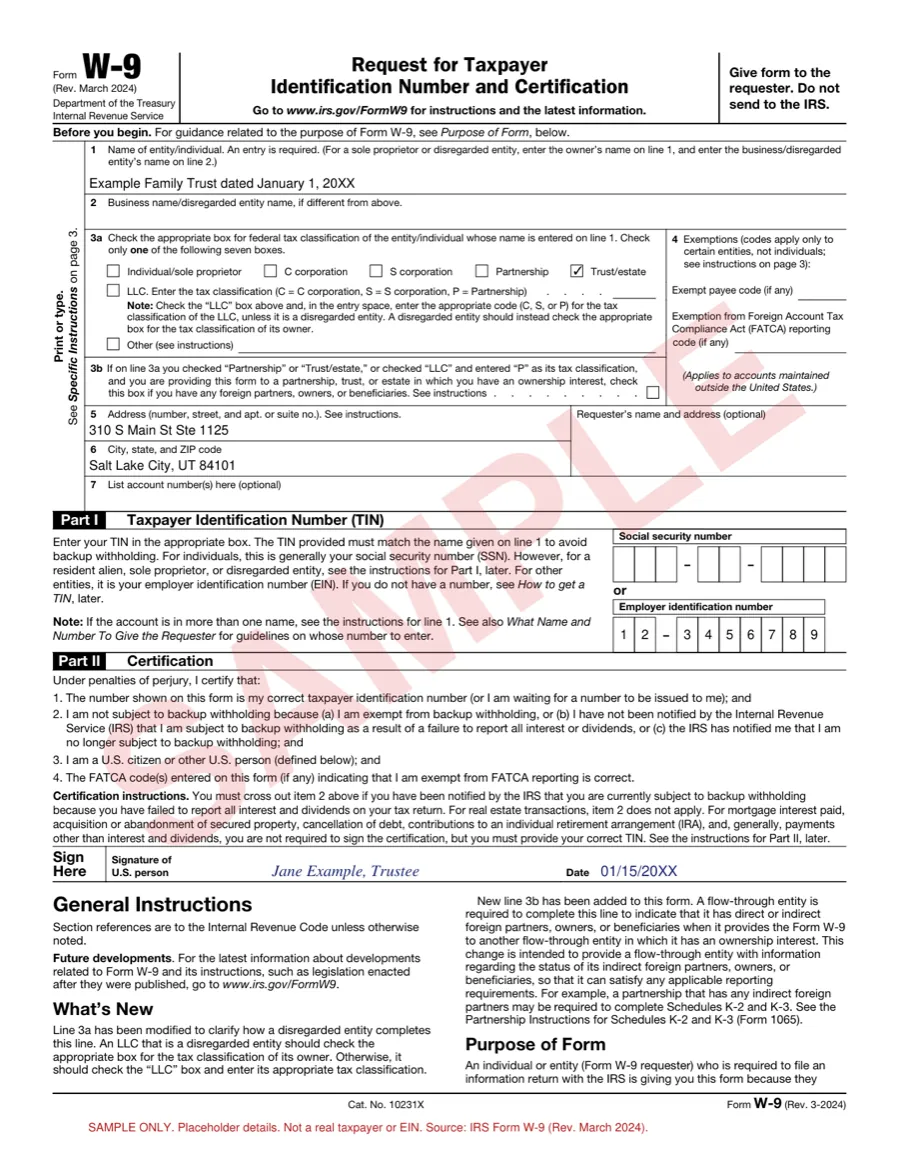
Example trust details used on the sample:
| Form field | Example entry |
|---|---|
| Line 1 | Example Family Trust dated January 1, 20XX |
| Line 2 | Blank |
| Line 3a | Trust/estate |
| Lines 5 and 6 | 310 S Main St Ste 1125, Salt Lake City, UT 84101 |
| Part I | EIN 12-3456789, placeholder only |
| Part II | Jane Example, Trustee |
A W-9 for a trust often comes up when a brokerage retitles trust assets, a bank opens a trust account, or a property manager needs to report rent paid to the trust.
How to fill out a W-9 for an estate, line by line
Use the current Form W-9, Rev. March 2024. If a requester sends you an older copy, ask whether they will accept the current IRS version.
Line 1: Name
Enter the legal name of the estate exactly as it appears on the EIN letter. The CP575B controls the name the IRS has on file, so check the letter before you sign. You can compare your letter with our CP575B EIN letter example.
For the sample estate W-9, Line 1 says: John Example Estate.
If a requester questions the name, show them the EIN letter.
Line 2: Business name or disregarded entity name
For an estate, Line 2 is usually blank. Do not use this line for the deceased person's name if Line 1 already names the estate. Do not add an executor name here unless the requester or a tax professional tells you to.
Line 3a: Federal tax classification
Check Trust/estate. Check only one box.
Do not check Individual/sole proprietor just because the executor is a person. The form is for the estate, not for you.
Line 3b: Foreign partners, owners, or beneficiaries
Line 3b is new on the Rev. March 2024 form. It relates to certain flow-through entities with foreign partners, owners, or beneficiaries when the form goes to a partnership, trust, or estate in which the entity has an ownership interest.
For a typical estate W-9 given to a bank, brokerage, insurer, title company, or buyer, Line 3b is usually left blank. If you are unsure, ask the requester or a tax professional. Do not guess.
Line 4: Exemptions
Line 4 has boxes for an exempt payee code and an exemption from FATCA reporting code. For a usual estate or trust W-9, these are left blank.
If a requester says an exemption code applies, ask them to explain what they need and why. If you are not sure, ask a tax professional before adding a code.
Lines 5 and 6: Address
Use the mailing address where the executor or personal representative should receive tax forms, including Forms 1099. The address does not have to be the deceased person's home.
In the sample estate W-9, the placeholder address is 310 S Main St Ste 1125, Salt Lake City, UT 84101. Use the address that should receive estate mail while the estate settlement is open.
Line 7: Account numbers
Line 7 is optional. Some requesters use it to tie the W-9 to an account number, claim number, policy number, loan number, or property file. If the requester does not ask for it, it can be left blank.
Requester name and address
The requester name and address box is optional. You can leave it blank. If the requester filled it in, leave it as is.
Part I: Taxpayer identification number
For a W-9 for an estate, put the estate EIN in the Employer identification number boxes. Leave the Social Security number boxes empty.
Do not use the deceased person's Social Security number. After death, the estate is a separate tax reporting entity for many payment and account purposes. Using the wrong TIN can cause rejected forms, tax form errors, or 24% backup withholding.
Part II: Signature and date
The executor or personal representative signs as fiduciary and dates the form. A common signature style is: Jane Example, Personal Representative.
The signature certifies under penalties of perjury that the TIN is correct and that the signer is not subject to backup withholding, unless the signer has been told otherwise.
How to fill out a W-9 for a trust, line by line
A W-9 for a trust follows the same basic pattern, but the trust name matters.
Line 1 should show the trust's legal name exactly as it appears on the EIN letter, such as Example Family Trust dated January 1, 20XX. Line 2 is usually blank. Line 3a should be Trust/estate. Lines 3b and 4 are usually blank unless the requester or a tax professional says otherwise.
Use the trustee's mailing address on Lines 5 and 6, where Forms 1099 and other tax mail should go. In Part I, enter the trust EIN in the employer identification number boxes and leave the Social Security number boxes empty. The trustee signs in Part II, for example: Jane Example, Trustee.
If you are serving as successor trustee, it can help to read more about successor trustee duties and irrevocable trust bank accounts after death.
The revocable trust trap after death
A revocable living trust often uses the grantor's Social Security number while the grantor is alive. After the grantor dies, the trust generally becomes irrevocable and needs its own EIN. Any bank, brokerage, or other payer holding trust assets may need a new W-9 with that new EIN.
This is where old paperwork causes problems. A W-9 that was correct before death may be out of date after death if it lists the grantor's Social Security number. The updated W-9 should use the trust name and trust EIN from the EIN letter.
For more on account setup, see Sunset's guide to opening an estate bank account and the guide to open an estate or trust account with Sunset.
Who asks for an estate or trust W-9?
You may be asked for a W-9 by any payer that may send money to the estate or trust and report it on a Form 1099. Common examples include:
- A bank opening an estate or trust account
- A brokerage retitling an account
- A life insurer or annuity company paying the estate
- An employer paying final wages to the estate
- A buyer or title company on a house sale
- A tenant or property manager paying rent to the estate
The same signed W-9 can usually be reused for many requesters as long as the legal name, EIN, and mailing address have not changed. Keep a signed copy in the estate records, along with the EIN letter, bank account papers, tax forms, and other records. For related filing issues, see tax filings after death.
Watch for scams. A W-9 request that arrives out of the blue by email from someone with no real reason to pay the estate is a red flag. Send W-9s only to payers you expect.
FAQ about estate and trust W-9 forms
What is a W-9?
Form W-9 is called Request for Taxpayer Identification Number and Certification. A payer uses it to collect the correct legal name and TIN for tax reporting. The signer certifies, under penalties of perjury, that the TIN is correct.
Does a W-9 get filed with the IRS?
No. You give the W-9 to the requester, and the requester keeps it. The requester uses the information later if it needs to issue a tax form, such as a Form 1099.
What TIN do I use on a W-9 for an estate?
Use the estate EIN in the employer identification number boxes. Do not use the deceased person's Social Security number. If you do not have the estate EIN yet, get the EIN before signing the estate W-9.
What TIN do I use on a W-9 for a trust after death?
Use the trust EIN. A revocable trust may have used the grantor's Social Security number during life, but after death the trust may need its own EIN and a new W-9.
What happens if the W-9 is missing or wrong?
The payer may apply backup withholding. That means the payer withholds 24% of reportable payments and sends that amount to the IRS. A correct W-9 helps the requester report payments under the right name and EIN.
Informational note
This post is general information about Form W-9 for estates and trusts. It is not tax or legal advice. For a specific situation, talk to a tax professional or attorney.
How Sunset can help with the estate account and W-9 details
An estate or trust needs its own EIN to open an estate or trust bank account, with Sunset or any other bank. When you open an estate or trust account through Sunset, Sunset collects the details a W-9 asks for: the legal name, the EIN, and the executor or trustee address. Each estate account and trust account is FDIC insured.
Sunset has helped 15,000+ families with estate settlement work. If you still need the EIN, account setup, or a place to keep the estate's financial details organized, get started with Sunset.
You can also download the sample estate W-9 (PDF) and the sample trust W-9 (PDF) to compare against the official form before you respond to a requester.