Tax Filings After Death: IRS and State Rules (2026)
Tax filings after death can include Form 1040, Form 1041, estate tax, and state returns. A CPA deadline guide for safer intake.
August 21, 2026

Tax filings after death usually start with a final Form 1040 for the person who died, then may expand into fiduciary income tax, federal estate tax, state estate tax, or state inheritance tax filings. For accountants and CPAs, the hard part is often not the form list. It is getting a complete view of assets, income-producing accounts, probate authority, beneficiaries, and state exposure early enough to file on time.
This guide is informational and current as of August 21, 2026. It is written for tax professionals helping families after a death, not as legal or tax advice for any single estate.
Start with the intake file: death, authority, assets, and states
A clean tax file after death usually needs four intake tracks running at once:
- Date of death, domicile, and marital status
- The person with authority to act, such as a surviving spouse, executor, administrator, trustee, or court-appointed personal representative
- Every asset and liability, including accounts that produced income after death
- Every state with a possible filing, payment, waiver, or probate issue
Families may arrive with a death certificate and a stack of mail, but no full balance sheet. That creates risk for the final Form 1040, Form 1041 estate income tax, state income tax, estate tax deadlines, and beneficiary reporting.
For death certificates, families may need more copies than they expect. Sunset explains common uses in its guide to how to order death certificates. If a court appointment is needed, the CPA may also need letters testamentary or letters of administration before banks, brokers, or the IRS will share information.
Final tax return for deceased person: Form 1040
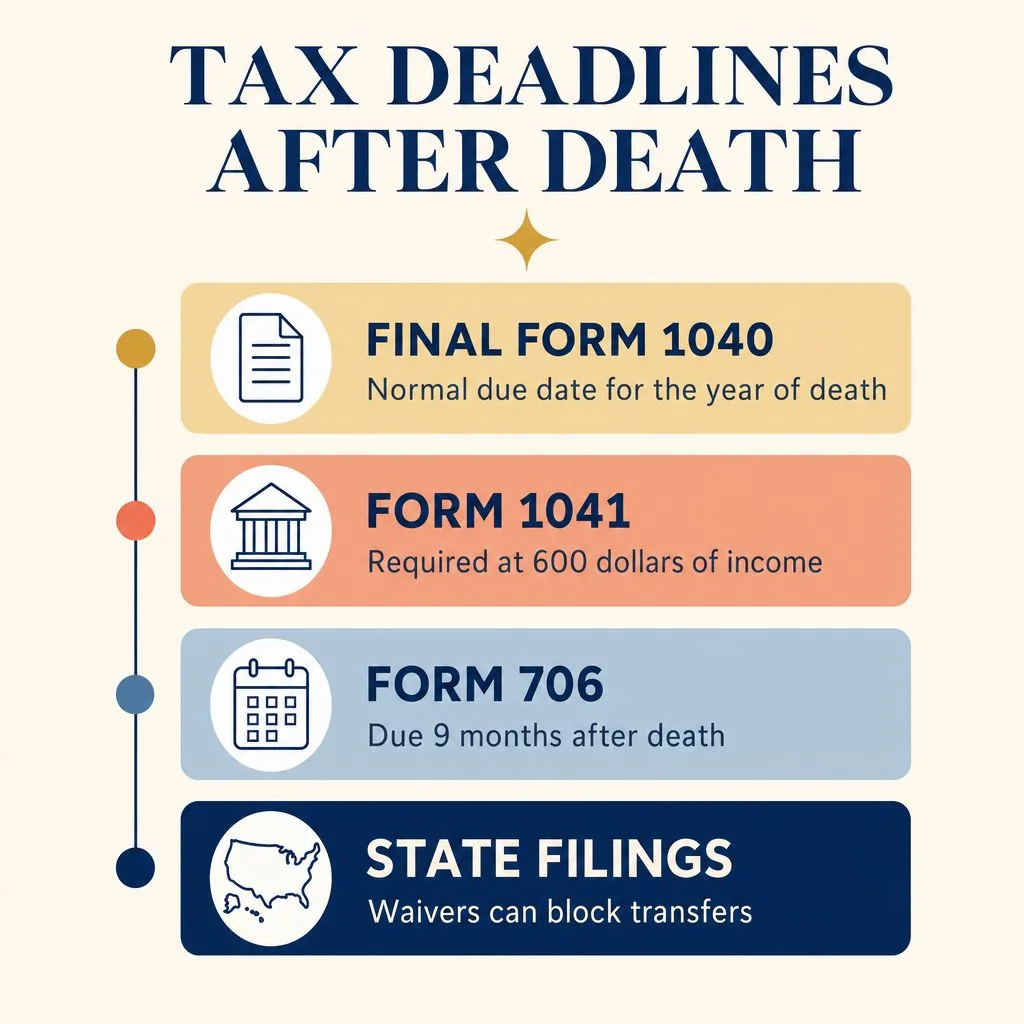
The final tax return for deceased person is generally due on the normal Form 1040 deadline for the year of death. For a person who dies during 2026, the final 2026 Form 1040 is generally due in April 2027, subject to the usual weekend, holiday, and extension rules.
The return covers income received through the date of death. Income received after death may belong on a fiduciary return for the estate or trust, or may be reported directly by a beneficiary, depending on the asset and ownership.
A surviving spouse may be able to file a joint final return for the year of death. If a refund is due and no joint return is filed, Form 1310 may be needed unless a court-appointed personal representative attaches the court papers. In practice, refund claims are a common delay point when the family has not opened probate or cannot prove authority.
CPAs should also think about IRS relationship forms early:
- Form 56 tells the IRS a fiduciary relationship has started. File it again when the fiduciary relationship ends.
- Form 2848 is needed for representation before the IRS. Form 8821 is an information authorization and does not grant representation authority.
- Transcript access may require Form 2848 plus the death certificate and letters, or Form 56, depending on the facts.
- Form 4506-T can be used for mailed transcript copies.
For families, these requests can feel repetitive. For the preparer, they are the audit trail that shows who can act for the deceased taxpayer and the estate.
Form 1041 estate income tax: when it is required
Form 1041 estate income tax filing is required for a domestic estate with gross income of $600 or more during the tax year. It is also required if the estate has any nonresident alien beneficiary.
Common sources of estate income include:
- Interest and dividends posted after death
- Capital gains or losses from estate sales
- Rental income received after death
- Business or LLC income allocated after death
- Retirement account or annuity income paid to the estate
The estate Form 1041 is due on the 15th day of the fourth month after the estate tax year ends. Form 7004 can extend the filing deadline by 5.5 months, but it does not extend time to pay.
One planning feature matters for CPA intake: an estate may elect a fiscal year. A trust generally cannot. That can affect timing for income distributions, beneficiary K-1s, and cash planning.
The section 663(b) 65-day rule may also matter. Under that rule, certain distributions made within 65 days after year end can be treated as made on the last day of the prior tax year if the fiduciary makes a valid election. This can change the estate or trust income tax result and the beneficiary K-1 timing.
Revocable trusts and the section 645 election
If the decedent had a qualified revocable trust, the fiduciaries may be able to make a section 645 election on Form 8855. The election treats the trust as part of the estate for income tax purposes for the election period.
For CPA workflow, the election can reduce duplicated filings and give the trust access to certain estate tax-year rules. The election is irrevocable once made, so it should be reviewed carefully with the fiduciary and any legal counsel involved.
This is also where asset discovery matters. A family may know about the trust account at one brokerage, while missing an old high-yield savings account, a retained-asset account, or a small taxable account still sending 1099s. A missed account can mean a missed 1041 item, a late amended return, or a wrong distribution picture.
Federal estate tax deadlines: Form 706 and portability
Federal estate tax is separate from fiduciary income tax. Form 706 is due 9 months after death. A 6-month extension is available, usually through Form 4768, though payment issues may still need attention.
For 2026, the federal basic exclusion amount is $15,000,000 under P.L. 119-21, signed July 4, 2025. The top federal estate tax rate remains 40 percent.
Many estates will not owe federal estate tax, but Form 706 may still matter for portability. A surviving spouse can use the deceased spouse's unused exclusion only if the estate files a proper portability election. Rev. Proc. 2022-32 allows a late portability election for certain estates up to 5 years after death.
Two additional forms can help fiduciaries manage exposure:
- Form 4810 can shorten the IRS assessment period to 18 months for certain returns.
- Form 5495 can request discharge from personal liability for income, gift, or estate tax.
These are not routine forms for every file. They can be worth discussing when the fiduciary wants a clearer closing path.
State estate and inheritance tax rules vary sharply
State filings can be the surprise in tax filings after death. Domicile drives much of the analysis, but real estate, tangible property, beneficiaries, and account transfer rules can pull other states into the file. Sunset covers one related probate issue in its guide to ancillary probate when property is in another state.
In 2026, 12 states plus the District of Columbia have an estate tax:
CT, HI, IL, ME, MD, MA, MN, NY, OR, RI, VT, WA, and DC.
A few state thresholds are especially important for intake:
- Oregon starts at $1,000,000.
- Massachusetts starts at $2,000,000.
- Illinois starts at $4,000,000.
- New York starts at $7,350,000 and has a 105 percent cliff that can tax the whole estate from dollar one.
- Washington rolls back to $3,000,000 on July 1, 2026, with a new 20 percent top rate, down from 35 percent.
Five states have an inheritance tax in 2026: Pennsylvania, New Jersey, Kentucky, Maryland, and Nebraska. Iowa repealed its inheritance tax for deaths on or after January 1, 2025. Maryland is the only state with both an estate tax and an inheritance tax.
Inheritance tax depends on the beneficiary relationship and state rules. That means a CPA may need the family tree, beneficiary designations, and transfer documents, not just the balance sheet.
State tax waivers can block account transfers
State rules can also affect whether an account can move to an estate account or beneficiary. New Jersey is a good example. Banks may release only 50 percent of certain assets until a Form 0-1 tax waiver arrives. For Class A beneficiaries, Form L-8 can act as a self-executing shortcut in many cases.
Pennsylvania has another timing wrinkle. Its inheritance tax return is due 9 months after death, but payment within 3 months earns a 5 percent discount. A family can pay an estimated amount without filing the return yet.
These state details matter to CPAs because they affect cash. A return may be ready, but a bank account may be partly frozen. A beneficiary may expect a quick transfer, but the institution may require a waiver first. A fiduciary may need an estate bank account to receive refunds, sell assets, pay expenses, and keep records separate.
CPA checklist for the first family meeting
A strong first meeting reduces amended returns and missed filings. Ask for:
- Death certificate copies
- Will, trust, and court appointment papers
- Prior-year federal and state returns
- IRS notices and state tax notices
- All Forms W-2, 1099, K-1, SSA-1099, and 1098
- Bank, brokerage, retirement, annuity, and crypto statements
- Real estate addresses, deeds, mortgages, and rents
- Business ownership records and final payroll details
- List of beneficiaries and their states of residence
- Funeral, medical, administration, appraisal, and legal expenses
- Records of distributions already made
For fiduciary bookkeeping, connect the tax file to the estate accounting file early. Sunset's guide to estate accounting explains why executors need to track receipts, expenses, transfers, and distributions from the start.
FAQ: tax filings after death
Who files the final tax return for a deceased person?
A surviving spouse may file a joint final return if the rules are met. Otherwise, the executor, administrator, or other authorized personal representative usually handles the final Form 1040. If a refund is claimed, Form 1310 or court papers may be needed.
Does every estate need to file Form 1041?
No. A Form 1041 is generally required when a domestic estate has $600 or more of gross income during the tax year, or if any beneficiary is a nonresident alien. Many small estates still need review because a single post-death interest, dividend, sale, or retirement distribution can create a filing duty.
What is the deadline for an estate income tax return?
Form 1041 is due on the 15th day of the fourth month after the estate tax year ends. Estates may elect a fiscal year. Form 7004 gives an automatic 5.5-month filing extension, but tax payments may still be due by the original deadline.
Is Form 706 required if no federal estate tax is due?
Sometimes, yes. An estate may file Form 706 to elect portability for a surviving spouse, even if the estate owes no federal estate tax. Federal estate tax rules and portability elections should be reviewed with the estate's tax and legal advisors.
Which states have inheritance tax in 2026?
Pennsylvania, New Jersey, Kentucky, Maryland, and Nebraska have inheritance tax in 2026. Iowa repealed its inheritance tax for deaths on or after January 1, 2025. Maryland is the only state with both estate tax and inheritance tax.
How Sunset helps tax professionals build a better estate file
A CPA cannot file a correct Form 1040, Form 1041, state return, or estate tax return without the full asset picture. Sunset helps families and professional partners find that picture sooner.
Sunset searches 2,300+ financial institutions to find accounts and assets, generates state- and county-specific probate packets, helps set up an FDIC-insured estate account, and supports transfers when accounts need to move. When counsel is needed, Sunset refers families to a local probate attorney.
For accountants and CPAs, the Sunset Pro estate asset summary can turn scattered family information into a clearer intake package: institutions found, account leads, probate status, and transfer blockers. More than 15,000 families have used Sunset to settle an estate.
If a client is missing accounts, waiting on bank responses, or unsure which assets produced income after death, Sunset can help the family gather the estate file you need to prepare the returns with more confidence.