Estate Accounting: What Executors Must Track (2026)
An estate accounting shows the court and the heirs every dollar in and out of the estate. What to include, when it is required, and how to keep clean records.
July 27, 2026
By Stephen Walter, Attorney and CEO
An estate accounting is a written financial report showing everything that came into the estate, everything that went out, and what is left to distribute. Most states require the executor to file one with the probate court before the estate can close, and beneficiaries have the right to see it. If you are settling an estate, the accounting is the document that proves you handled the money correctly.
The good news: an accounting is not hard to produce if you kept records from the beginning. It becomes painful only when you have to reconstruct nine months of transactions from memory and a shoebox of receipts.
This guide covers what belongs in an estate accounting, when courts require a formal one, the mistakes that get accountings rejected, and how to set up your record-keeping on day one so the final report writes itself.
What is an estate accounting?
An estate accounting is a ledger for the estate as its own financial entity. It starts with what the deceased person owned on the date of death, adds anything the estate received afterward, subtracts everything the estate paid out, and ends with the balance available for the heirs.
Courts in most states use some version of the "charge and discharge" format, which sounds more formal than it is. You are charged with the assets you took control of, and you discharge that responsibility by showing where each dollar went. The math has to close: opening value plus receipts, minus disbursements and distributions, equals the ending balance. If it does not balance to the penny, the court sends it back.
The accounting is separate from the inventory. The inventory is a snapshot of what existed at death, usually filed within the first 60 to 90 days. The accounting is the movie: every transaction across the whole administration period.
When courts require a formal accounting
This depends heavily on your state and on which probate track the estate is on.
Formal or supervised administration. The court reviews the executor's work at each stage. A detailed accounting is required before the judge will approve distributions and discharge you. Expect line-item schedules and supporting documentation.
Informal or unsupervised administration. States that adopted the Uniform Probate Code, including Colorado, Michigan, Minnesota, and Arizona, let executors administer estates without ongoing court supervision. Instead of a court-audited accounting, you file a closing statement swearing that you paid the debts, filed the taxes, and distributed the assets, and that you sent a full accounting to every beneficiary. The accounting still gets made. It just goes to the heirs instead of the judge.
Waived accountings. In many states, if every beneficiary signs a waiver of accounting along with a receipt and release, the court will close the estate without reviewing the numbers. This is common in family estates where everyone agrees. Get the signatures before you distribute, not after.
Small estate procedures. If the estate qualified for a small estate affidavit or a summary procedure, there is usually no accounting requirement at all.
Interim accountings. If administration runs past the one-year mark, several states want an annual accounting in the meantime. Since probate commonly takes 9 to 18 months, this catches more executors than they expect.
Even when nobody requires a filing, produce the accounting anyway. It is your defense if a beneficiary questions a payment two years from now.
What goes in an estate accounting
Every accounting, whatever format your county uses, is built from four groups of numbers.
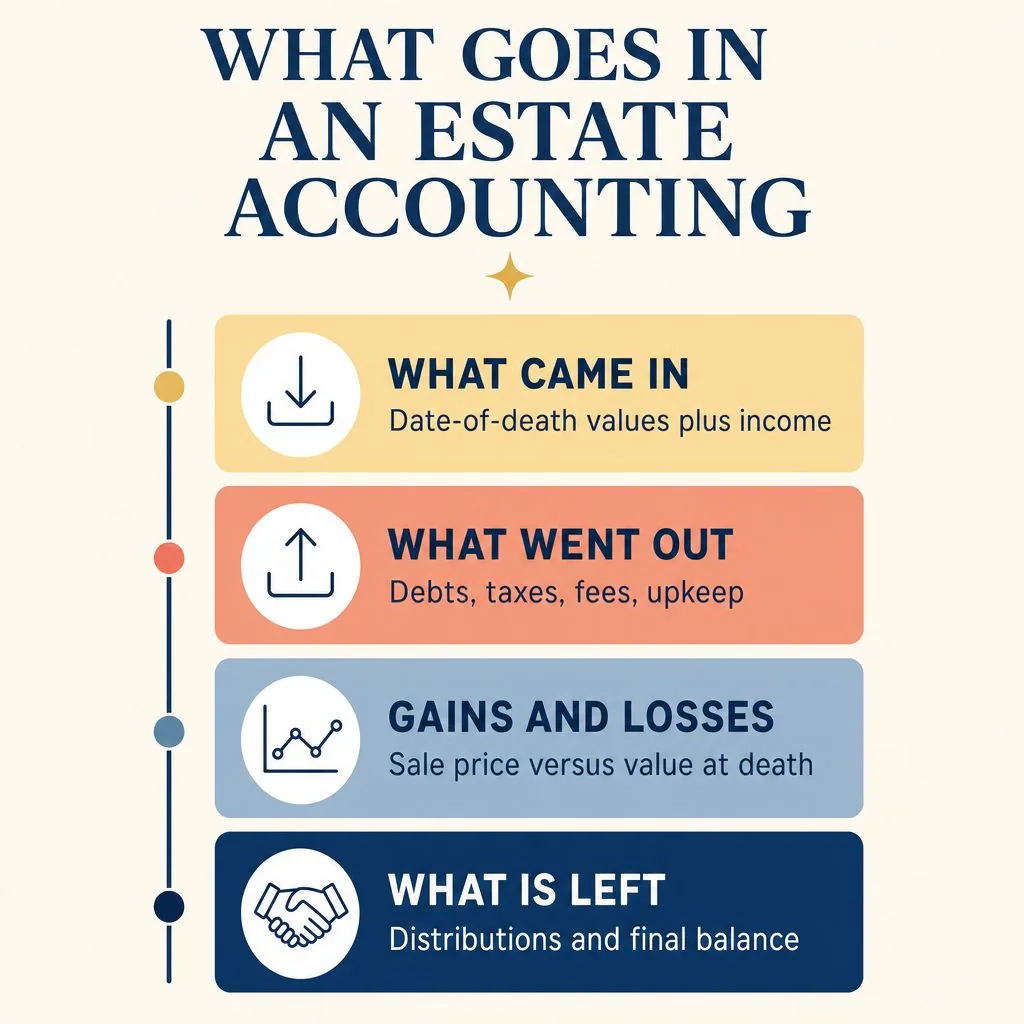
1. What came in
Start with the date-of-death value of every asset you took control of: bank and brokerage balances, real estate, vehicles, personal property, business interests. Use the value as of the date of death, not today's value. For accounts, that means the statement balance on that date. For real property and unusual assets, that means an appraisal.
Then add everything the estate received after death:
- Interest and dividends earned during administration
- Rent from estate-owned property
- Final paychecks, accrued vacation pay, and expense reimbursements
- Refunds, rebates, and tax refunds
- Life insurance or retirement money paid to the estate instead of a named beneficiary
- Recovered assets you found later, like unclaimed property or a forgotten account
Income earned during administration is the line executors forget most often. A brokerage account that paid $1,400 in dividends over eleven months has to show up.
2. What went out
Every dollar the estate paid, with a date, a payee, and a purpose:
- Funeral and burial costs
- Valid creditor claims and final bills
- Mortgage, insurance, utilities, and upkeep on estate property
- Court filing fees, publication costs, and bond premiums
- Attorney, accountant, and appraiser fees
- The deceased person's final income tax return, plus any estate income tax return
- Your own executor commission, if you take one
3. Gains and losses
When you sell an estate asset, the court wants to see the difference between the date-of-death value and what you actually got. A house valued at $340,000 that sold for $327,500 shows a $12,500 loss on sale. A stock position that appreciated before you liquidated it shows a gain. These are separate schedules in most formats, and skipping them is what usually breaks the math.
4. What is left and who received it
Distributions to each beneficiary, itemized by person and by asset, plus the remaining balance. Every distribution should be backed by a signed receipt from the person who got it.
How to keep records that survive review
Set this up in the first two weeks and the accounting takes an afternoon instead of a month.
Open an estate account and run everything through it. One estate bank account under the estate's own EIN becomes your ledger. Every deposit and every payment flows through it, so the bank statements are most of your accounting already. Never pay estate expenses from your personal account and reimburse yourself later without documentation, and never move estate money into a personal account for convenience. Commingling funds is the single fastest way to lose a judge's confidence.
Capture date-of-death values immediately. Request statements as of the date of death from every institution while you are already sending them the death certificate. Getting a historical statement in month eight is much harder.
Keep a receipt for everything, including small items. Mileage to the courthouse, certified copies, postage, the locksmith. These are reimbursable, but only with documentation.
Log transactions as they happen. A simple spreadsheet with date, payee, amount, category, and a note on why it was paid is enough. Reconstructing this later is where executors burn weeks.
Save the closing statements. Any real estate sale, vehicle transfer, or account liquidation produces paperwork that proves the number you reported.
Mistakes that get an accounting rejected
- The math does not close. Opening plus receipts minus payments has to equal the ending balance exactly. A missing $37 debit card charge means a rejection.
- Today's values instead of date-of-death values. Courts want the value at death, with gains and losses shown separately.
- Missing income. Interest, dividends, and rent during administration are estate receipts.
- Undocumented reimbursements. Paying yourself back is fine. Paying yourself back without a receipt looks like self-dealing.
- Paying yourself a commission before the court approves it. In many states executor compensation needs approval first.
- Distributing before creditor claims close. If you pay the heirs and a valid claim arrives during the claim window, the shortfall can land on you personally. Creditor rules vary by state.
- Vague descriptions. "Miscellaneous expenses, $2,300" invites a hearing. Itemize.
What beneficiaries are entitled to see
Beneficiaries and heirs have a right to an accounting in every state. The specific mechanism varies, but the pattern is consistent: if the executor will not produce one, an interested party can petition the court to compel it, and the court usually grants that request.
If you are the executor, get ahead of this. Send an informal statement of the estate's finances every few months, even a one-page summary. Most beneficiary disputes are really information disputes. Families who know where the money is rarely hire a lawyer to find out. Our guide to beneficiary rights covers the other side of this conversation.
Frequently asked questions
Do I need an accountant to prepare an estate accounting?
Usually no. For an estate with a few bank accounts, a house, and ordinary bills, a careful spreadsheet backed by statements and receipts is enough, and many courts publish a fill-in accounting form. Bring in a CPA when the estate holds a business, files its own income tax return, or has beneficiaries who are already in conflict.
How much does an estate accounting cost?
Nothing if you prepare it yourself beyond copying and filing fees. If an attorney or accountant prepares it, expect a few hundred to a few thousand dollars depending on the number of transactions, which comes out of estate funds. See our breakdown of what probate actually costs.
What if I made a mistake in the accounting?
Correct it and file an amended accounting. Honest errors that you disclose and fix are handled routinely. Errors a beneficiary discovers first are what turn into surcharge claims against the executor.
Can beneficiaries object to the accounting?
Yes. After you file, beneficiaries get a window to file written objections, often 30 days. The court then holds a hearing on the disputed items. If nobody objects, the court approves the accounting, and that approval protects you from later claims about the transactions it covers.
How long do I have to keep the records?
Keep everything for at least three years after the estate closes, and longer if a tax return is involved or a beneficiary was a minor. Court approval of your accounting is your protection, but the underlying receipts are what prove it.
Sunset can handle the ledger for you
Sunset helps families settle estates from start to finish, and record-keeping is built into every step. We find the accounts and assets you did not know existed, produce the probate paperwork your county requires, open an FDIC-insured estate account so every dollar moves through one place, and transfer the assets to the people who inherit them.
Because the money runs through a single estate account, the transaction history that becomes your accounting builds itself as you go. No reconstructing eleven months of activity the week before your court deadline.
More than 20,000 families have used Sunset. If you are an executor staring at a court deadline and a pile of statements, start with Sunset and let us put the numbers in order.
This article is informational and is not legal advice. Accounting requirements and deadlines vary by state and county. For guidance on a specific estate, consult an attorney licensed in your state.