States With Inheritance Tax (2026)
See states with inheritance tax in 2026, who pays, key exemptions by family relationship, and estate tax differences for heirs.
October 7, 2026
By Stephen Walter, Attorney and CEO
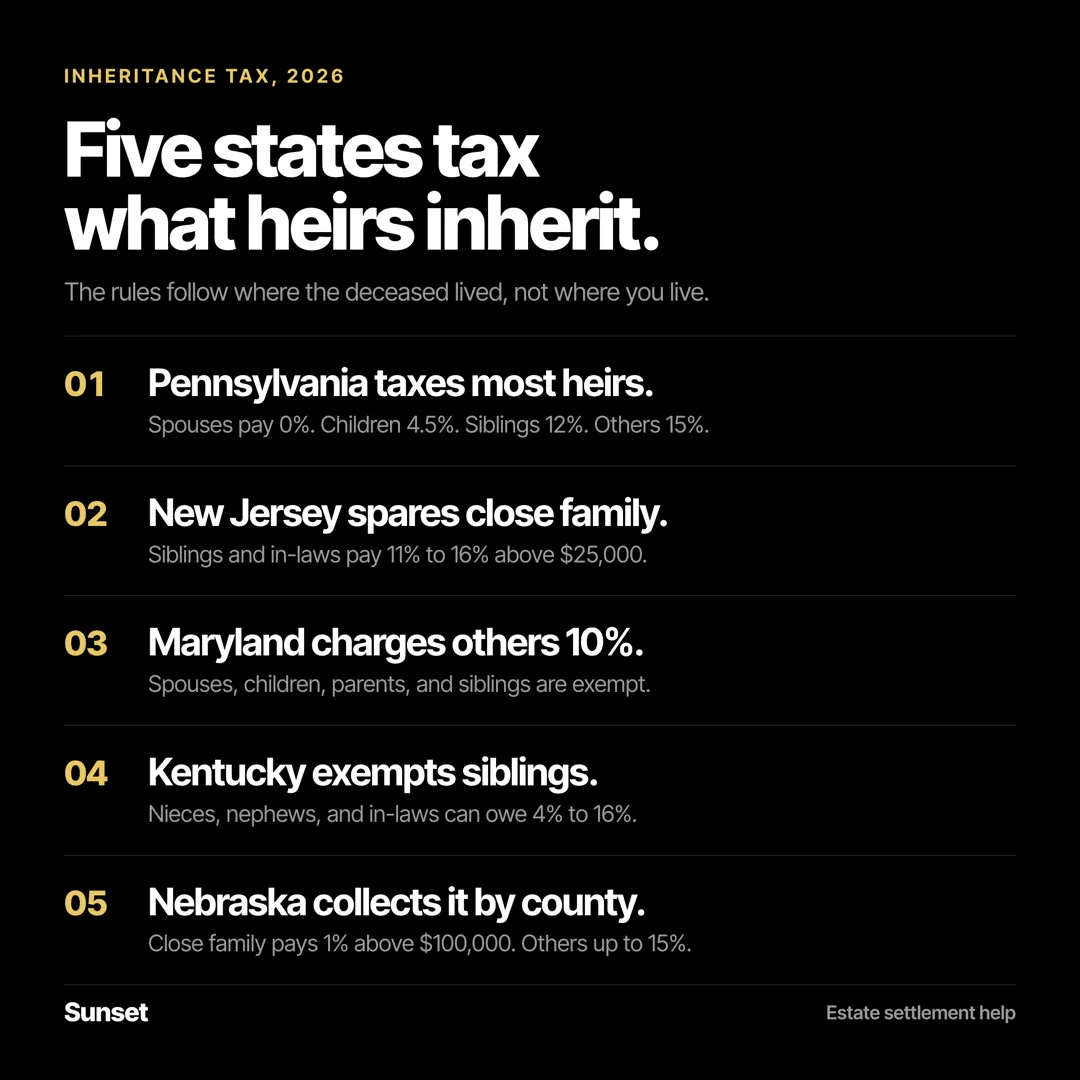
Only five states have an inheritance tax for deaths in 2026: Pennsylvania, New Jersey, Maryland, Kentucky, and Nebraska. Iowa used to be on many lists, but it fully repealed its inheritance tax for deaths on or after January 1, 2025.
If you are asking, do I pay tax on inheritance, the answer usually depends on where the person who died lived, where any real estate is located, and your relationship to that person. It usually does not depend on where you, the heir, live.
This guide is for heirs and beneficiaries trying to understand the basics. It is general information, not legal or tax advice. State rules change, and the right answer can depend on the estate facts, so check current state guidance or ask a probate attorney or tax professional before paying or filing.
Inheritance tax by state in 2026
Here are the states with inheritance tax for 2026 deaths, based on current rules.
| State | Who may owe inheritance tax | Basic rule |
|---|---|---|
| Pennsylvania | Many heirs, with lower rates for close family | Spouses and certain parent-child transfers are exempt. Rates rise by relationship distance. |
| New Jersey | Siblings, in-laws, and unrelated beneficiaries may owe | Close family is exempt. Other classes may owe tax above state exemptions. |
| Maryland | Most close family is exempt | Other beneficiaries generally pay 10%, with small inheritances exempt. |
| Kentucky | Nieces, nephews, extended family, in-laws, and others may owe | Close family is exempt. Other classes have small exemptions and graduated rates. |
| Nebraska | County-level inheritance tax | Spouses are exempt. Other heirs may owe based on relationship and exemption amount. |
Iowa is not included for 2026 deaths because the tax was repealed for deaths on or after January 1, 2025.
What is an inheritance tax?
An inheritance tax is a tax on the person who receives property from someone who died. That is different from an estate tax, which is paid by the estate before assets are distributed.
In simple terms:
- Inheritance tax asks, who received the property?
- Estate tax asks, how large is the estate?
- Income tax asks, did the heir or estate receive taxable income?
For many families, no inheritance tax is owed because the heir is a spouse, child, parent, sibling, or another exempt person under that state law. But the details vary a lot by state.
If you are also handling final income tax filings, that is a separate topic. Sunset has a guide to tax filings after a death that explains final individual returns, estate income tax returns, and common IRS issues.
The tax is usually based on the decedent, not the heir
A common question is: do I pay tax on inheritance if I live in a different state?
Usually, inheritance tax is tied to the state where the person who died was domiciled, meaning their legal home. It can also apply to real estate located in an inheritance tax state, even if the person lived elsewhere.
For example, if your aunt lived in Pennsylvania and left you cash, Pennsylvania inheritance tax rules may apply even if you live in Texas. If your uncle lived in Florida but owned a house in Nebraska, Nebraska inheritance tax rules may matter for that real estate.
Your own home state may still have other tax rules, but inheritance tax by state starts with the decedent and the property.
Pennsylvania inheritance tax
Pennsylvania taxes many inheritances, but the rate depends heavily on relationship.
Current Pennsylvania rules include:
- Spouse: 0%
- Child under 21 inheriting from a parent: 0%
- Parent inheriting from a child age 21 or younger: 0%
- Lineal heirs: 4.5%
- Siblings: 12%
- Others: 15%
Lineal heirs generally means children, grandchildren, parents, and grandparents, subject to the state definitions. Pennsylvania also offers a 5% discount if the tax is paid within 3 months. The return and tax are generally due 9 months after death.
Life insurance paid directly to a named beneficiary is generally exempt from inheritance tax in Pennsylvania and the other inheritance tax states discussed here. That can be very different from assets that pass through the probate estate.
New Jersey inheritance tax
New Jersey does not tax many close family inheritances, but it can tax inheritances to siblings, in-laws, unrelated people, and some others.
New Jersey uses beneficiary classes:
- Class A: exempt. This includes a spouse, civil union partner, domestic partner, children, stepchildren, grandchildren, parents, and grandparents.
- Class C: siblings and a son-in-law or daughter-in-law. Tax generally applies at 11% to 16% above a $25,000 exemption.
- Class D: other beneficiaries. Tax generally applies at 15% to 16%.
- Class E: charities and certain organizations. Exempt.
New Jersey is a good example of why relationship matters. A child may owe nothing on the same inheritance that creates tax for a friend or sibling.
If a beneficiary designation is involved, the named beneficiary may receive the asset outside probate. That does not always answer the tax question, but it can affect who receives the asset and how quickly. For more on beneficiary assets, see Sunset's guide to what happens when an ex-spouse is still the named beneficiary.
Maryland inheritance tax
Maryland has an inheritance tax and an estate tax. It is the only state with both.
For Maryland inheritance tax, many close relatives are exempt, including:
- Spouse
- Children
- Stepchildren
- Grandchildren
- Parents
- Grandparents
- Siblings
- Domestic partner
Other beneficiaries generally pay 10%. Amounts under $1,000 are exempt.
Because Maryland can involve both estate tax and inheritance tax, heirs may need help separating what the estate owes from what a beneficiary owes. This is one area where it can be wise to speak with a Maryland probate attorney or tax professional.
Kentucky inheritance tax
Kentucky divides beneficiaries into classes.
Class A beneficiaries are exempt. This includes a spouse, parent, child, stepchild, grandchild, and sibling.
Class B beneficiaries include nieces, nephews, aunts, uncles, in-laws, and great-grandchildren. They may owe 4% to 16% after a $1,000 exemption.
Class C beneficiaries include other beneficiaries. They may owe 6% to 16% after a $500 exemption.
For heirs, Kentucky can feel surprising because a sibling is exempt, but a niece or nephew may owe tax. That is why it helps to identify every beneficiary and relationship early in the estate settlement.
Nebraska inheritance tax
Nebraska has a county-level inheritance tax. This means the tax is handled through the county court system, and the county where the estate matter is handled can be part of the process.
Current Nebraska rules include:
- Spouse: exempt
- Immediate relatives: 1% above $100,000
- Remote relatives: 11% above $40,000
- Others: 15% above $25,000
Immediate relatives, remote relatives, and other beneficiaries are legal categories under Nebraska law. Do not assume that a person is in the lower category based only on how close the family felt. The legal relationship controls.
Inheritance tax versus estate tax
Inheritance tax and estate tax are often mixed together, but they are not the same.
An inheritance tax is based on the beneficiary. Two people can inherit from the same estate and have different tax results because one is exempt and the other is not.
An estate tax is based on the estate. If the estate is large enough to trigger tax, the estate pays before distributions.
Some states have estate taxes but no inheritance tax. Some have neither. Maryland has both. The federal government also has an estate tax, but that usually affects only very large estates.
Inheritance tax is also separate from capital gains tax. If you sell inherited property later, the stepped-up basis rules may matter. Sunset explains that topic here: Inherited property and capital gains: how the stepped-up basis works.
Assets that may be treated differently
Not every asset is handled the same way. Before anyone pays tax, the executor or family should make a list of assets and liabilities first.
Common items to review include:
- Bank and brokerage accounts
- Retirement accounts
- Real estate
- Vehicles
- Life insurance
- Personal property
- Debts and final bills
- Funeral expenses
Life insurance paid to a named beneficiary is generally exempt from inheritance tax in these states. Retirement accounts can have separate income tax rules for beneficiaries. Joint accounts and payable-on-death accounts may pass outside probate, but they still need to be reviewed under the state tax rules.
This is also why asset discovery matters. Sunset searches 2,300+ financial institutions to help families find accounts and assets that might otherwise be missed.
What heirs should do next
If you think an inheritance tax state may be involved, start with a few practical steps.
First, confirm the decedent's legal residence. Look at the home address, voter registration, tax filings, driver's license, and where the person intended to live.
Second, list any real estate and where it is located. Real estate can pull another state into the process.
Third, identify each beneficiary's relationship to the person who died. In inheritance tax states, the relationship can change the rate or remove the tax entirely.
Fourth, separate probate assets from assets with named beneficiaries. This helps the executor see what belongs in the probate process and what may transfer directly.
Fifth, check deadlines. Pennsylvania, for example, generally has a 9 month due date and a discount for early payment. Other states have their own forms and timing.
Sunset can help with the estate administration work around these steps. Sunset generates state- and county-specific probate packets, helps families organize assets and liabilities, supports an FDIC-insured estate account, and can refer families to a local probate attorney when counsel is needed. Sunset has helped 15,000+ families settle estates.
FAQ
What states have an inheritance tax in 2026?
The states with inheritance tax in 2026 are Pennsylvania, New Jersey, Maryland, Kentucky, and Nebraska. Iowa repealed its inheritance tax for deaths on or after January 1, 2025.
Do I pay tax on inheritance if I live in another state?
Your state of residence is usually not the main factor. Inheritance tax is usually based on where the person who died lived and where real estate is located. You may still need state-specific advice if more than one state is involved.
Is inheritance tax the same as estate tax?
No. Inheritance tax is paid by or tied to the beneficiary who receives property. Estate tax is paid by the estate based on the estate's value. Maryland is the only state that has both an estate tax and an inheritance tax.
Are children taxed on inheritance?
In many inheritance tax states, children are exempt or taxed at a lower rate. For example, New Jersey, Maryland, and Kentucky exempt children. Pennsylvania taxes most lineal heirs at 4.5%, with a 0% rate for a child under 21 inheriting from a parent.
Is life insurance subject to inheritance tax?
Life insurance paid directly to a named beneficiary is generally exempt from inheritance tax in these states. If the policy is payable to the estate or has no living beneficiary, the handling can be different.
How Sunset can help
Inheritance tax is only one part of settling an estate. Families often have to find accounts, gather debts, prepare probate forms, open an estate account, transfer assets, and answer questions from heirs at the same time.
Sunset can help you organize the work, search for assets, prepare probate paperwork for your state and county, and connect with a local probate attorney when you need legal guidance. Start with Sunset today.