Ancillary Probate: When You Need a Second Court (2026)
Ancillary probate is a second probate case in a state where the deceased owned property. Learn when it is required, what it costs, and how to handle it.
July 7, 2026
By Stephen Walter, Attorney and CEO
Ancillary probate is a second probate case opened in another state because the person who died owned property there. The main probate case happens in the state where they lived. But a court in that state has no power over land in a different state, so the vacation cabin, the rental condo, or the family farmland across the state line needs its own, smaller probate case in the state where it sits. That second case is called ancillary probate.
If you are the executor of an estate with out-of-state property, this guide walks through when ancillary probate is required, how the two cases fit together, what it costs, and the shortcuts that can make the second case faster and cheaper.
Why one probate case is not enough
Probate is handled at the state level, and each state's courts control the property inside its borders. When someone dies, the primary probate case, lawyers call it the domiciliary probate, opens in the county where the person legally lived. That court can pass along bank accounts, investment accounts, vehicles, and personal belongings no matter where the institutions happen to be located.
Real estate is different. A deed to Arizona land can only be changed by an Arizona court. If your mother lived in Illinois and owned a winter home in Scottsdale, the Illinois probate court can handle everything except that Scottsdale house. To sell it or transfer it to her heirs, you open an ancillary probate case in Arizona.
What property triggers ancillary probate
The most common trigger is real estate, but it is not the only one:
- Houses, condos, and land owned in the deceased person's name in another state
- Timeshares that are deeded real estate interests (many are, and they surprise a lot of executors)
- Mineral, oil, and gas rights, especially in states like Texas, Oklahoma, and North Dakota
- Livestock, equipment, or business property physically located and registered in another state
Property that usually does not trigger ancillary probate: bank and brokerage accounts held at out-of-state institutions, out-of-state life insurance, and anything that passes outside probate, like accounts with named beneficiaries, jointly owned property with survivorship rights, or property held in a living trust.
How ancillary probate works, step by step
The second case leans heavily on the first one. Here is the usual order of operations.
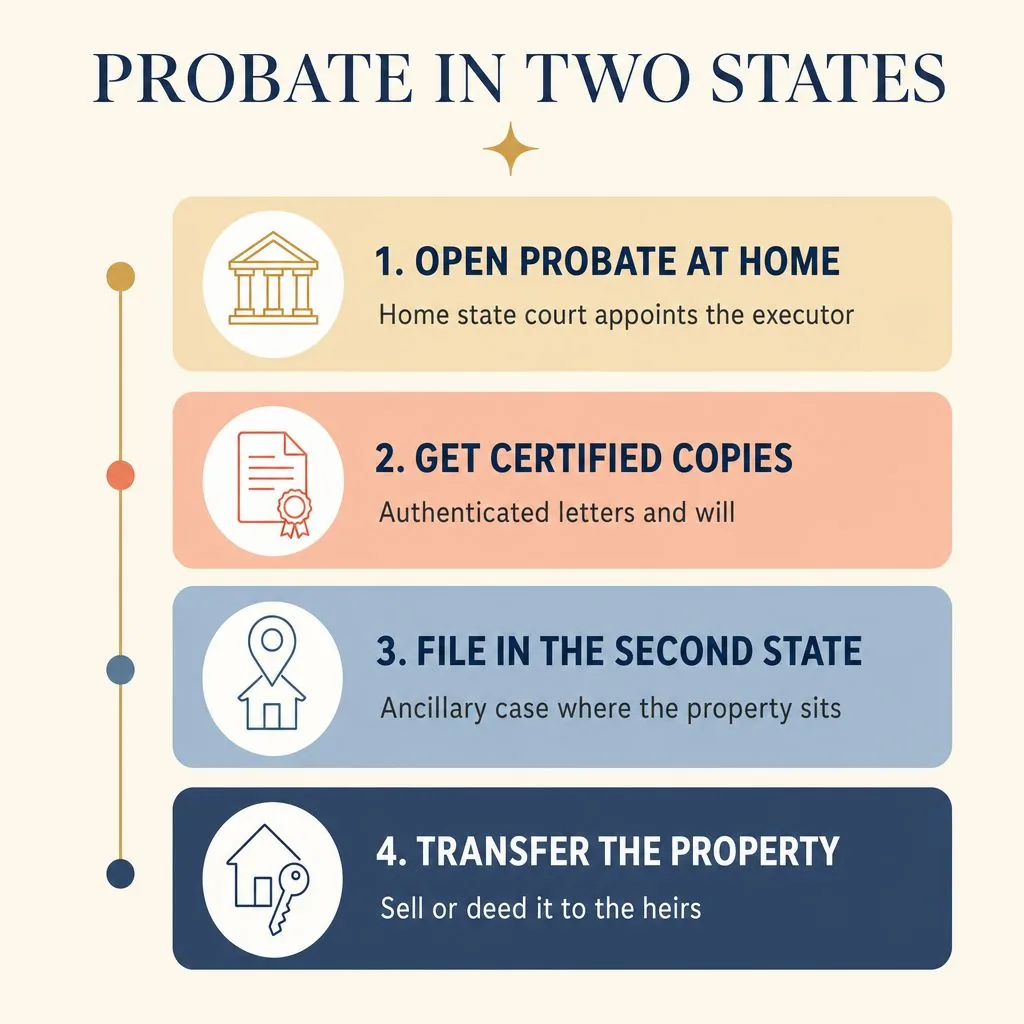
1. Open the primary probate case at home
Everything starts in the state where the person lived. The court there admits the will (if there is one), appoints the executor or administrator, and issues letters testamentary or letters of administration. If you are just getting started, our executor's first 30 days checklist covers this stage.
2. Get authenticated copies of the court papers
The out-of-state court will not accept plain photocopies. You will order authenticated copies, sometimes called exemplified copies, of the will, the order admitting it, and your letters from the home-state court clerk. These carry the certifications that let a second state rely on the first court's work. Expect a small per-document fee and a short wait.
3. File the ancillary case where the property sits
The ancillary petition is filed in the county where the property is located. Because the will has already been proven in the home state, most states accept it as a "foreign will" without making witnesses testify again. The second court then appoints a personal representative for the ancillary case. That is often the same executor, though a handful of states require a personal representative or agent who lives in-state, so check the local rule before you file.
4. Clear the property and close the case
Once appointed, the ancillary representative can sell the property or deed it to the heirs, pay any local debts such as property taxes or a contractor's lien, and file a short accounting. Sale proceeds usually flow back to the primary estate, where they are distributed with everything else. If the estate needs a dedicated place to hold those funds, an estate bank account keeps the money separate and the records clean.
Shortcuts: not every state makes you do full probate twice
The second case is usually simpler than the first, and many states offer a reduced process for out-of-state executors:
- Recording authenticated letters. States that follow the Uniform Probate Code often let a foreign executor file authenticated copies of their letters with the local court or land records, then act on the property without a full second case.
- Small estate procedures. If the out-of-state property is modest, it may fit under that state's small estate limit. Some states allow an affidavit or a short summary proceeding instead of a formal case. Our small estate affidavit guide lists the limits in all 50 states.
- Muniment of title (Texas). Texas can admit a will as a muniment of title, which transfers Texas real estate without appointing an executor at all. It is a popular route for out-of-state families who inherit Texas property.
Which shortcut applies depends entirely on the property state's law, so this is worth a call to the local probate clerk or a short consultation with a local attorney before filing the full package.
What ancillary probate costs and how long it takes
Plan on a second set of court filing fees (commonly $200 to $500), fees for authenticated copies, publication or notice costs, and often a second attorney licensed in the property state. Some states calculate attorney fees as a percentage of the property value, which can sting on a valuable home. All in, a straightforward ancillary case often runs $2,000 to $5,000 and adds 2 to 6 months, though it usually runs in parallel with the primary case instead of after it. For context on the primary case, see our guides to probate timelines and the true cost of probate.
The good news for heirs: the extra cost is paid by the estate, not out of anyone's pocket, and a well-run ancillary case rarely changes who inherits. It just adds paperwork and time.
Can you avoid ancillary probate?
For the executor of a current estate, usually not. If the deed is in the deceased person's sole name, the second case (or a statutory shortcut) is the only way to pass clean title. Where families can act is in advance, for their own property:
- A revocable living trust that holds the out-of-state property. Trust property skips probate in every state.
- A transfer-on-death deed, now available in more than half the states, which names who gets the property without probate.
- Joint ownership with right of survivorship, so the property passes to the co-owner automatically.
- Holding rental property in an LLC. LLC membership interests are personal property, which the home-state probate can handle.
If you are settling an estate now and wishing the deceased had done one of these, you are in good company. It is one of the most common lessons executors carry into their own planning.
How Sunset helps with multi-state estates
Sunset settles estates end to end, and multi-state estates are where the coordination burden really shows. Sunset searches thousands of institutions to find the deceased person's accounts and property, prepares probate paperwork for every state and county, provides a free FDIC-insured estate account to hold funds from both cases, and handles the transfers to heirs at the end. More than 20,000 families have used Sunset to settle an estate. If your estate involves property in more than one state, Sunset can keep both tracks moving at once.
Frequently asked questions
Do I need a lawyer in the second state?
Often yes, and sometimes it is required. Several states make out-of-state executors act through local counsel or appoint an in-state agent for service of process. Even where it is optional, a local attorney who files these regularly can be worth the fee. Ask the probate clerk in the property's county what the local practice is.
Does the will have to go through probate twice?
The will is proven once, in the home state. The ancillary court accepts the authenticated copy as a foreign will and generally will not re-try its validity. A contest over the will almost always belongs in the primary case.
What if there was no will?
Ancillary probate still works without a will, but with a wrinkle: the property state's intestacy law, not the home state's, typically decides who inherits real estate located there. In most families the two states' rules point to the same people, but blended families and unmarried partners should check both.
What happens if I just skip ancillary probate?
The property stays titled in the deceased person's name. No one can sell it, refinance it, or insure it properly, and property taxes keep coming due. The problem does not age well: heirs die, families scatter, and clearing title years later costs far more than doing the ancillary case now.
Does a small out-of-state property still need ancillary probate?
Maybe not a full case. If the value falls under the property state's small estate limit, an affidavit or summary proceeding may transfer it. Timeshares are the classic example, and some resort states have built simplified timeshare transfer procedures for exactly this reason.
Settling an estate with property in more than one state means twice the courts, but it does not have to mean twice the work for you. Get started with Sunset and let one team keep every state's paperwork on track.