How to Find Out if Someone Had a Will (2026)
Learn how to find out if someone had a will, where wills are kept after death, why the original matters, and what happens if none turns up.
September 23, 2026
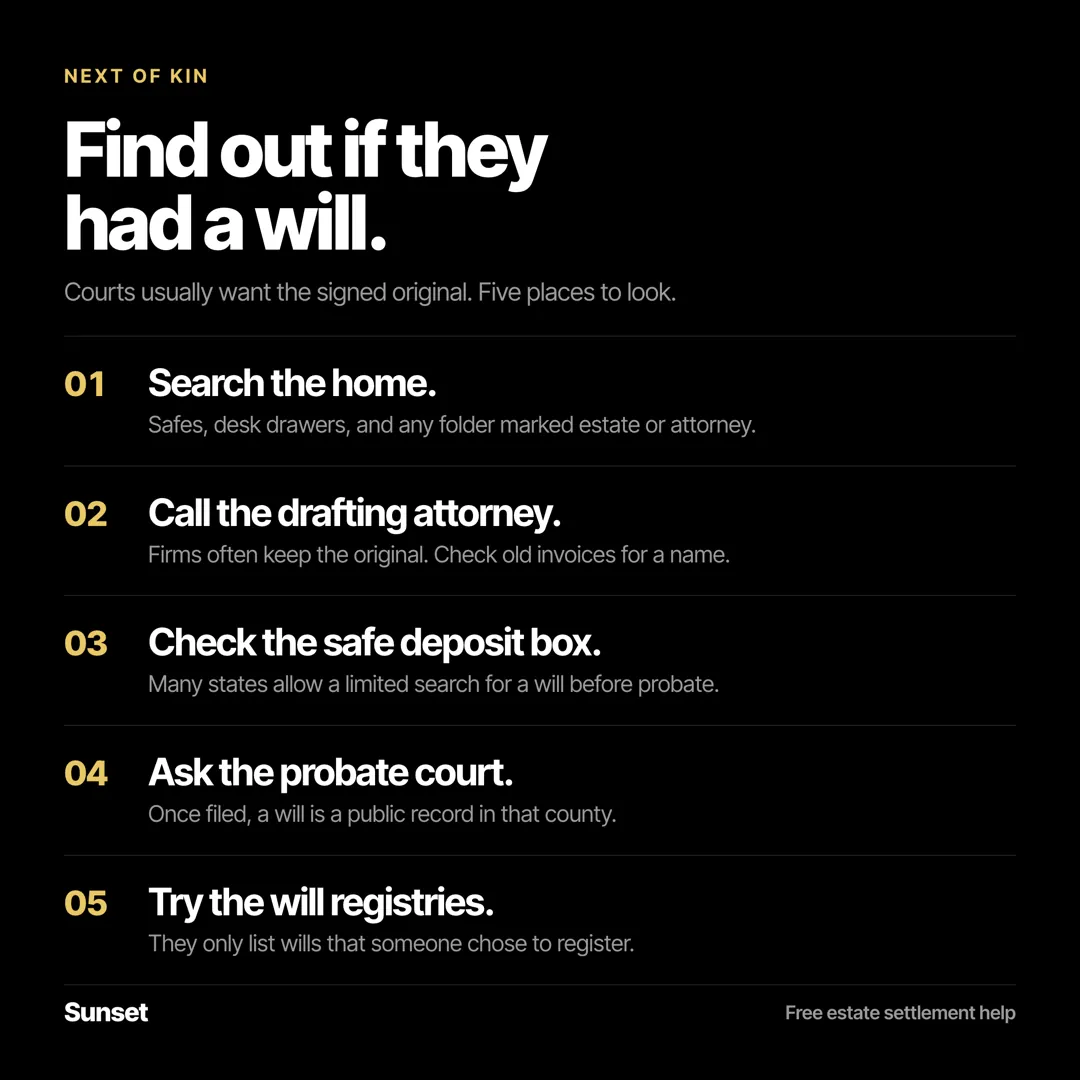
The fastest way to find out if someone had a will is to look for the original signed document, then check with the people and places most likely to have stored it: the home, the drafting attorney, a safe deposit box, local court records, and voluntary will registries. If a will was filed with probate court after death, it usually becomes a public court record.
This guide is general information, not legal advice. Rules vary by state and county, and some states require anyone holding a will to deliver it to the court after the person dies.
Why finding the will comes first
A will can name the executor, say who should inherit probate assets, name guardians for minor children, and give instructions for personal property. For next of kin, finding it early can prevent the wrong person from starting probate or distributing property based on assumptions.
The original matters because probate courts often want the signed paper document, not just a copy. A copy may help prove what the person intended, but it can raise extra questions. In many cases, the court may ask why the original is missing, whether it was destroyed on purpose, and whether the copy is valid under state law.
If you find what looks like a will, do not write on it, remove staples, add notes, or separate pages. Put it in a safe place, make a digital copy for reference, and ask the probate court or a local probate attorney what the next step is in that county.
Search the home carefully
Many families find a will at home, often in a place where other papers were kept. Look for both the original and clues about where the original might be stored.
Common places to check include:
- A home safe or lockbox
- A filing cabinet or desk drawer
- A folder marked estate, will, trust, taxes, attorney, or funeral
- A fireproof document bag
- A nightstand, closet shelf, or box of personal papers
- Tax files, since attorney letters or invoices may be nearby
- A computer folder, email account, or password manager with the attorney name
You may find a copy instead of the original. A copy can still be useful because it may show the name of the drafting attorney, witnesses, notary, date signed, or a prior address. It can also help you ask more targeted questions.
If several relatives are involved, it is wise to make a simple list of where you looked and who was present. This can reduce conflict later if someone asks whether a certain location was searched.
Ask the attorney who drafted it
If you find an attorney name, law firm letterhead, estate planning invoice, or business card, call the office and explain that the person has died. The attorney may ask for a death certificate, your identification, and your relationship to the person.
The attorney may be able to tell you whether the firm holds the original will, whether the document was sent home with the client, or whether another person is named as executor. Attorneys have duties of confidentiality, so they may not be able to answer every question on the phone. Still, they can often explain the process for releasing or filing the will.
If the attorney has retired, the state bar association, local bar association, or a successor law firm may be able to help you find where old client files went. If the attorney has died, another lawyer may have taken custody of files or arranged storage.
Check safe deposit boxes
Wills are often stored in safe deposit boxes. The hard part is that the box may be in the deceased person's name, and banks have their own access rules after a death.
Look for bank statements, keys, mailed rental notices, checkbook entries, or automatic payments that mention a safe deposit box. If you know the bank, call the branch and ask what documents are needed to search the box for a will. Some states allow a limited search for a will or burial instructions before a probate case is opened. Others require a court order or letters from the probate court.
Sunset has a separate guide on opening a deceased person's safe deposit box, including what banks may ask for and why access can take time.
Check the county probate court
A will may have been filed with the probate court before or after death, depending on state and county practice. Some courts allow a person to deposit a will for safekeeping during life. After death, many states require the person holding the will to deliver it to the court within a set time.
Start with the probate court in the county where the person lived at death. If they recently moved, also check the county where they lived before. If they owned real estate in another state, that county may become relevant later, but the first probate search usually begins with the county of residence.
Once a will is filed with the probate court, it is generally public. That means you may be able to search the court docket online or request a copy from the clerk. Some counties have online records. Others require a phone call, email, mailed form, or in-person visit.
When you contact the clerk, be ready with:
- The person's full legal name
- Date of death
- Last known address
- Possible prior names
- Your contact information
Court staff can usually explain filing procedures and record access, but they cannot give legal advice.
Search state and private will registries
If the home, attorney, bank, and court do not turn up a will, you can check registries. These can be helpful, but they have limits.
Some states have official will deposit systems or will registries. The format varies. In one state, the court may hold the original will. In another, a registry may list where the will is stored. Check the probate court website or state court website for the state where the person lived.
There are also private voluntary registries, including the US Will Registry. These services may list the location of a will or related estate planning documents if the person chose to register them. Registries do not contain every will. If a person never registered the will, the registry will not know it exists.
A registry result should be treated as a clue, not the final answer. You may still need to contact an attorney, court, bank, or named person to locate the signed original.
Ask family, close friends, and financial contacts
People sometimes tell one trusted person where the will is kept. Ask calmly and keep the question narrow: "Do you know whether they had a will, or where they kept legal papers?"
Good people to ask include:
- The person named as executor in a copy of the will
- A spouse, adult child, sibling, or close friend
- A financial advisor, tax preparer, or insurance agent
- A clergy member or funeral planner, if they helped with end-of-life planning
- A long-time caregiver, if they helped organize papers
Be careful with original documents. If someone else says they have the will, ask whether they will deliver it to the probate court or provide it to the person named as executor. In some states, holding back a will after death can cause legal problems.
What if you find only a copy?
A copy is better than no information, but it may not be enough by itself. Probate courts often prefer the original signed will because it reduces the risk of fraud and shows the document was not revoked.
If only a copy exists, the court may ask for evidence about what happened to the original. For example, was it kept by an attorney whose files were lost? Was it destroyed in a fire or flood? Did the deceased person keep it at home and later throw it away? State law controls how a copy can be used.
Do not assume a copy is useless. It may name the executor and beneficiaries, point to the attorney, and give the court a starting point. A local probate attorney can explain how your county handles a missing original.
What if no will turns up?
If no will is found after a reasonable search, the estate may be treated as intestate. Intestacy means state law decides who has priority to serve as personal representative and who inherits probate property.
This does not always mean the state gets everything. In most cases, spouses, children, parents, siblings, or other relatives inherit in an order set by law. The exact order depends on the state and family situation.
Sunset explains this in more detail in what happens if someone dies without a will. If you are still handling first steps, you may also want the broader checklist for what to do when someone dies.
Even without a will, you may still need to gather assets, list debts, notify institutions, and file probate forms. The estate settlement can take months, especially when accounts are hard to find or relatives disagree about who should act.
What to do after you find the will
Once you find the will, read the first pages for the executor or personal representative. That person usually has priority to start probate, though the court must still approve the appointment.
Next steps often include:
- Secure the original will
- Order certified copies of the death certificate
- Contact the probate court in the county of residence
- Find out whether the will must be filed by a deadline
- Identify probate assets and non-probate assets
- List known debts and recurring bills
- Avoid distributing property until you know who has authority
A will does not transfer every asset. Joint accounts, beneficiary accounts, life insurance, retirement accounts, and assets in a trust may pass outside the will. Probate usually deals with assets owned in the person's name alone, with no beneficiary or co-owner.
That is why many families start with an assets-and-liabilities view before making decisions. Knowing what exists, what is owed, and which assets pass outside probate can prevent delays.
How Sunset can help
Sunset helps families with the practical work after a death. While Sunset cannot promise to find a will, it can help you organize the estate work that often comes next.
Sunset searches 2,300+ financial institutions to help find accounts and assets. It generates state- and county-specific probate packets, and when legal counsel is needed, Sunset can refer families to a local probate attorney. Families can also use an FDIC-insured estate account to collect estate funds and make approved transfers.
Sunset has helped 15,000+ families settle estates. Sunset is free to families, paid through our bank partnership, so the estate does not pay Sunset and the assets go to the beneficiaries and heirs.
FAQ
How do I find a will after death?
Start at the person's home, then check with the drafting attorney, banks that may hold a safe deposit box, the county probate court, state will deposit systems, and voluntary registries. Ask close family and advisors whether they know where legal papers were kept.
Where are wills kept after someone dies?
Wills may be kept at home, in a safe deposit box, at an attorney's office, with the probate court, or with a trusted person. Some states allow wills to be deposited with a court during life. After death, some states require the holder to deliver the will to court.
Are wills public record?
A will is usually private while the person is alive. Once it is filed with the probate court after death, it generally becomes a public court record. Access rules and online search tools vary by county.
Can probate start if no will is found?
Yes. If no valid will is found, probate may proceed under the state's intestacy laws. The court can appoint a personal representative, and state law decides who inherits probate assets.
Is a copy of a will enough?
Sometimes, but the original is usually preferred. If only a copy is available, the court may ask for evidence about why the original is missing. A local probate attorney can explain what your county requires.
A careful search can save time later
Finding a will is part detective work and part paperwork. Begin with the home, attorney, bank, court, and registries, and keep a record of what you checked. If no will appears, the estate may still move forward under state intestacy rules.
If you are also trying to identify accounts, prepare probate forms, or understand what has to happen next, Sunset can help you get organized and move one step at a time.