Died With No Next of Kin: Who Inherits (2026)
When someone dies with no spouse, children, or parents, the law keeps looking. Here is the order of heirs, who settles the estate, and how to claim.
August 14, 2026

When someone dies without a spouse, children, or living parents, their estate does not go to the state right away. Every state has an intestate succession statute that keeps working outward through the family tree: siblings first, then nieces and nephews, then grandparents, then aunts, uncles, and cousins. The state only takes the money after a court is satisfied that no qualifying relative exists anywhere.
That is why a cousin you met twice at a wedding can turn out to be your legal heir. And it is why a letter from a company you have never heard of might land in your mailbox telling you that a relative died and you have money coming.
What "no next of kin" usually means
The phrase gets used loosely. A hospital, a landlord, or a county coroner says "no next of kin" when nobody answered the phone, when there is no emergency contact on file, or when the closest relatives are dead. Almost none of that is a legal finding.
Legally, someone has no next of kin only after a court-supervised search comes up empty. In practice, most estates that start out labeled this way end with an heir being found. People lose touch. Families scatter. A man who died alone in an apartment in Ohio can easily have a living niece in Oregon who never knew he was sick.
So if you have been told a relative died with no family, treat that as a starting point, not a conclusion.
The order the law follows
Intestate succession works in tiers. The law moves to the next tier only when the one above it is completely empty. Every living person in a tier shares before anyone below them gets a dollar.
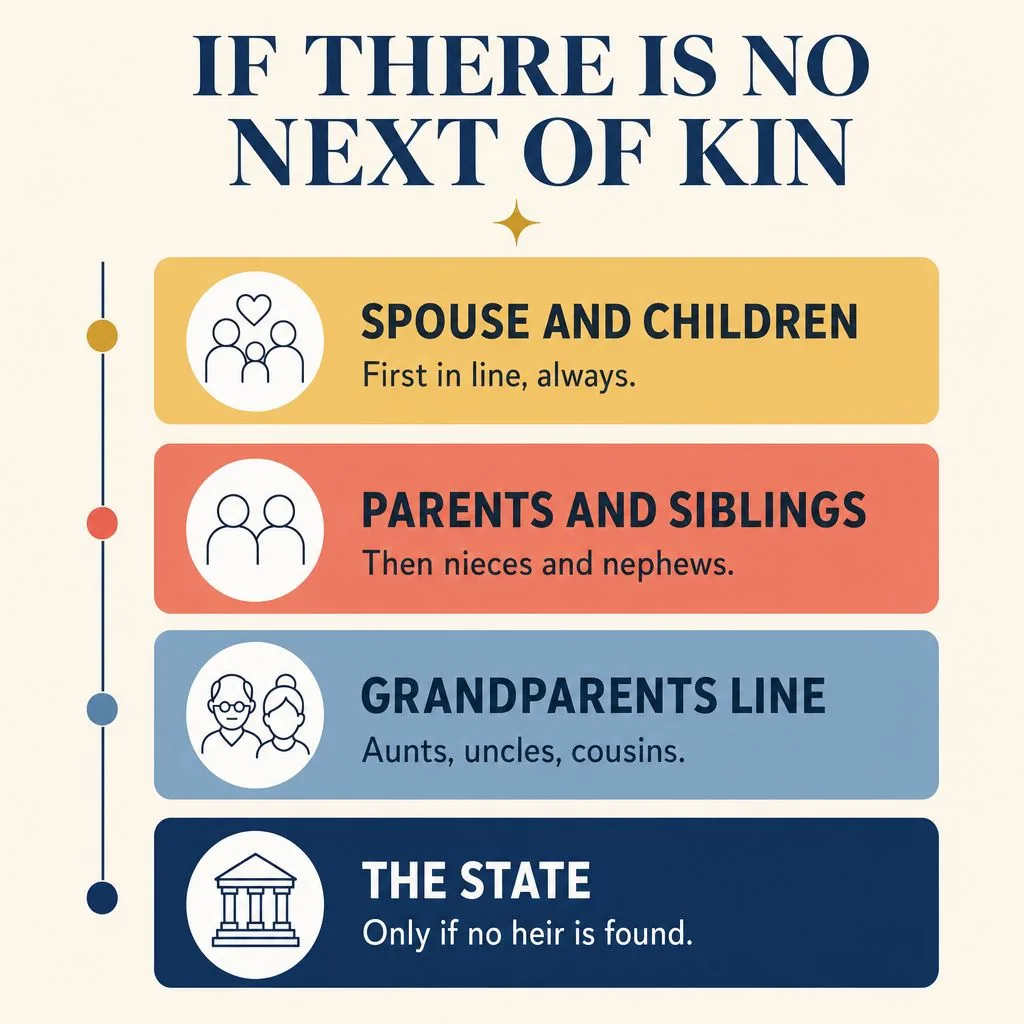
The general order in most states:
- Surviving spouse. Depending on the state, a spouse takes everything or splits with the decedent's children or parents.
- Children and their descendants. If a child died first, that child's own children usually step into their share.
- Parents. If no spouse and no descendants survive, the estate goes up a generation.
- Siblings and their descendants. This is where nieces and nephews enter, and where a lot of no-spouse, no-children estates land.
- Grandparents and their descendants. Aunts, uncles, and first cousins inherit through this branch.
Two details surprise people here. Half-siblings inherit in most states, often on equal footing with full siblings. And a legally adopted child inherits from the adoptive family exactly like a biological child, while a stepchild who was never adopted usually inherits nothing under intestacy.
Where the search stops
There is a limit. States that follow the Uniform Probate Code cut off eligibility at a grandparent or a descendant of a grandparent. Under that rule, first cousins can inherit but second cousins and great-aunts generally cannot, no matter how well documented the relationship is.
Estate lawyers call the relatives past that line "laughing heirs," people so distant they would collect a windfall from someone they never knew existed and feel no loss at all. Not every state draws the line in the same place. Some reach further out, and a few keep going until any blood relative is found. The controlling law is the law of the state where the person lived when they died.
Who settles the estate when nobody steps forward
A death does not open a probate case. A person does, by petitioning the court. When there is no obvious family member to file, the case sits, and bills, taxes, and property keep needing attention.
Most counties have a public administrator, sometimes housed in the treasurer's or coroner's office, sometimes a private attorney appointed by the court. This office handles estates where the decedent had no known heirs, or where the heirs are known but nobody is willing or able to serve. The public administrator secures the home, inventories the assets, pays the creditors, and runs the heir search.
A creditor can also petition to open the estate. So can a person holding the decedent's property. If you are a distant relative who wants a say, you can petition too, though a closer relative always outranks you in the priority list to serve as administrator.
Public administrator offices are usually stretched thin and paid out of the estate. That combination is worth knowing about, because an estate handled this way tends to move slowly and cost more than one a family member handles.
How heir search firms find you first
Heir search firms, also called forensic genealogists or heir hunters, read probate dockets looking for estates with missing heirs. They trace the family tree, find you before the court does, and offer to tell you what you have inherited in exchange for a cut.
Their contract usually asks for a percentage of whatever you receive, often somewhere between 10 and 40 percent. The letter frequently does not name the decedent, because the name is the whole product.
None of this is a scam by itself. Good heir search firms do real work and find people the court never would. But the pressure to sign fast is the part to resist. A few things to do before you sign anything:
- Ask which court and which case number. A legitimate firm will eventually have to file your claim in a specific probate court, and that court's docket is public.
- Search the probate records yourself. If a relative you have lost touch with recently died, check the probate court in the county where they lived. Many counties post dockets online at no cost.
- Check your state's rules on these agreements. California, for one, requires the written agreement to be filed with the probate court and lets the judge review whether the fee is reasonable. Other states have their own limits.
- Take your time. The estate is not going anywhere while probate runs, and no legitimate offer expires in 48 hours.
If you can identify the estate on your own, you can file your own claim of heirship and keep the entire inheritance.
What happens if no heir is ever found
Two different things get called escheat, and the difference matters.
Ordinary unclaimed property, a dormant bank account or an uncashed insurance check turned over to the state, is held by the state as a custodian. Most states will pay it out to the owner or the owner's heirs whenever they show up, with no deadline. That is why a search of your state's unclaimed property database can turn up money from a relative who died 20 years ago.
True escheat, where a probate court closes an intestate estate with no heirs and the assets pass to the state, is stricter. The property becomes state property, and states set their own window for a late-arriving heir to come forward. Some allow several years, some far less. A 2025 Ohio budget provision converting long-held unclaimed property to outright state ownership drew a legal challenge almost immediately, so this area is actively changing.
The practical takeaway: an intestate estate that closes with no heir is not a piggy bank you can raid a decade later. If you have any reason to think you are related to someone who died alone, look now.
If you think you might be the heir
The burden is on you to prove the connection, in a form a court and a bank will accept.
- Confirm the death and the county. A certified death certificate and the county of residence tell you which probate court has the case.
- Check the probate docket. Find out whether an estate is already open and who was appointed.
- Build the paper chain. Birth certificates, marriage certificates, and death certificates that connect you to the decedent through each generation. An affidavit of kinship covers the gaps where a record is missing or a name changed.
- Find out what is actually there. Distant heirs almost never know what the person owned. Bank accounts, a life insurance policy with a lapsed beneficiary, a pension, a house, unclaimed property already sitting with the state. Our guide to finding a deceased person's assets walks through where to look.
- Petition to be appointed, if no one else has. A court will not hand you anything on the strength of a family story.
Step four is where these estates fall apart. When the person who died was a cousin or a great-uncle, there is no drawer of statements to go through and no surviving spouse who knows where the money was. Sunset was built for exactly that problem. We search for accounts, policies, and unclaimed property across thousands of institutions, produce the probate paperwork for all 50 states, open an FDIC-insured estate account so the money has somewhere safe to land, and handle the transfers. More than 15,000 families have used it, and it is free to families.
Frequently asked questions
What happens if someone dies with no family and no will?
The estate still goes through probate. A public administrator or another interested party opens the case, a heir search is conducted, and the assets pass to the closest qualifying relative under state law. Only if that search fails does the property go to the state.
Do cousins inherit if there are no closer relatives?
Usually yes. First cousins descend from a shared grandparent, which puts them inside the eligibility line in most states. Second cousins and more distant relatives often fall outside it.
Who pays for the funeral when there is no next of kin?
The estate pays if it has assets, and funeral costs generally have high priority among the bills. If the estate has nothing and no family claims the body, the county handles the burial or cremation at public expense.
Am I responsible for a distant relative's debts if I inherit?
No. You do not inherit debt personally. The debts get paid out of the estate before anything is distributed, so a heavily indebted estate may simply leave you nothing.
How long do I have to claim an inheritance from a relative I never knew?
It depends on what the money is and where it is. Unclaimed property held by a state can generally be claimed with no deadline. Assets that escheated through a closed probate case are subject to a state-specific window that can run out. Do not wait to find out which one applies.
Can I refuse to be the administrator but still inherit?
Yes. Serving as administrator and inheriting are separate. You can decline the appointment, let the public administrator or another relative serve, and still receive your share.
Getting help with an estate nobody expected
Being the heir to someone you barely knew is a strange position. You are handed a legal obligation, a stack of proof requirements, and no knowledge of what the person actually owned.
Sunset handles the work end to end: finding the assets, producing the court paperwork, opening the estate account, and closing the accounts down. Free to families, in all 50 states.