Letters Testamentary vs Administration (2026)
Letters testamentary prove estate authority. Learn how executors get court letters, certified copies, and bank acceptance steps.
November 24, 2026
By Stephen Walter, Attorney and CEO
Letters testamentary are court papers proving that an executor has legal authority to act for an estate. Letters of administration do the same job for an administrator, usually when there is no will or when the named executor cannot or will not serve.
Banks, brokerages, transfer agents, county offices, and the IRS often ask for these letters before they will discuss accounts, release funds, issue tax information, or let someone sign for the estate. This article explains what the letters are, how to get letters testamentary, why certified copies matter, and what to do if an institution rejects them. This is general information, not legal advice.
The short answer: what these letters prove
A will can name an executor, but the will by itself usually does not give that person power over estate property. The probate court must admit the will, appoint the executor, and issue letters testamentary.
If there is no will, the court appoints an administrator under state law. The court then issues letters of administration. Both documents tell third parties that the court has given someone authority to act for the estate.
The wording can feel confusing because states use different names. Depending on where the case is filed, you may see:
- Letters testamentary
- Letters of administration
- Letters of authority
- Letters of office
- Letters of appointment
- Letters for personal representative
The role name can also change. Some states use "executor" and "administrator." Others use "personal representative" for both.
Letters testamentary vs letters of administration
The key difference is usually whether there is a will and whether the named executor is serving.
| Document | When it is used | Who receives it |
|---|---|---|
| Letters testamentary | There is a valid will, and the court appoints the executor named in the will | Executor |
| Letters of administration | There is no will, or the named executor cannot serve, will not serve, or is not appointed | Administrator |
| Letters of authority or office | State-specific name for the same type of court appointment paper | Personal representative, executor, or administrator |
In everyday estate settlement, institutions care less about the label and more about the authority. They want to see a current court-issued document showing the case number, the estate name, the appointed person, and any limits on that person's powers.
What letters say
There is no national letters form. Each state and county may use its own format, and even courts in the same state may issue letters that look different.
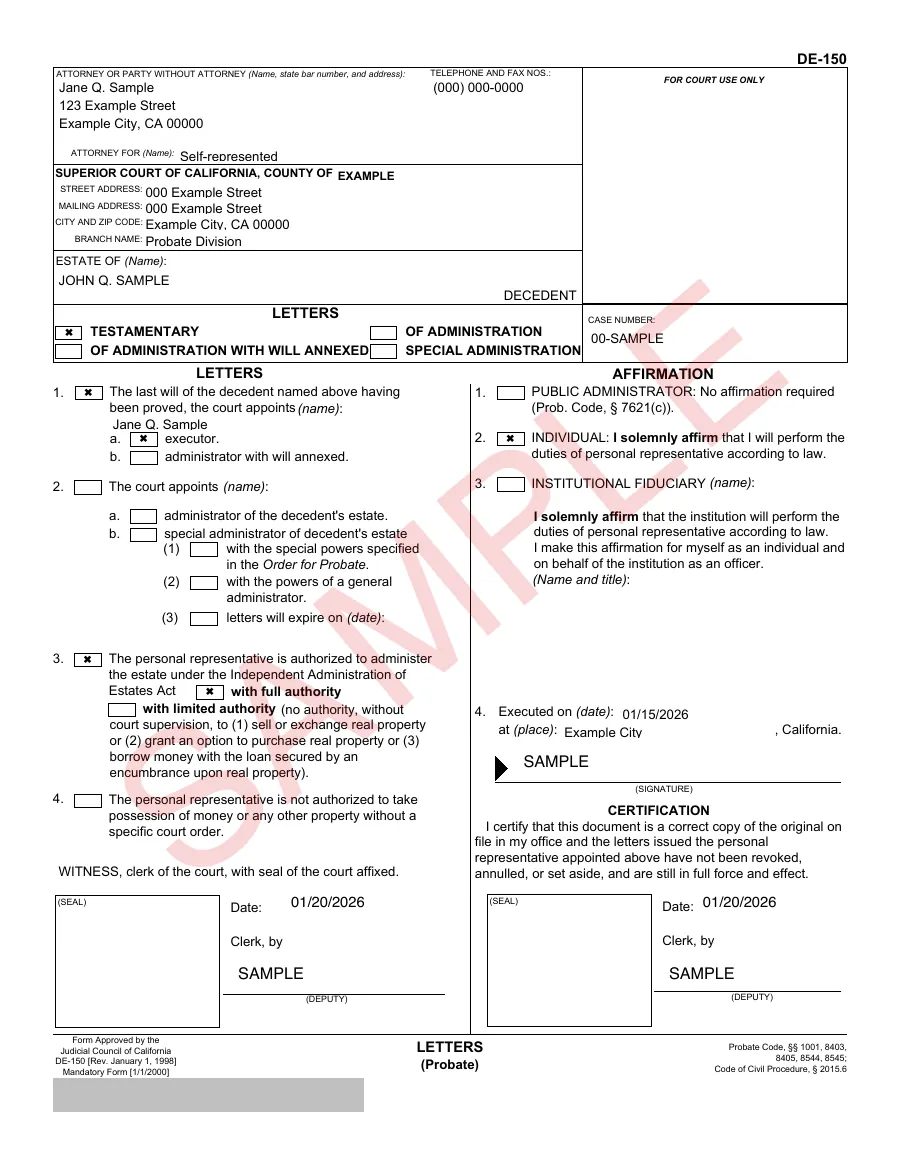

Most letters include:
- The court name and county
- The estate name, often "Estate of" the person who died
- The probate case number
- The appointed person's name and title
- The date of appointment
- Whether the authority is full or limited
- The clerk's seal or court certification
- Sometimes, an expiration date or bond information
If the court limits the executor's authority, the letters may say that court approval is needed before selling real estate, making certain distributions, or taking other actions. Institutions may read those limits closely.
How to get letters testamentary
The process varies by state and county, but the usual path has the same core steps.
- File a probate petition. The person asking to serve files a petition in the correct probate court. If there is a will, the original will is usually filed with the court. The right court is usually in the county where the deceased lived at death, though real estate in another state can add steps. Sunset has a guide on which county to file probate in.
- Give required notice. Heirs, beneficiaries, and sometimes creditors may need notice of the filing. The rules depend on state law and local court practice.
- Attend a hearing or receive an informal appointment. Some courts set a hearing before appointing the executor or administrator. Other courts allow a no-hearing informal appointment if the paperwork is complete and no one objects.
- Sign an oath or acceptance. The appointed person often signs an oath promising to follow the law and carry out executor duties.
- Post bond if required. A bond is a type of insurance for the estate. The will may waive bond, or the court may require it. Some states require bond unless all interested parties waive it.
- Receive the letters. After appointment, oath, and any required bond, the clerk issues letters testamentary, letters of administration, or the state's version of the document.
Sunset can help prepare state- and county-specific probate packets for many estates. Learn more about how Sunset builds probate papers by county.
Certified copies vs photocopies
A certified copy of letters testamentary is a copy issued or certified by the court clerk. It usually has a raised seal, stamp, certification page, electronic certification, or other court mark showing it is official.
A photocopy or scanned PDF may be useful for your records, but many institutions will not accept it. Banks and brokerages often need a certified copy because they are relying on the court's appointment before allowing access to money or account information.
Order several certified copies when the letters are first issued. Executors often need them for:
- Banks and credit unions
- Brokerage firms and transfer agents
- Life insurance companies
- The IRS and state tax agencies
- County recorders or tax offices
- Motor vehicle offices
- Estate account setup
Certified copies usually cost a few dollars to around $25 each, depending on the county and whether there is an added certification fee. Some courts charge per page plus a certification charge.
How long are letters testamentary good for?
In many states, letters testamentary remain valid until the court revokes them, replaces the executor, or closes the estate. Even so, banks and other institutions often ask for certified copies issued recently.
A common request is a certified copy issued within the last 60 days. Some institutions accept 90 days. Others may allow 6 months. The rule is usually the institution's internal policy, not the same as the court's legal rule.
For that reason, it can help to order a few certified copies at the start, then reorder later if a bank, brokerage, or title company wants a fresher copy. Ask the clerk whether the court can mail new certified copies or whether you must request them in person or through an online portal.
What if a bank rejects the letters?
If a bank rejects letters testamentary or letters of administration, ask for the reason in writing or ask what exact document is missing. The problem may be fixable.
Common reasons include:
- The copy is not certified by the court
- The certified copy is too old under the bank's policy
- The name on the letters does not match the executor's ID
- The estate name or case number is missing from the bank's file
- The letters show limited authority
- The bank also needs a death certificate, EIN letter, W-9, or its own estate form
- The account has a beneficiary or transfer-on-death designation, so it may not be controlled by probate
If the bank says a will is enough, or says a will is not enough, the next step depends on the account and the bank's policy. Sunset explains the common issue in why a bank will not accept a will that has not been probated.
If the front-line branch employee is unsure, ask for the estate department, deceased customer department, or legal processing team. Send a certified copy only when the institution requires it, and ask whether it will be returned.
When a small estate affidavit avoids letters
Some estates do not need letters at all. Many states offer a small estate affidavit or small estate procedure when the probate property is below a state limit and other requirements are met.
A small estate affidavit can let an heir or successor collect certain property without a full probate appointment. If accepted, it may replace the need for letters testamentary or letters of administration for that asset.
Small estate rules vary widely. Some states exclude real estate. Some require a waiting period after death. Some require court filing, while others allow an affidavit to be presented directly to the institution. Sunset has a guide to small estate affidavits that explains the general idea.
How letters fit into executor duties
Letters are often one of the first papers an executor needs because they open doors to asset and debt information. Once appointed, the executor may need to identify accounts, protect estate property, pay valid estate bills, file tax forms, and distribute what remains when the estate is ready.
A practical order is to list assets and liabilities first. This helps the executor see whether the estate likely needs full probate, a small estate process, or attorney help. It also helps prevent early distributions before debts, taxes, and expenses are known.
Sunset searches 2,500+ financial institutions to help find accounts and assets, generates probate packets by state and county, offers an FDIC-insured estate account, and helps with transfers as the estate moves forward. When attorney help is needed, Sunset can refer families to a local probate attorney. Sunset has helped more than 20,000 families settle estates.
Any Sunset fee counts as an estate administration expense the executor can reimburse from the estate.
FAQ
Are letters testamentary the same as a will?
No. A will says who the deceased chose as executor and who should receive property. Letters testamentary are issued by the probate court after the court appoints the executor. Many banks will not act on a will alone.
Can I get letters testamentary without probate?
Usually no. Letters testamentary are a probate court document. If the estate qualifies for a small estate affidavit or another non-probate process, you may be able to collect property without letters, but that is a different procedure.
Who can get letters of administration?
State law sets the priority. A surviving spouse, adult child, parent, sibling, or another interested person may have priority, depending on the family situation and the state. If people disagree, the court decides who will be appointed.
Do I need a certified copy of letters testamentary for every bank?
Often, yes. Some institutions will accept a scanned certified copy for review but still require the original certified copy before releasing funds. Ask each institution whether it needs to keep the certified copy or only inspect it.
What are letters of authority?
Letters of authority are another state's name for the court paper proving that a personal representative can act for the estate. The document may serve the same practical purpose as letters testamentary or letters of administration.
Get help with the paperwork
Letters are one of the main documents that let an executor move from being named in a will to being recognized by banks, brokerages, tax agencies, and other institutions. The right document, in certified form, can save repeated calls and rejected requests.
Sunset can help you identify what probate paperwork may be needed in the right county, search for financial accounts, and keep estate settlement tasks organized from the first filings through account transfers. Start with Sunset when you are ready to work through the next step.