9 Types of Hidden Assets Most Families Forget to Look For After a Death (2026)
Find 9 types of hidden assets after death most families miss. From forgotten 401(k)s to crypto wallets, learn where to search in 2026.
June 4, 2026
By Stephen Walter, Attorney and CEO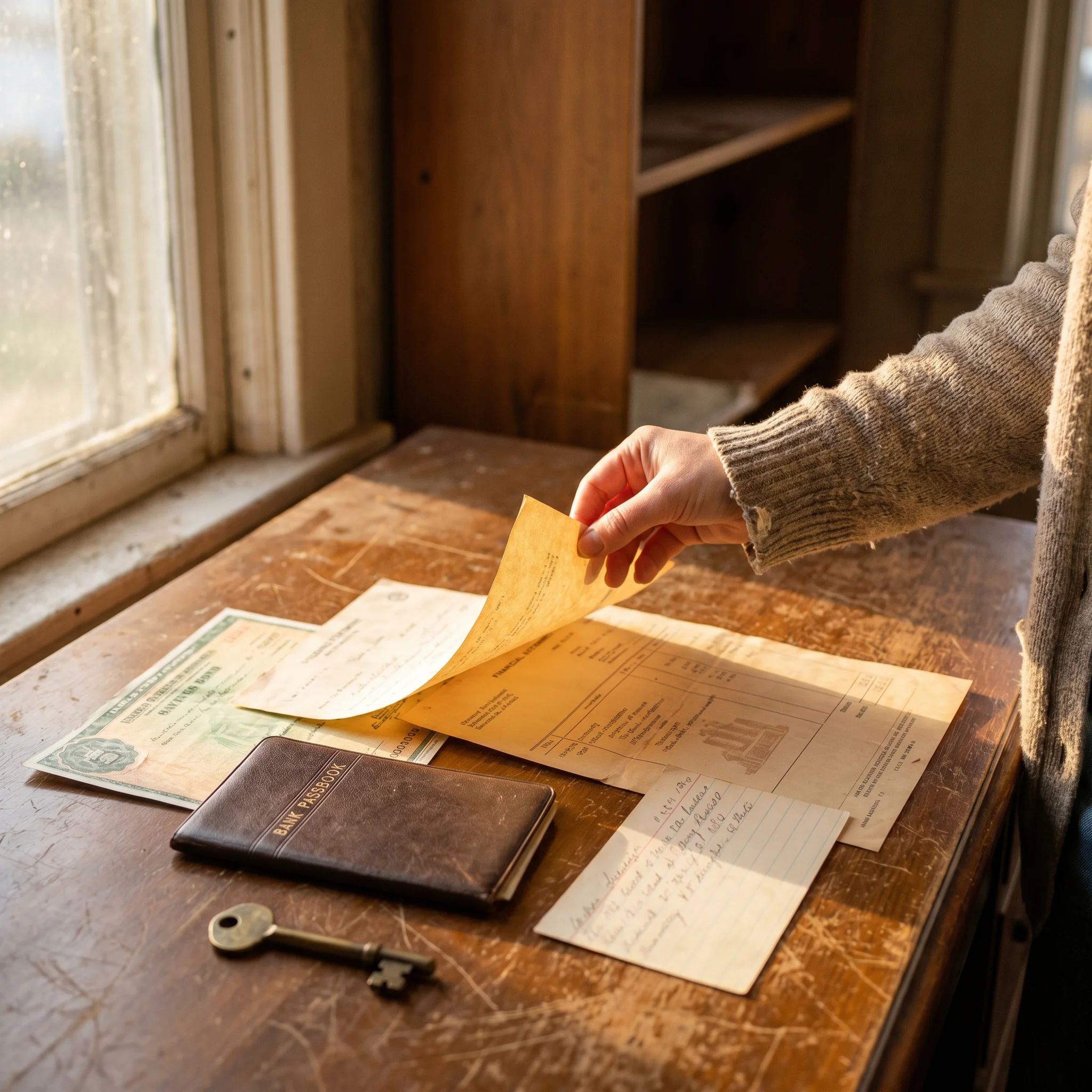
Most people think they know what accounts their parents or spouse had. Then someone dies, and you start digging, and you realize how much was never mentioned. A 401(k) from three jobs ago, a life insurance policy that predates email, a bank account opened in a different state, or Bitcoin bought in 2015 and never discussed again. The hidden assets deceased person owned don't send reminder letters or show up in probate automatically. You have to go looking, and if you don't know the nine places families forget to check, you'll miss something.
TLDR:
- Over 90% of bank statements are paperless, and there's no central U.S. registry for accounts.
- $1 billion in life insurance and $80 billion in unclaimed property sit waiting to be claimed.
- Check old tax returns, credit reports, and county property records to find hidden assets.
- Crypto held in private wallets is lost forever without the seed phrase or recovery key.
- Sunset searches 2,500+ financial institutions and all 50 state registries automatically.
Bank Accounts Without Beneficiaries
Bank accounts are the obvious first place to look after a death, which is partly why they get missed. Most people expect a statement in the mail, but over 90% of bank and investment statements are now paperless, leaving survivors to guess which institutions the deceased even used.
There's no central registry for bank accounts in the U.S. If your father quietly opened a savings account at a credit union in 1994 and never mentioned it, that money can sit there indefinitely. Banks also mark statements "do not forward," so even mail forwarding won't surface bank accounts. Without a paper trail or account login, families are essentially searching blind.
Forgotten Retirement Accounts and Old 401(k)s
People change jobs an average of 12 times over their careers, and a forgotten 401(k) or pension gets left behind at nearly every stop. These accounts don't disappear — they just sit unclaimed, sometimes for decades, waiting for someone to ask about them.
Start by checking the deceased's old tax returns and W-2s for employer names. Each former employer's HR department can confirm whether a retirement account exists. The National Registry of Unclaimed Retirement Benefits is a free searchable database worth checking as well.
Unclaimed Life Insurance Policies
Many families never think to search for life insurance policies their relative held, and the numbers behind this gap are striking. An estimated $1 billion in life insurance benefits goes unclaimed every year in the United States, often because beneficiaries simply didn't know a policy existed.
Where to start looking
A few reliable paths can turn up policies that might otherwise stay buried:
- Check the deceased's bank and credit card statements for premium payments to an insurance company, since recurring small charges are often the first clue a policy exists.
- Contact the state's unclaimed property office, as insurers are required to transfer unclaimed death benefits to the state after a set dormancy period.
- Use the NAIC Life Insurance Policy Locator, which searches participating insurers directly, though it only responds when a match is found and runs on roughly a 90-day timeline.
Cryptocurrency and Digital Wallets
Cryptocurrency sits in its own category. Bank accounts can be found through financial databases; crypto held in a private wallet is invisible to anyone but the keyholder. Lose the private key, and the funds are gone permanently, regardless of what any probate court orders.

The numbers here are sobering. An estimated 4 million Bitcoins are permanently inaccessible due to owner deaths and missing private keys, worth more than $240 billion.
If the deceased used an exchange like Coinbase or Kraken, a standard claim process is available. As of tax year 2025, crypto exchanges must report proceeds on Form 1099-DA, meaning executors who sell or transfer crypto from an estate should expect these forms. Self-custody wallets are harder; search their devices and password managers for a seed phrase or recovery key before assuming the funds are gone.
Unclaimed Property Held by States
When a financial account or payout goes uncollected long enough, the institution is required to hand it over to the state. This process is called escheatment, and it happens across a wider range of assets than most people realize. Roughly $80 billion in unclaimed assets currently sit in state databases waiting to be claimed by rightful owners.

Uncashed checks, utility and rental deposits, unpaid wages, insurance proceeds, and gift cards can all end up there. Every state runs a searchable unclaimed property database, and MissingMoney.com lets you search multiple states at once for free. If the deceased lived in more than one state over their lifetime, search each of them.
Business Ownership and LLC Interests
When a deceased person owned a business, their stake in it is often one of the most valuable assets in the estate and one of the easiest to overlook. Sole proprietorships, partnership shares, and LLC membership interests don't always show up in obvious places like bank statements or brokerage accounts.
Start by searching state business registries, where LLC formations and ownership records are often publicly available. Old tax returns are especially useful here, since Schedule K-1 forms show business income passed through to the owner each year.
If the deceased had a business partner, that relationship may also trigger a buy-sell agreement, which can mean the estate is entitled to a payout.
Real Estate in Multiple States and Investment Properties
Many families assume they know which properties a deceased person owned, but the reality is more complicated. A vacation home purchased decades ago, a rental property in another state, or a small parcel of inherited land can all slip through the cracks during estate settlement.
Where to look
County property records in every state where the deceased lived, worked, or vacationed are a good starting point. Each county maintains its own deed registry, so a property in a different state won't show up in a local probate search.
- County assessor websites let you search by owner name across most jurisdictions, though coverage and search functionality vary widely by county.
- A title search company can pull records across multiple states if the paper trail is thin or the deceased moved frequently.
- Mortgage statements and property tax bills in old mail or email accounts often surface properties that weren't mentioned in a will.
Safe Deposit Boxes and Their Contents
Banks have no legal obligation to notify anyone when an account holder dies, so a safe deposit box can sit untouched for years without anyone knowing it exists. Mail forwarding won't surface it either. Look for a small flat key among personal belongings, or scan old bank statements for a box-rental fee, which typically appears as a modest annual charge. Inside, you might find cash, jewelry, paper savings bonds, deeds, an old will, or notes pointing toward accounts and policies the family never knew about.
Vehicles, Boats, and Titled Personal Property
Physical property with a title is among the most commonly overlooked asset categories after a death. Vehicles, boats, motorcycles, RVs, and trailers all carry state-issued titles that must be transferred or sold as part of the estate, yet families often forget to check for them entirely.
Start with the DMV in any state where the deceased lived or owned property. Most states let you run a title search by name, and that search may surface vehicles the family didn't know existed, including older cars stored at a second property or a boat kept at a marina.
A few things worth checking:
- Vehicles held in the deceased's name alone require a formal title transfer before they can be sold, donated, or kept by an heir. Skipping this step creates legal headaches down the road.
- Specialty vehicles like ATVs, snowmobiles, and personal watercraft are titled separately in many states and get missed frequently.
- If a vehicle has a lien against it, that debt doesn't disappear. The estate is responsible for settling it before the title can transfer cleanly.
Safe deposit boxes, storage units, and private garages are also worth a physical walkthrough. Collectible vehicles, in particular, can carry notable value that never shows up in any financial account search.
Where to Search When You Don't Know What's Missing
Starting fresh with an empty section, here is the content for "Where to Search When You Don't Know What's Missing":
Knowing what to look for is only half the problem. Knowing where to actually search is where most families get stuck, especially when the deceased kept their finances close to the chest.
A few starting points worth working through:
- Check the deceased's email inbox for account statements, policy renewal notices, or deposit confirmations. Financial institutions send paper trails even when people don't keep them organized.
- Pull a copy of their credit report through AnnualCreditReport.com. Open credit lines often point directly to banks or lenders holding active accounts.
- Review two to three years of tax returns. Interest income, dividend statements, and retirement distributions all appear on 1099s and point to specific institutions.
- Contact your state's unclaimed property database. Every state holds dormant funds indefinitely, and searches are free.
- Look through physical mail and any stored paperwork for policy numbers, account numbers, or brokerage correspondence that predates digital statements.
None of these steps require legal authority to begin, and most take less than an afternoon to work through.
| Search Method | What It Finds | Coverage | Time Required |
|---|---|---|---|
| State Unclaimed Property Database | Dormant bank accounts, unpaid wages, insurance proceeds, uncashed checks, utility deposits | Single state per search; must search each state where deceased lived or worked | 15 minutes per state; families often miss states |
| NAIC Life Insurance Policy Locator | Life insurance policies from participating insurers | Participating carriers only; responds only when a match is found | 90 days for a response if a policy exists |
| Credit Report Pull | Open credit lines, active bank relationships, loans | Accounts reporting to credit bureaus; misses closed accounts and cash-only relationships | 30 minutes through AnnualCreditReport.com |
| County Property Records Search | Real estate, land parcels, deeds | Single county per search; no cross-county or cross-state database | 20 minutes per county; must identify which counties to search |
| Tax Return Review | Interest income, dividends, retirement distributions, employer names, business ownership | Only accounts that generated taxable events in that year | 1 hour per year of returns reviewed |
| Sunset Automated Search | Bank accounts, retirement accounts, investment accounts, life insurance, real estate, business ownership, unclaimed property | 2,500+ financial institutions and all 50 state registries searched simultaneously | 5 to 6 days for complete results with documented negative findings |
What Happens If You Find Assets After Probate Closes
Finding an asset after probate closes is frustrating, but it rarely means the asset is forfeit. Most states allow an estate to be reopened through a petition to the probate court that originally handled the case.
Once reopened, the executor must inventory the newly found asset, notify heirs, and distribute it according to the original will or intestacy rules. If the estate required a federal estate tax return, an amended Form 706 may need to be filed. A probate attorney can confirm whether your state requires formal reopening or whether a simpler affidavit process applies for smaller finds.
Executors carry a continuing legal duty to locate estate property, so sitting on a found asset isn't an option.
How Sunset Finds Hidden Assets Automatically Across All 50 States
Every step in this article requires manual effort unless you have a way to automate it. That's what we built Sunset to do.
When a family uploads a death certificate, we search 2,500+ institutions and all 50 state registries, business ownership records, life insurance carriers, and unclaimed property databases nationwide. We're the only online tool that can find unknown life insurance policies, and we report both what we find and what we don't. That negative result matters: it gives executors documented confidence that the search was thorough.
More than 15,000 families have used Sunset since we launched in November 2024, and we've located over $100 million in retirement assets and over $200 million in investment assets. Any Sunset fee counts as an estate administration expense the executor can reimburse from the estate.
Final Thoughts on Finding Assets From a Deceased Relative
Finding hidden assets isn't about being thorough, it's about knowing where to look. Most families check the obvious places and miss retirement accounts, old insurance policies, and property in other states. Sunset automates the entire search so you're not relying on memory or guesswork. We search 2,500+ institutions and report everything we find, which gives you documented proof the estate was handled right.
FAQ
How do I find hidden bank accounts of a deceased person for free?
Pull a credit report through AnnualCreditReport.com to see active accounts, search every state where the deceased lived using free unclaimed property databases, and check old tax returns for interest income on Form 1099-INT. Each method takes 20 to 30 minutes but must be repeated for every state and every institution you can identify.
Can I find hidden assets without knowing which banks or institutions the deceased used?
Yes. Sunset searches 2,500+ financial institutions, all 50 state property registries, and unclaimed property databases nationwide without requiring any institution names or account logins. Most families find 100% of assets within 5 to 6 days.
How do I find out if the deceased had Bitcoin or cryptocurrency?
Search their devices and password managers for a seed phrase, recovery key, or account logins to exchanges like Coinbase or Kraken. Crypto held in private wallets is permanently inaccessible without the private key — an estimated 4 million Bitcoins worth over $240 billion are lost this way.
How do I search for life insurance policies if I don't know which company issued them?
Check bank statements for recurring premium payments, contact your state's unclaimed property office, or use the NAIC Life Insurance Policy Locator — though it only responds when a match is found and runs on roughly a 90-day timeline. Sunset is the only online tool that searches life insurance carriers directly and reports both what it finds and what it doesn't.
What happens if I find a bank account or property after probate already closed?
You can reopen the estate through a petition to the probate court that handled the original case. Once reopened, the executor inventories the newly found asset, notifies heirs, and distributes it according to the will or intestacy rules. Executors carry a continuing legal duty to locate estate property, so you must act on found assets.