Best Estate Asset Discovery Tools (2026)
Find the best estate asset discovery tools in 2026. Compare features, pricing, and capabilities to locate unknown accounts and settle estates faster.
May 19, 2026

Most estate settlement tools assume you already have a list of accounts. But getting that list is the hard part. Your dad's 401(k) from a job he left in 2003 won't announce itself. We ranked the tools that start earlier in the process by actually searching for accounts you don't know about yet.
TLDR:
- Sunset searches 2,500+ financial institutions, all 50 state unclaimed property databases, and retirement accounts to find assets most families locate in 5-6 days
- The tool has located over $300M in assets for 15,000+ families since launching in 2024
- Sunset generates probate documents for all 3,000+ counties and automates account closure, making it the only tool that handles discovery, paperwork, and settlement
- Other tools like Empathy, Atticus, and EstateExec assume you already know what accounts exist and focus on organization or closure support
- Sunset is the only online tool that can find life insurance policies and reports both what it found and what it didn't find
What is estate asset discovery?
Estate asset discovery is the process of locating every financial account, property, and valuable a deceased person owned. That sounds straightforward. In practice, it rarely is.

Most families begin estate settlement with a partial picture at best. With 90% of financial statements now paperless, survivors often have no idea where to look. There's no forwarded mail, no obvious paper trail, no single database to check. 32% of Americans have estate plans, which means the majority leave no organized record of their accounts. Locating and managing assets is one of the most common executor challenges.
The scale of what goes missing is real: state governments returned over $2.8 billion in unclaimed money to rightful owners in just the past year.
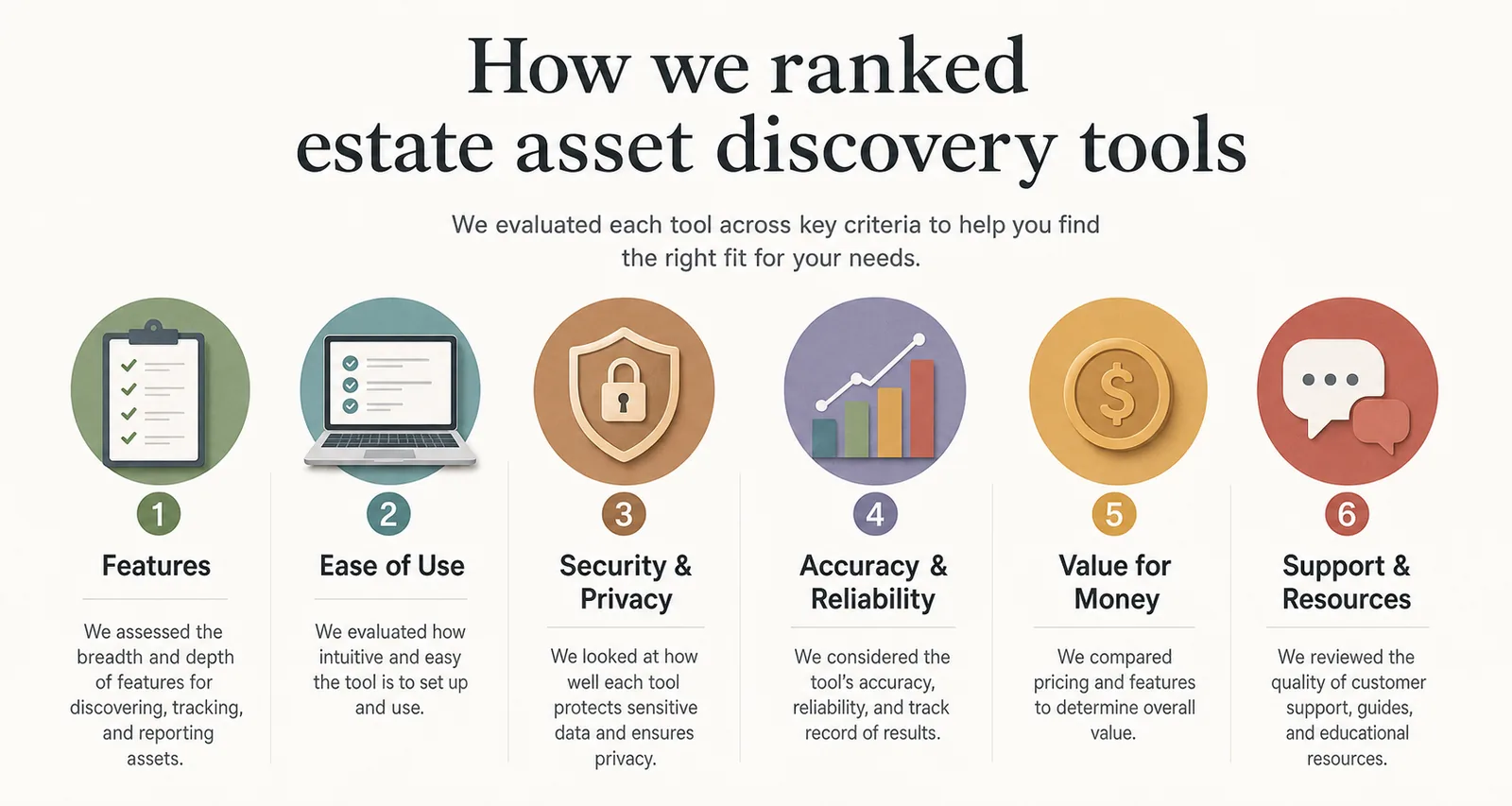
How we ranked estate asset discovery tools
Finding assets is only part of the job. To rank these tools, we looked at what matters across the full settlement process:
- Automated search across financial institutions, retirement accounts, life insurance, real estate, vehicles, and unclaimed property
- Speed and completeness of results
- Probate document generation covering all 50 states and their county variations
- Account closure and settlement support
- Pricing transparency, including whether the tool is free for families
- Security certifications like SOC 2 Type II
No single tool does everything. The best ones come close, going beyond asset search to cover the paperwork and closing work that follows.
Best overall estate asset discovery tool: Sunset
Sunset is the only tool online that can find life insurance policies for a deceased person's estate. That alone sets it apart. But the full scope of what it searches goes well beyond insurance.
Sunset checks bank and credit union accounts across 2,500+ financial institutions, retirement and investment brokerages, unclaimed property in all 50 states, and 3,000+ county court records for probate filings. Nothing moves forward without your approval.
The business model is straightforward: Sunset earns a small fee from institutions when funds are transferred, paid by the institution, not the family.
Empathy
Founded in 2020 by Ron Gura and Yonatan Bergman, Empathy pairs human care managers with digital tools for grief support, estate settlement, and account closure. Access typically comes through life insurance policies or employer bereavement benefits instead of a direct family purchase.
What they offer
- Custom care plans with a dedicated care manager and on-demand team access
- Probate checklist, document storage, and family collaboration for up to nine people
- Account closure support for bank accounts and subscriptions
- Grief resources alongside administrative guidance
Good for families receiving Empathy through an employer or insurance provider who want human-led support throughout the process.
The key gap: Empathy does not search for assets automatically. Families must already know what accounts exist before the service can help close them.
Atticus
Atticus is a legal guidance tool built for executors who feel lost in the probate process. It walks you through your state's specific requirements, generates the forms you need, and tells you what to file and when.
Where it fits in estate asset search is narrow. Atticus helps you understand what you're supposed to do with assets once you know about them. Finding those assets in the first place is outside its scope.
It's a solid fit if your main challenge is procedural confusion instead of locating unknown accounts or unclaimed property.
EstateExec
EstateExec is a web-based tool designed to help executors manage and track estate assets through the settlement process. It's built around an executor workflow, letting users log assets, estimate values, and track distributions to beneficiaries.
The tool is particularly useful for organizing assets you've already found, though it relies on you to input that information manually. It won't search financial institutions or locate unknown accounts on your behalf.
Pricing starts free for basic use, with a paid tier unlocking more features. It's a reasonable fit for executors who want a structured way to stay organized once asset discovery is already done.
EverSettled
EverSettled is a web-based estate settlement tool that helps executors track assets, manage tasks, and organize documents during the probate process. It offers a guided checklist approach, walking users through the steps of settling an estate from notification to final distribution.
The tool is more focused on task management and organization than active asset searching. It won't query financial institutions or search for unknown accounts on your behalf.
Who it's built for
EverSettled tends to suit executors who already have a handle on what assets exist and need help managing the paperwork and process around settling them.
Elayne
Elayne is a web-based search tool that helps families locate unclaimed property and dormant financial accounts held by state governments. It pulls from state unclaimed property databases and presents results in a single search interface, so users don't have to check each state individually.
The tool is straightforward to use: enter the deceased's name and state, and Elayne returns any matching unclaimed funds on record. It works best when you already have a general sense of where the deceased lived or worked.
Coverage is limited to unclaimed property that has already been escheated to the state, so active accounts, life insurance policies, and retirement assets all fall outside its scope.
Feature comparison table of estate asset discovery tools
Here's how each tool compares across the features that matter most for estate asset search and settlement.
| Feature | Sunset | Empathy | Atticus | EstateExec | EverSettled | Elayne |
|---|---|---|---|---|---|---|
| Automated asset discovery | Yes | No | No | No | Not specified | Not specified |
| Financial institutions searched | 2,500+ | Not applicable | Not applicable | Not applicable | Not specified | Not specified |
| Asset categories covered | 9 | Not applicable | Not applicable | Not applicable | Not specified | Not specified |
| Life insurance discovery | Yes | No | No | No | Not specified | Not specified |
| Probate document generation | Yes, all 3,000+ counties | No | Yes, 5,250+ forms | Yes, state specific | Yes, with guidance | Yes |
| Account closure automation | Yes | Guided | Guided | Guided | Manual with support | Concierge service |
| Negative results reporting | Yes | No | No | No | No | No |
| Cost to families | Free | Varies by provider | Not disclosed | $199 | $1,499 | Not disclosed |
| Families served | 15,000+ | Not disclosed | Not disclosed | Not disclosed | 1,000+ | Not disclosed |
| Assets found | $300M+ | Not applicable | Not applicable | Not applicable | Not disclosed | Not disclosed |
Why Sunset is the best estate asset discovery tool
Every other tool on this list assumes you already know what accounts exist. Sunset starts one step earlier. Upload a death certificate, and it searches 2,500+ financial institutions, all 50 state unclaimed property databases, real estate records, vehicle titles, retirement brokerages, and more. Most families have a full picture within five to six days.
The results: $300 million in assets found for 15,000+ families, all free. And when the search is done, Sunset handles probate documents for every county and account closure too. No other tool on this list does all three.
Final thoughts on estate settlement tools
The right estate settlement tool depends on what problem you're trying to solve. If you already know every account and just need task management, several options work fine. If you're starting from scratch with no idea what accounts exist, you need automated search capability that queries banks, brokerages, insurance companies, and state databases directly. That's where most families get stuck, and it's where most tools stop helping. Start your search here and you'll know within a week what assets actually exist, then handle the probate paperwork and account closures in the same place.
FAQ
How do I choose the right estate asset discovery tool for my situation?
Start with whether you need automated asset searching or just help organizing what you already know. If you're starting from scratch with no clear picture of accounts, look for tools that search financial institutions directly (most on this list don't). If you already know what exists and need probate forms or closure help, task management tools may be enough.
Which estate asset discovery tools are best for executors who don't know what accounts exist?
Sunset is the only tool in this comparison that searches automatically across financial institutions, retirement accounts, life insurance, and unclaimed property databases. The other tools focus on organizing known assets or generating probate documents after you've already located accounts through other means.
Can these tools find life insurance policies if I don't know which company issued them?
Most tools can't search for unknown life insurance policies at all. Sunset searches across insurance carriers and reports both what it finds and what it doesn't, which is the only way to know you haven't missed anything. Other tools require you to already have the policy information before they can help with claims or closure.
What's the difference between asset discovery tools and probate document generators?
Asset discovery tools search for unknown accounts across financial institutions and government databases. Probate document generators help you fill out court forms for the assets you already know about. Some tools do both. Sunset covers discovery, probate documents for all 3,000+ counties, and account closure. Atticus and EstateExec focus mainly on probate forms and task management without the search capability.