What Happens If You Don't Report a Death to the Credit Bureaus (2026)
If you don't report a death to the credit bureaus, thieves open accounts in the deceased's name. Here's what goes wrong, who's liable, and how to close the file free.
July 2, 2026
If you don't report a death to the credit bureaus, the person's credit file keeps reading "alive and in good standing," and that open file is exactly what identity thieves use to open new accounts in a dead person's name. The fraud is called "ghosting," and it usually surfaces months later as a collections letter or a strange bill, long after the family thought the estate was settled. Reporting the death to Equifax, Experian, and TransUnion is what closes the file and stops it.
Most families don't skip this step on purpose. It just doesn't feel urgent next to the funeral, the bank, and the will, so it slides down the list and then off it. This is the story of what actually happens in those quiet weeks, why the cleanup lands on the people least able to handle it, and how to close the gap before anyone finds it.
The ghosting timeline: what happens week by week
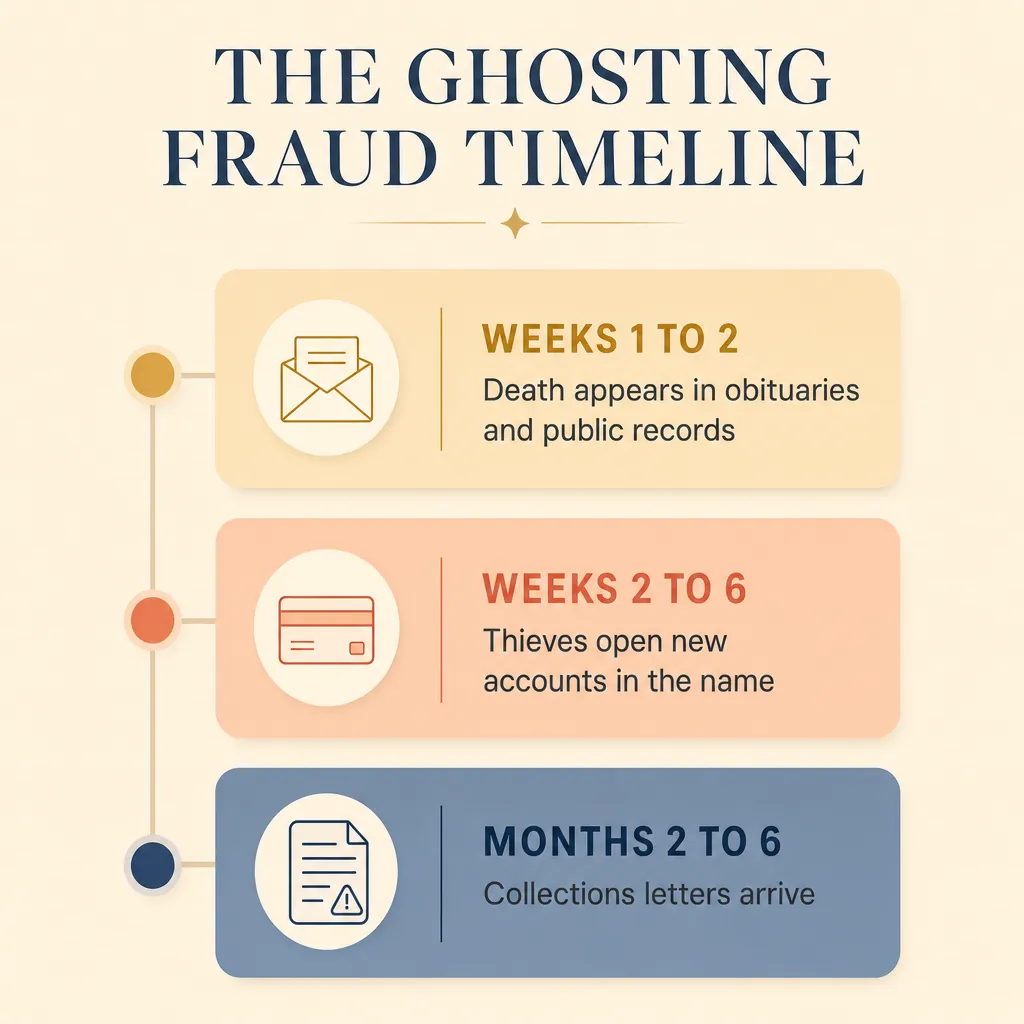
Fraud against the recently deceased runs on a predictable clock. The gap between when someone dies and when the systems catch up is the whole opportunity.
Weeks 1 to 2. The death shows up in an obituary, a funeral home notice, or a public record. Data brokers and criminals scrape those constantly. A name, an address, and a date of death are enough to start, and a Social Security number is often already for sale from an old breach. Meanwhile the family is planning a service, not watching a credit file.
Weeks 2 to 6. With the file still open, a thief applies for credit cards, store accounts, or small loans in the deceased person's name. Lenders check the credit report, see a file that reads "alive and in good standing," and approve. Nothing bounces, because no one has told anyone this person died. The Social Security Administration does report deaths, but that feed is slow and has a known gap, so leaning on it to protect the file does not work in this window.
Months 2 to 6. The bills and collections notices start arriving, addressed to someone who has passed. A family member opens the mail, sees a credit card they have never heard of, and realizes accounts were opened after the date of death. Now it is not prevention anymore. It is cleanup.
Every week the file stays open widens that middle window. Closing it early is the difference between a five-minute task and a six-month problem.
The real consequences of leaving the file open
The damage from skipping this step is not abstract. It shows up in a few concrete ways, and none of them are pleasant to deal with while grieving.
- Fraudulent debt attached to the estate. New accounts opened in the deceased person's name become claims against the estate. Even though the debt is fraudulent, someone has to prove that, dispute it, and get it removed. Until then it can hold up closing the estate and distributing anything to the heirs.
- A frozen, tangled estate. An executor cannot cleanly wrap up an estate that has mystery accounts and open disputes hanging off it. What should have been a routine closing turns into months of letters, affidavits, and phone calls with fraud departments.
- Damage to a joint account holder. If the deceased shared any account with a spouse or co-signer, fraud on the file can bleed into the living person's credit too, dragging a survivor into a mess they did not create.
- Emotional cost. Discovering that someone opened a loan in your late parent's name months after the funeral reopens the grief. Families describe it as feeling like the person is being robbed after they are gone. That weight is real, and it is avoidable.
The through line is that none of this stays contained to the deceased. It lands on the survivors, the executor, and sometimes an innocent joint account holder.
Who actually ends up liable
A common fear is that the family is on the hook for fraudulent debt. In general, you are not personally responsible for debts opened by a criminal in a dead person's name, and you are not responsible for the person's legitimate debts out of your own pocket either. Debts are paid from the estate's assets, not from the family's.
But "not liable" does not mean "not your problem." Someone still has to do the work of disputing every fraudulent account, sending each lender a copy of the death certificate, and proving the debt is not valid. That someone is almost always the executor or the closest surviving family member, and the burden is worse the longer the file sat open. A death notice you send in week one is prevention. A dispute you file in month five is a part-time job.
There is also a quieter benefit to reporting the death early: it creates a dated paper trail. If a lender ever comes after the estate for an account opened after the date of death, a death notice already on file with the bureaus is your proof that the account cannot be legitimate.
Why families skip it (and why the excuse doesn't hold)
Almost everyone who skips this step has a reasonable-sounding reason at the time.
- "Social Security will handle it." The SSA does report deaths, but the feed is slow and, since a 2011 policy change, it stopped receiving roughly a million death records a year that it used to collect. Counting on it to protect the credit file leaves the file open during the exact weeks fraud happens.
- "There's nothing to steal, the accounts are closed." Ghosting does not use the existing accounts. It opens new ones. An empty checking account does not stop a thief from getting a brand-new credit card approved in the name.
- "I'll get to it after probate." By the time probate is moving, the vulnerable window has already been open for weeks or months. This is a first-week task, not a later-on task.
- "It's three separate letters and I'm overwhelmed." This one is real. The bureaus do not share death notices, so protecting the file has always meant contacting all three separately. That is exactly the friction a free tool now removes.
How to close the gap in a few minutes
You have two ways to shut the file.
Do it yourself. Write to each bureau, state that the person has died, include their name, address, Social Security number, and date of death, enclose a copy of the death certificate and proof you are authorized to act, and mail it. Then do it twice more, because Equifax, Experian, and TransUnion each need their own notice.
- Equifax: P.O. Box 105139, Atlanta, GA 30348-5139
- Experian: P.O. Box 4500, Allen, TX 75013
- TransUnion: P.O. Box 2000, Chester, PA 19016
Or use Sunset's tool. Sunset built a tool that notifies all three bureaus from one short form. You enter the deceased person's name, address, Social Security number, and date of death, upload a copy of the death certificate, and confirm you are authorized to act. Sunset generates a formal letter for each bureau, mails all three to the official address, and emails you confirmation within a few business days.
It is free, with no Sunset account, no subscription, and nothing charged to the estate. Any surviving spouse, adult child, executor, or sibling can use it. You can report a death to the credit bureaus here. One form closes the file on all three reports, which is the single move that shuts down the most common path for this fraud.
For the step-by-step version of the mailing process, see our guide on how to report a death to the credit bureaus, and for the wider first-week triage, three accounts to freeze first after a death.
How Sunset helps with the rest of the estate
Reporting the death is often the first thing families do with Sunset, and it points at the larger job underneath. Sunset handles the parts of estate settlement that are easy to underestimate:
- Finding the accounts. Sunset searches for the bank, brokerage, retirement, and insurance accounts a person left behind, so nothing is missed and a fraudulent account is easier to spot against a known list.
- The probate paperwork. Court forms are generated and filled for the right county, with filing instructions, so you are not guessing at what your state requires.
- A place to hold the money. Sunset opens an FDIC-insured estate account so the estate's funds sit in one place while you settle it.
- Moving assets to the heirs. Sunset handles the transfers so the right people receive what they are owed.
More than 15,000 families have used Sunset to settle an estate. Closing the credit file is a small, free place to start.
Frequently asked questions
What happens if you don't notify the credit bureaus of a death?
The person's credit file stays open and readable as "alive and in good standing," which lets thieves open new accounts in their name. The fraud, called ghosting, usually surfaces months later as collections notices and can hold up closing the estate until every fraudulent account is disputed and removed.
Can someone open a credit card in a dead person's name?
Yes. It is common enough to have a name, ghosting. Criminals use obituaries and old data breaches to apply for credit before anyone is watching the file, and an open credit file gets approved. Flagging the file as deceased at all three bureaus is what stops it.
Is the family responsible for fraudulent debt opened after death?
No. You are not personally liable for accounts a criminal opens in a dead person's name. But someone still has to dispute each account and prove it is fraudulent, and that cleanup falls on the executor or family. Reporting the death early prevents most of it.
Does Social Security automatically notify the credit bureaus?
The Social Security Administration reports deaths, but the feed is slow and misses a large share of records, so the credit file can stay open for weeks. Reporting the death directly to Equifax, Experian, and TransUnion is the reliable way to close it.
How do I report a death to all three credit bureaus at once?
You can mail a notice to each bureau yourself, or use Sunset's tool, which sends all three from a single form with no account and no charge to the estate.
Don't leave the file open
Reporting a death to the credit bureaus is a small task with a large downside if you skip it. The file stays open exactly during the weeks fraud happens, and the cleanup lands on the people already carrying the most. You can send all three notices yourself using the addresses above, or let Sunset do it in a few minutes. Report a death to the credit bureaus and close the file before anyone else finds it.