Reverse Mortgage After Death of Borrower: Deadlines (2026)
What heirs must do after a reverse mortgage borrower dies: the 30-day reply, extensions, the 95 percent payoff rule, and spouse protections.
September 10, 2026

A reverse mortgage usually becomes due and payable after the death of the borrower, which means the lender or loan servicer will ask the estate or heirs to repay the loan, sell the home, or give up the property. For most federally insured HECM loans, the first clock to watch is the 30-day response window after the due-and-payable notice arrives.
If you want to keep the house, sell it, or protect a surviving spouse, do not wait for probate to be finished before calling the servicer. The loan timeline can run while the rest of the estate settlement is still getting organized.
This guide is general information for heirs, not legal advice. Reverse mortgage rules can depend on the loan type, the date of the loan, who lived in the home, title, state law, and HUD rules. If the home matters to your family, ask the servicer for deadlines in writing and talk with a local probate attorney or HUD-approved housing counselor.
What happens to a reverse mortgage when the borrower dies
Most reverse mortgages do not require monthly principal and interest payments while the borrower is alive and living in the home. The balance grows over time from loan advances, interest, mortgage insurance, and fees. When the last borrower dies, the loan generally becomes due and payable.
For a HECM due and payable loan, the servicer will usually ask for one of these outcomes:
| Family goal | Common path |
|---|---|
| Keep the home | Pay off the reverse mortgage, often by refinancing or using other funds |
| Sell the home | List and sell the property, then use sale proceeds to pay the loan |
| Walk away from the home | Consider a deed in lieu of foreclosure if the family does not want the house |
| Protect a surviving spouse | Check whether the spouse qualifies for non-borrowing spouse protections |
A HECM is non-recourse. In plain English, that usually means the lender can look to the home for repayment, but the heirs are not personally responsible for a shortfall if the house sells for less than the loan balance. Other debts of the estate are a separate issue. For a broader debt overview, see Sunset's guide to which debts must be paid after a death.
The due-and-payable notice starts the heir clock
After the servicer learns that the borrower died, it may send a due-and-payable notice. This letter matters. It should tell you that the loan is due, request a response, and explain what the servicer needs next.
For many HECM situations, heirs or the estate are expected to respond within 30 days of the notice. That response is usually not full repayment. It is often a statement of intent, such as:
- The estate plans to sell the home.
- An heir plans to pay off or refinance the loan.
- The family may request a deed in lieu of foreclosure.
- A surviving spouse is asking the servicer to review non-borrowing spouse rights.
Ask the servicer for the loan number, the current balance, the payoff figure, the appraised value if one has been ordered, and the exact deadline for your response. If you are the executor, administrator, trustee, or another authorized person, the servicer may ask for a death certificate and proof of authority before discussing details.
If no one responds, the servicer may move the file toward foreclosure. That does not always mean a sale happens right away, but silence is risky. A short call followed by a written response can protect time while your family decides what to do.
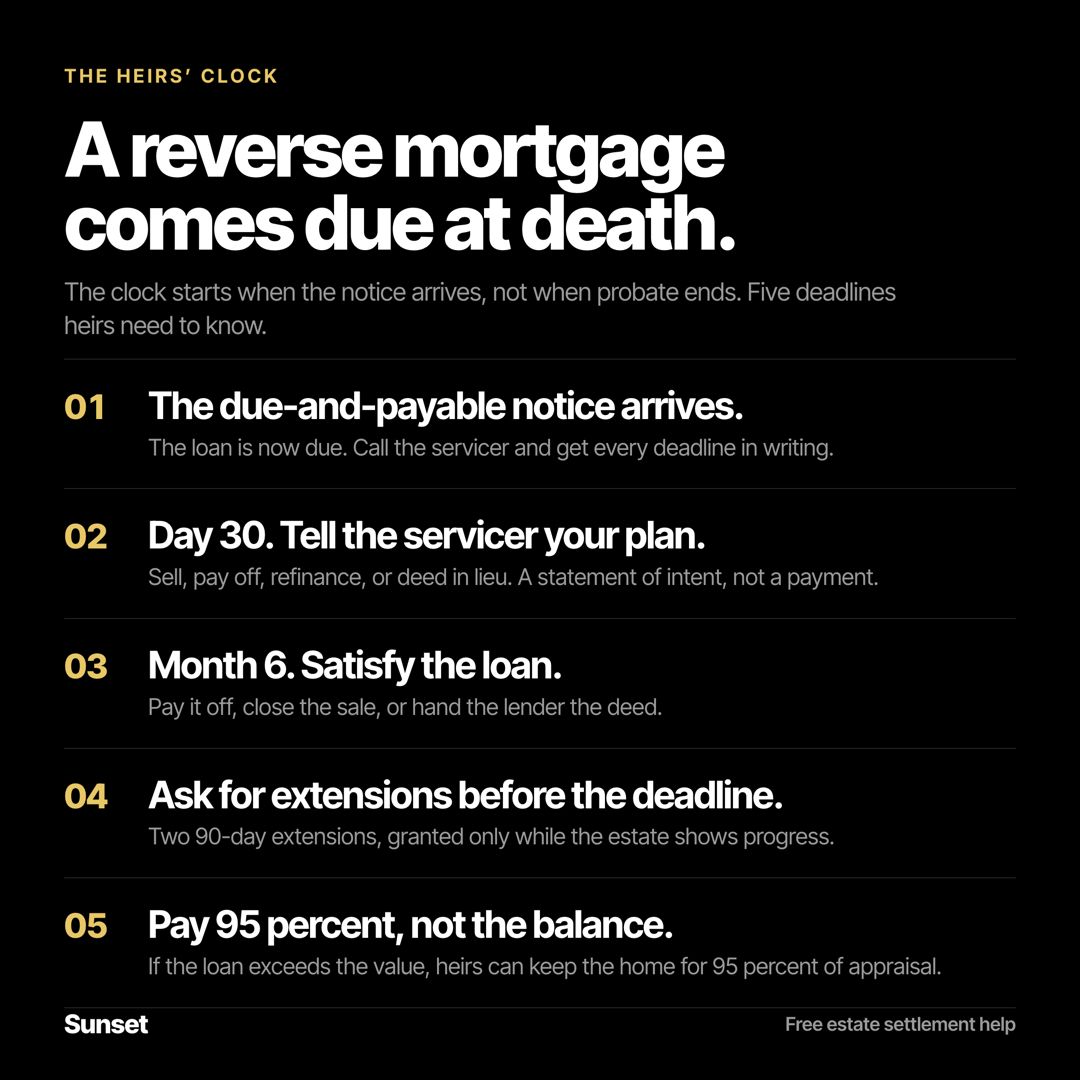
The 30-day response, 6-month payoff period, and extensions
A common HECM timeline looks like this:
- The servicer learns of the borrower's death.
- The servicer sends a due-and-payable notice.
- The estate or heirs respond, often within 30 days.
- The family works toward payoff, refinance, sale, or deed in lieu.
- If more time is needed, the estate asks for an extension before the deadline.
Heirs are often given up to 6 months to satisfy the loan after the due-and-payable event, if they are taking active steps. Extensions may be available, commonly in 90-day periods, when the estate can show progress. That may mean the home is listed for sale, a refinance is in process, title issues are being fixed, or probate authority is pending.
Do not assume extensions are automatic. Ask what proof the servicer needs and when it must be received. Save copies of listing agreements, purchase contracts, probate filings, repair invoices, refinance emails, and letters from the court. If the estate needs more time, request it before the current deadline expires.
If you are still early in the process, Sunset's guide on what to do when a parent dies can help you order the first tasks.
The 95 percent appraised-value payoff option
One of the most important HECM rules for heirs is the 95 percent appraised-value payoff option. If the reverse mortgage balance is higher than the home's value, heirs may be able to keep the property by paying the lesser of the full loan balance or 95 percent of the home's appraised value.
Example: if the HECM balance is $430,000 and the home appraises at $350,000, an heir may be able to buy the home for 95 percent of $350,000, which is $332,500, subject to servicer and HUD rules. FHA insurance covers the approved shortfall on a HECM.
This rule can matter when the family wants to keep a long-time home but the loan balance has grown beyond the market value. It can also matter in a sale. A buyer may be able to purchase the home for at least 95 percent of the appraised value when the balance is higher than the value, again subject to the servicer's process.
A few practical points:
- The servicer's appraisal matters. A family estimate or online value is not enough.
- The payoff quote can change as interest and fees accrue.
- If you disagree with an appraisal, ask the servicer what review options exist.
- Get the 95 percent figure in writing before relying on it.
The options heirs usually compare
The decision usually comes down to equity, family agreement, and who has legal authority to act.
Option 1: Keep the home
To keep the home, an heir or the estate must pay off the reverse mortgage. That may happen through a refinance, cash from the estate, money from heirs, or a purchase by one heir. If several siblings inherit the home, decide early who wants ownership, who can qualify for financing, and how the others will be bought out.
Probate or trust paperwork may also be needed before title can change. Sunset's guide to selling or transferring a house after the owner dies explains how title, probate, and deed transfers can fit together.
Option 2: Sell the home
If the home has equity, selling may leave money for beneficiaries after the reverse mortgage, closing costs, taxes, repairs, and other approved estate costs are paid. If the loan balance is higher than the value, the sale may still work because HECM loans are non-recourse and the 95 percent rule may apply.
Tell the servicer the home will be listed, then ask what documents it needs. If the property is in probate, the executor or administrator may need court authority before a sale can close.
Option 3: Deed in lieu of foreclosure
A deed in lieu of foreclosure means the estate or titleholder voluntarily deeds the property to the lender instead of making the lender complete a foreclosure. Families consider this when no one wants the home, there is no equity, or the property needs repairs the estate cannot manage.
It is not as simple as mailing in the keys. The servicer may require clear title, signed documents from all needed parties, removal of personal property, and proof that there are no blocking liens or occupancy issues. Ask for written terms before agreeing.
Option 4: Let foreclosure proceed
Sometimes families do nothing because the home is underwater and no one wants it. With a HECM, heirs usually are not personally liable for a deficiency, but foreclosure can still affect timing, property access, and the estate record. If there are other liens, taxes, an occupied home, or family conflict, get advice before choosing silence as a strategy.
Non-borrowing spouse protections after death
A surviving spouse is not always a borrower on the reverse mortgage. This often happened when one spouse was too young to qualify or was left off the loan for another reason. If the borrower dies, the surviving spouse should contact the servicer quickly and ask whether they are an eligible non-borrowing spouse.
For many HECM loans, an eligible non-borrowing spouse may be allowed to stay in the home after the borrower's death if required conditions are met. Those conditions can include marriage to the borrower, living in the property as a principal residence, being listed in the loan documents as a non-borrowing spouse, and meeting ongoing loan duties such as property taxes, insurance, and maintenance. The spouse may also need to show a legal right to remain in the property within required time limits.
Protections vary based on loan date and facts. A spouse who is protected may get a deferral of the due-and-payable status, but that does not create new loan advances. Taxes, insurance, HOA dues, and upkeep still matter. If the servicer says the spouse is not protected, ask for the reason in writing and consider getting help right away.
What to do in the first week after the notice arrives
The first week is about information and proof. Try to gather:
- The due-and-payable notice and all reverse mortgage letters.
- The borrower's death certificate.
- The will, trust, or court appointment papers, if any.
- Home insurance, tax bills, HOA statements, and utility bills.
- Names and contact information for all heirs or beneficiaries.
- Any prior appraisal, repair estimate, or listing opinion.
Then call the servicer and ask these questions:
- What is the current loan balance and payoff good-through date?
- What is the deadline for the 30-day response?
- Has an appraisal been ordered?
- What does the servicer need if we plan to sell, refinance, or request deed in lieu?
- What extension process applies, and what proof is required?
- Is there a non-borrowing spouse review available?
Write down the date, the representative's name, and what was said, then follow up in writing.
How the reverse mortgage fits with the rest of the estate
The house is often the biggest asset, but it is rarely the only task. Before heirs make final choices, it helps to list assets and liabilities first. That means bank accounts, life insurance, retirement accounts, vehicles, credit cards, medical bills, taxes, funeral costs, and home expenses.
Sunset can help families build that picture. Sunset searches 2,300+ financial institutions to find accounts and assets, generates state- and county-specific probate packets, and provides an FDIC-insured estate account through its bank partnership. When counsel is needed, Sunset refers families to a local probate attorney. The estate does not pay Sunset, and all assets go to the beneficiaries and heirs.
This matters with a reverse mortgage because families often need to know whether there is cash to keep insurance current, pay property taxes, clean out the house, order documents, or cover probate costs while a sale is pending.
FAQ
How long do heirs have to pay off a reverse mortgage after death?
For many HECM loans, heirs must respond to the due-and-payable notice within 30 days and may have up to 6 months to pay off, refinance, sell, or otherwise satisfy the loan. Extensions, often in 90-day periods, may be available if the estate shows active progress and asks on time.
Can heirs walk away from a reverse mortgage?
Yes, heirs often can walk away from a HECM because it is non-recourse. The lender's remedy is usually against the home, not the heirs personally. Families may still need to deal with title, personal property, occupancy, other liens, or a deed in lieu process.
Can a child keep a house with a reverse mortgage?
A child may be able to keep the house by paying off the reverse mortgage, refinancing, or buying the property from the estate. If the HECM balance is higher than the home value, the child may be able to pay 95 percent of the appraised value, subject to the servicer's rules.
What happens if the reverse mortgage is more than the house is worth?
With a HECM, the loan is generally non-recourse. The home can be sold or transferred under HUD rules, and heirs are usually not responsible for the difference between the loan balance and the home's value. The 95 percent appraised-value payoff option may help an heir buy the home.
Can a non-borrowing spouse stay in the home?
Some non-borrowing spouses can stay if they meet HECM eligibility rules and keep up with taxes, insurance, and maintenance. The spouse should contact the servicer as soon as possible and ask for a written review of their status.
Sunset can help you get the estate organized
A reverse mortgage deadline can arrive before the family has finished sorting papers, finding accounts, or opening probate. Sunset helps bring the estate picture together so heirs can make informed choices about the home, debts, and transfers.
Sunset has helped 15,000+ families settle estates. If you are handling a deceased parent's or spouse's home with a reverse mortgage, Sunset can help find assets, prepare probate paperwork, set up an FDIC-insured estate account, and refer you to a local probate attorney when counsel is needed.