Estranged Parent Died: What Happens Next? (2026)
Estranged parent died after years apart? Learn who may inherit, whether you must serve, and how to find assets without taking on debts.
August 20, 2026

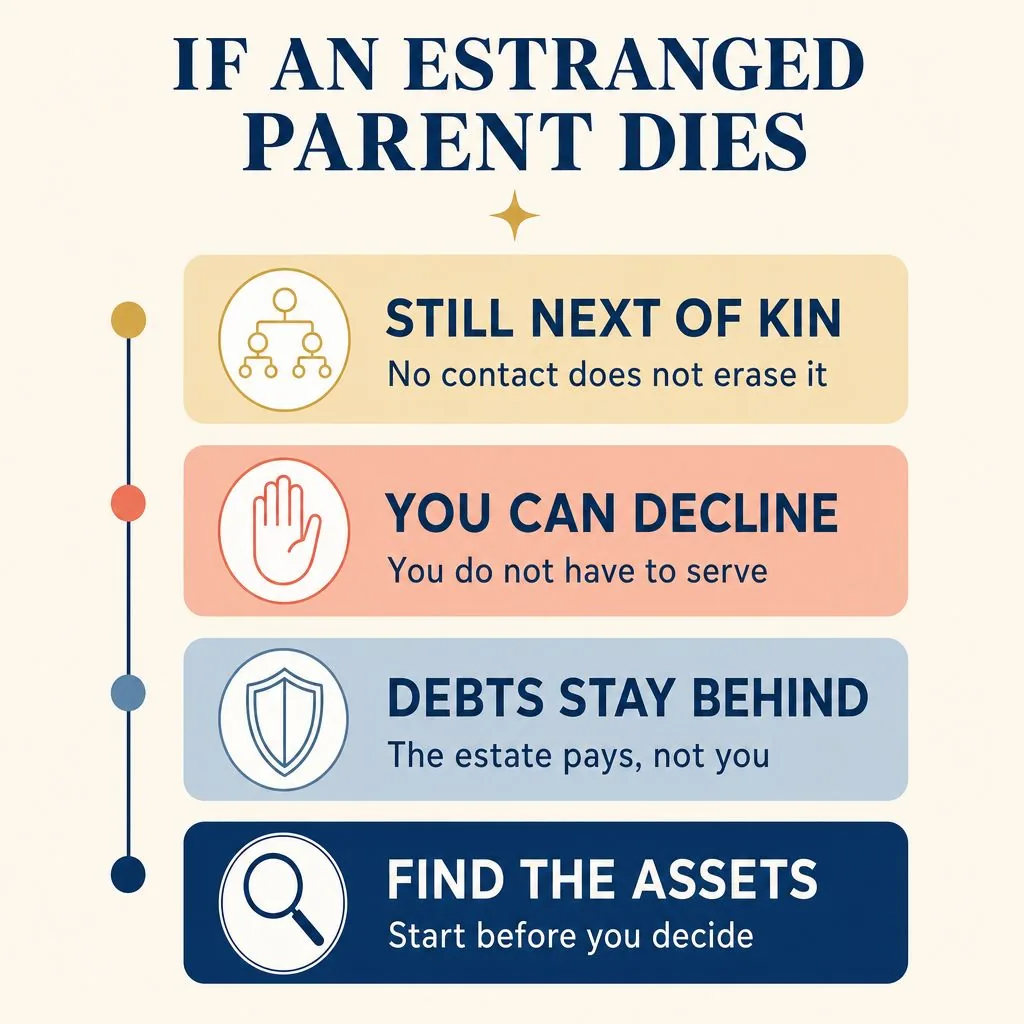
If an estranged parent died, you may still be their legal next of kin and a possible heir, even if you had no contact for decades. You are not forced to settle the estate just because you are their child, and you generally do not inherit their debts unless you were already legally responsible for them.
For an adult child who knows little or nothing about a parent's finances, the hardest part is often asset discovery: finding accounts, property, insurance, debts, and paperwork before decisions can be made. This guide is informational, not legal advice, but it can help you understand the first steps and the choices you may have.
First, separate the relationship from the legal order
Estrangement changes a family relationship. It does not always change the legal order of who may inherit or who has the right to ask the court for authority to act.
If your parent had a valid will, the will may name an executor and say who receives property. The person named as executor can usually choose whether to serve. If your parent did not have a will, state law decides who inherits. In many states, a surviving spouse comes first, then children, though the exact shares depend on the state and the family facts.
So an adult child can be pulled into estate questions after years of silence. You might hear from a funeral home, landlord, hospital, creditor, distant relative, or county office because your name shows up on a birth record or an emergency contact list. Being contacted does not mean you have accepted responsibility. It means someone is trying to find the right person to ask.
Do I have to settle my estranged parent's estate?
No, in many situations you can decline to serve as executor or personal representative. If you were named in a will, you can usually refuse the appointment. If there is no will, you can often choose not to petition the probate court to be appointed.
The role carries real duties. An executor may need to collect assets, notify heirs and creditors, protect property, file court papers, pay valid estate bills, keep records, and transfer what remains to the people entitled to it.
Before agreeing to serve, ask:
- Is there a will?
- Did my parent own a home, vehicle, bank account, business, or other property?
- Are there unpaid taxes, medical bills, loans, or credit cards?
- Are there other heirs who will expect updates?
- Is there conflict with a spouse, sibling, partner, or caregiver?
- Do I have the time and emotional space to take this on?
If no family member is willing to act, another person may be able to petition, such as a named executor, another heir, a creditor, or in some places a public administrator. Rules vary by state and county.
If you already started acting for the estate, for example by selling property, paying debts, or collecting money, talk with a probate attorney before stepping away. The point is not to scare you. It is to avoid creating confusion about whether you accepted duties.
Can I inherit from a parent I did not know?
Yes. You can inherit from a parent you did not know, or from one you had not spoken to in many years. Estrangement by itself does not remove a child's inheritance rights.
What you receive depends on several things:
- Whether there is a valid will or trust
- Whether your parent was married at death
- Whether there are other children
- Whether assets had beneficiary designations
- Whether the estate has debts and expenses
- State inheritance law
Some assets pass outside probate. Life insurance, retirement accounts, payable on death bank accounts, and transfer on death accounts may go directly to named beneficiaries. If someone else is named, those funds may never become part of the probate estate. If no beneficiary is named, or the named beneficiary died first, the asset may need estate handling.
A will may leave you something, leave you nothing, or name someone else to manage the estate. No-contact history does not answer those questions. Documents and account records do.
You do not inherit their debt
A common fear after an estranged parent dies is that creditors will come after the child. In general, a parent's debts belong to the parent's estate, not to the adult child.
The estate pays valid debts from estate assets before heirs receive anything. If there are not enough assets, some debts may go unpaid. You usually do not have to pay those debts with your own money.
There are exceptions where you may already be responsible, such as:
- You co-signed a loan
- You were a joint account holder, not just an authorized user
- You owned property together
- You personally guaranteed a debt
- State law creates a rare family support claim
Be careful with debt collectors. Do not promise payment from your own funds. Ask for written proof of the debt and whether the claim is against the estate. If you are unsure, get legal guidance before paying.
Asset discovery matters most when you know nothing about their finances
You may not know where they banked, whether they had life insurance, or whether they owned property. Asset discovery becomes the first real task. Start with what can be found safely and legally:
- Order several certified death certificates. Many banks, insurers, and courts will ask for one. Sunset has a guide on how to order death certificates.
- Look for a will, trust, safe deposit box key, address book, tax returns, or mail.
- Check the county property records where they lived.
- Look for vehicle titles, registration notices, and insurance cards.
- Review statements for bank accounts, brokerage accounts, pensions, and retirement plans.
- Search state unclaimed property databases.
- Contact former employers if you know where they worked.
Do not assume there are no assets because the relationship was distant. Some families find an old retirement account, a small life insurance policy, a refund, or a bank account no one knew about.
Sunset searches 2,300+ financial institutions to find accounts and assets tied to an estate. That can be especially useful when you have no financial history, no passwords, and no clear starting point.
Protect property without taking on personal risk
If you decide to help, the early goal is to protect what exists while you learn more. That does not mean paying bills out of your pocket or taking control before you have authority. Reasonable first steps:
- Make sure a home is locked and insured if you have access.
- Move vehicles only if needed to prevent towing or damage.
- Forward mail if allowed, so statements and notices are not missed.
- Save documents, do not throw away records too soon.
- Notify key agencies and financial firms after you have a death certificate.
- Watch for fraud using the deceased person's identity.
Identity theft can happen quickly after a death, especially when mail piles up or accounts stay open. Sunset's guide to protecting a deceased loved one's identity from fraud explains steps families can take.
Once a court appoints an executor or personal representative, the estate may need its own bank account. That keeps estate money separate from personal money and creates a clean record for bills and distributions. Learn more in Sunset's guide to estate bank accounts.
Probate may still be needed, even if no one was close
Probate is the court process for appointing someone to act for the estate and transferring probate assets. Whether probate is needed depends on the type of assets, how they were titled, the dollar value, and state law.
Probate may be needed if your parent owned:
- A house in their name alone
- A bank account with no joint owner or beneficiary
- A vehicle that cannot be transferred by a simple form
- Personal injury claims, refunds, or checks payable to the estate
- Business interests with no transfer plan
Some states have small estate shortcuts for lower-value estates. Others require full probate for real estate. If your parent owned property in more than one state, extra court steps may be needed.
Sunset generates state- and county-specific probate packets, which can help families understand what forms may be required where the death occurred or where property is located. When attorney help is needed, Sunset can refer families to a local probate attorney.
Transfers come after authority and asset review
It is tempting to focus on who gets what. Start with assets and liabilities instead. Transfers wait until you know what exists, what debts must be paid, and who has legal authority.
Common transfers include:
- Closing bank accounts and moving funds to an estate account
- Transferring or selling a vehicle
- Selling or transferring a house
- Claiming life insurance or retirement benefits
- Distributing personal property
If there are multiple heirs, document each step. Save receipts, copies of checks, bank statements, appraisals, sale records, and written communications. Even when family members are distant, clear records reduce later disputes.
Handling contact with relatives, spouses, and creditors
You may be dealing with a second spouse, half-siblings, stepchildren, a former partner, a caregiver, or relatives you barely know. A few boundaries help:
- Communicate in writing when possible.
- Do not share guesses about inheritance.
- Do not sign documents you do not understand.
- Do not remove property from a home without authority.
- Keep estate money separate from your own.
If someone else is serving as executor and you are a beneficiary, you may have rights to information. Those rights vary by state, but you can usually ask for basic updates, a copy of the will if it was filed, and an accounting when one is required.
If you decide to decline
Declining may be the right choice. You may be grieving, angry, numb, or unwilling to reopen a painful chapter. You can still want things done correctly without being the person in charge.
If you want to decline, avoid actions that look like estate administration. Do not collect estate funds, sell property, pay estate debts from estate assets, or tell creditors you are the responsible party unless you have accepted the role.
You can tell the person who contacted you that you are not willing to serve and ask who else may be contacted. If court papers name you, respond by the deadline or ask a probate attorney what filing is needed to decline.
FAQ
Do I have to settle my estranged parent's estate?
Usually, no. Being an adult child does not automatically force you to serve as executor or personal representative. If you are named in a will or asked to serve, you can often decline, subject to your state's process and any steps you have already taken.
Am I responsible for my estranged parent's debt after death?
In most cases, no. Debts are paid from the estate before heirs receive assets. You may be responsible only if you were already legally tied to the debt, such as through a co-signed loan, joint account, or personal guarantee.
Can an estranged child inherit if there is no will?
Yes. If there is no will, state intestacy law decides who inherits. An estranged child may still be treated as a child under that law. The share depends on whether there is a spouse, other children, and the rules in that state.
What if I do not know where my parent banked?
Start with mail, tax records, old statements, property records, and unclaimed property searches. Sunset can also search 2,300+ financial institutions for accounts and assets connected to the estate, which helps when you are starting with little information.
Should I pay funeral or estate bills myself?
Be cautious. If you choose to pay a cost personally, reimbursement may depend on estate funds and state rules. Do not promise creditors that you will pay your parent's debts from your own money unless you know you are legally responsible.
Sunset can help you find the next step
When an estranged parent dies, the first question is not whether you were close. It is what exists, who has authority, and what choices you have. You may be an heir. You may be next of kin. You may also be able to decline the job of settling the estate.
Sunset helps families find assets, prepare probate paperwork, open an FDIC-insured estate account, and work through transfers. Sunset has helped thousands of families settle estates. If you are starting with no records and many unanswered questions, Sunset can help you get a clearer picture before you decide what role, if any, you want to take.