Do You Inherit Your Parents' Debt When They Die? (2026)
Learn when you inherit your parents' debt after death, exceptions like co-signing and community property states, and what creditors can claim. 2026 guide.
May 22, 2026

Your mom passed away two months ago, and you're wondering about inheriting medical debt. The short answer is usually no, but the reality depends on where you live, whether you co-signed anything, and what kind of debt she left behind. Most debts get paid from the estate itself, and if there's not enough money to cover them, creditors eat the loss. You're only on the hook in specific situations, like if you live in a community property state or if your state has filial responsibility laws that nursing homes can enforce. Let's go through when you're actually responsible and when you can tell a debt collector to stop calling.
TLDR:
- You don't inherit your parents' debt unless you co-signed, live in a community property state, or are a spouse in certain situations
- Creditors get paid from the estate's assets in a legal priority order; if assets run out, remaining debts are forgiven
- 27 states have filial responsibility laws that can require adult children to pay unpaid medical or nursing home bills
- Assets with named beneficiaries (life insurance, retirement accounts, trusts) typically bypass the estate and remain protected from creditors
- Sunset helps you find all debts and assets across 2,500+ institutions within 5-6 days, then handles the entire settlement process
The General Rule: You Do Not Inherit Your Parents' Debt
About 73% of Americans die carrying some form of debt, according to Experian data. That number alone is enough to make any adult child nervous. But you almost certainly won't have to pay it.
Under U.S. law, debts belong to the person who incurred them. When someone dies, those obligations become the responsibility of their estate. Creditors get paid from whatever assets the deceased left behind, and if the estate runs out of money before all debts are cleared, most remaining balances go unpaid.
Dying without enough assets to cover debts is called dying insolvent. Creditors absorb the loss. They cannot pursue you personally simply because you're a surviving family member.
How the Estate Settlement Process Handles Debt
When someone dies, the executor must inventory assets, notify creditors, and pay valid claims before distributing anything to heirs. Most states require publishing a formal notice to creditors, which opens a claims window of roughly two to six months.
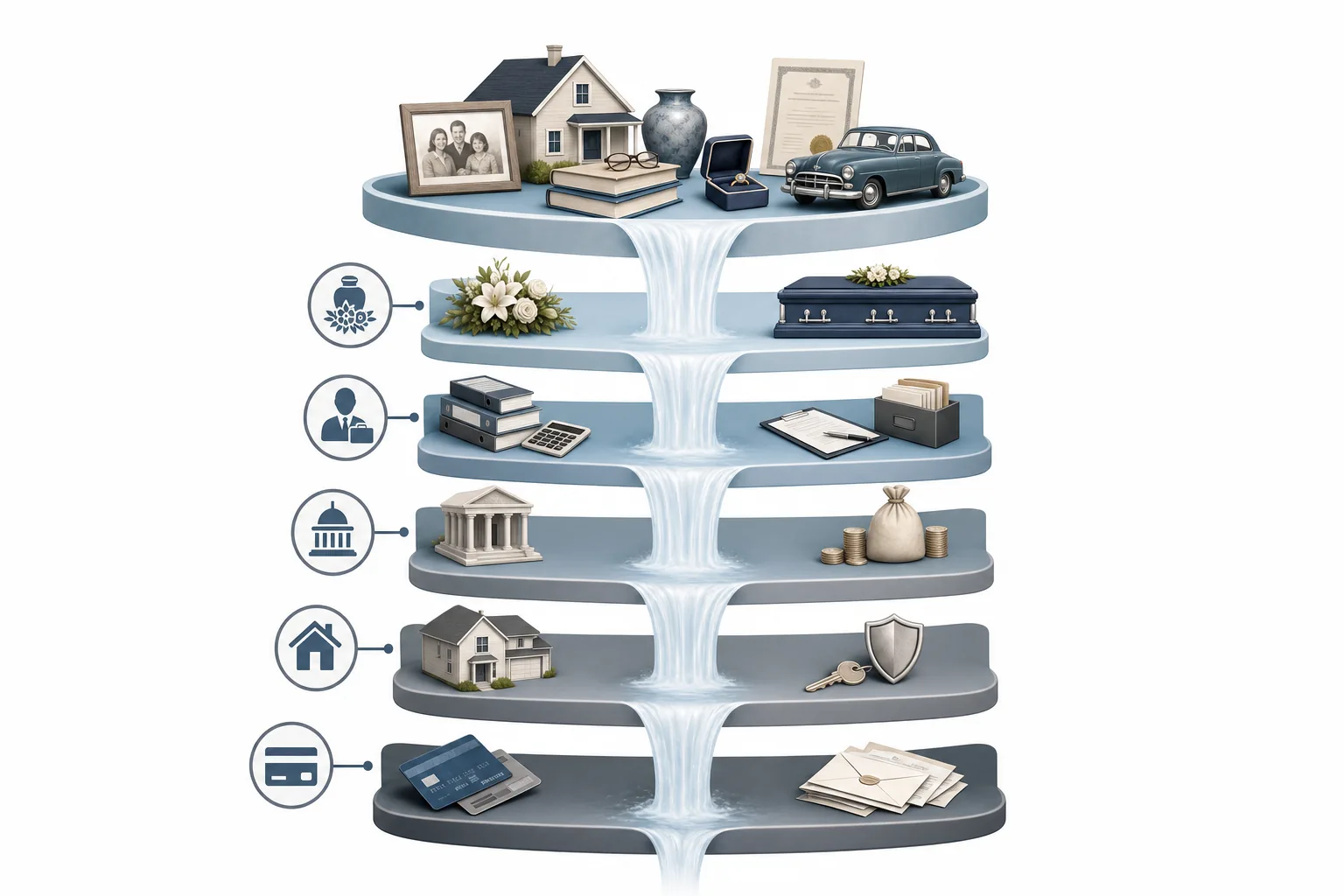
Debts are paid according to a legal priority order, not first-come, first-served. States generally follow this sequence:
- Funeral and burial expenses
- Estate administration costs
- Federal and state taxes
- Secured debts like mortgages and auto loans
- Unsecured debts like credit cards and medical bills
When assets cover everything, beneficiaries receive what remains. When they don't, lower-priority creditors absorb the shortfall. You, as an heir, are not personally liable for that gap.
When You ARE Responsible: The Key Exceptions
There are real situations where you can end up on the hook for a parent's debt. Here are the main exceptions to watch for:
- You co-signed the loan or were a joint account holder, making you legally liable from the start.
- You live in a community property state (Arizona, California, Idaho, Louisiana, Nevada, New Mexico, Texas, Washington, or Wisconsin), where debts incurred during a marriage may be shared by the surviving spouse.
- You were named as a guarantor on a debt, which carries the same weight as co-signing.
- Some states have filial responsibility laws that can require adult children to cover a parent's unpaid medical or nursing home bills, though enforcement varies widely by state.
- You are the surviving spouse in a state that holds both spouses responsible for certain necessary expenses, such as medical care.
If none of these apply to you, creditors generally cannot pursue you personally for what a parent owed. Your exposure is almost always limited to what the estate itself can pay.
Community Property States and Spousal Debt Responsibility
In those nine states, marriage creates a financial partnership that doesn't end cleanly at death. Debts either spouse takes on during the marriage are generally treated as shared, even if only one name is on the account.
The distinction that matters is timing. Debts brought into the marriage, or accumulated after legal separation, typically stay separate. But debts incurred while married are community debts, and the surviving spouse can be held responsible for them.
If your spouse died owing $30,000 on a credit card opened after the wedding, that balance may follow you regardless of whether you ever used it.
Filial Responsibility Laws: When Adult Children Must Pay Medical Debt
As of 2026, 27 states have filial responsibility laws on the books. Having a law and enforcing it are two very different things, though.
These statutes were largely written decades ago, and most states rarely pursue cases against adult children. Nursing homes and long-term care facilities have started using them more aggressively, however, when a parent's bill goes unpaid and no estate assets remain.
Liability generally requires three things: the parent cannot pay, the adult child has the financial means to contribute, and the facility actively pursues a legal claim. States where enforcement has actually occurred include Pennsylvania, South Dakota, and North Dakota. Pennsylvania in particular has seen nursing homes win judgments directly against adult children.
If your parent is in long-term care, this is worth knowing before the bill arrives.
Types of Debt and Whether They Transfer After Death
Different types of debt follow different rules after death. Here's a quick breakdown of the most common ones:
- Credit card debt is generally unsecured, so it gets paid from the estate if assets exist. Children are rarely liable unless they were joint account holders.
- Medical debt works the same way in most states. It's an estate obligation, not a family one, though spouses may have some liability depending on state law.
- Tax debt doesn't disappear at death. The estate owes any outstanding federal or state taxes, and an executor must file a final return.
- Mortgage debt stays with the property. Heirs who inherit the home typically inherit the loan too.
- Student loans are often discharged at death, especially federal loans, though some private lenders have different policies.
| Debt Type | Paid From Estate | Family Member Liable If... | Family Member NOT Liable If... |
|---|---|---|---|
| Credit card debt | Yes, as unsecured debt in priority order | You were a joint account holder or co-signer on the account | You were only an authorized user with no joint liability |
| Medical bills | Yes, as unsecured debt after secured creditors | You're a spouse in a state that holds both spouses responsible for necessary medical care, or your state enforces filial responsibility laws | You're an adult child in a state that doesn't enforce filial laws, and you didn't co-sign any treatment agreements |
| Mortgage debt | Only if the estate keeps the property; heirs who inherit the home inherit the loan | You inherit the property and want to keep it, making you responsible for continued payments | You disclaim the inheritance or the property is sold to satisfy the debt |
| Auto loans | Yes, as secured debt with higher priority than unsecured debts | You were a co-signer or co-borrower on the original loan | You were not on the loan and choose not to keep the vehicle |
| Federal student loans | No, these are typically discharged at death | Federal student loans are generally forgiven upon death with proper documentation | You were not a co-signer; federal loans rarely transfer to family |
| Private student loans | Yes, unless the lender offers death discharge | You co-signed the private student loan as a guarantor | You did not co-sign and the lender's policy includes death discharge |
| Tax debt (federal and state) | Yes, with high priority in the payment order | You filed jointly with your spouse and live in certain states where joint filers share liability | You filed separately and had no joint tax obligations with the deceased |
Dealing With Debt Collectors After a Loved One's Death
Debt collectors are allowed to contact family members to locate the executor of an estate. What they cannot do is demand payment from anyone who has no legal obligation for the debt.
The Fair Debt Collection Practices Act makes it illegal for collectors to pressure non-liable relatives into paying. Harassment and threats are off the table too. If a collector tells you that you personally owe a debt that isn't yours, that's a violation worth reporting to the Consumer Financial Protection Bureau.
You can also request in writing that a collector stop contacting you. Once they receive that request, further contact is restricted under federal law.
Protecting Your Inheritance: What Estate Assets Are Safe From Creditors
When a parent dies with outstanding debts, creditors have a claim against the estate itself, not against you personally. Certain assets are structured to pass outside the estate entirely, which puts them beyond creditors' reach.

Assets that typically remain protected include:
- Retirement accounts like 401(k)s and IRAs that pass directly to a named beneficiary, bypassing probate and creditor claims against the estate
- Life insurance proceeds paid to a named beneficiary, not to the estate itself
- Jointly held property with right of survivorship, which transfers automatically to the surviving owner
- Assets held in a properly structured trust, which exist outside the probate estate
If no beneficiary is named, or if the estate is listed as the beneficiary, these protections can collapse. The asset then flows into the estate and becomes fair game for creditors before anything reaches you.
Managing the Estate Settlement Process to Minimize Financial Surprises
Starting the estate settlement process early gives you a clearer picture of what debts exist before creditors come calling. Here is what that process typically looks like:
- Get a full accounting of assets and liabilities as soon as possible, since the estate's solvency determines which debts get paid and in what order.
- Notify creditors through proper legal channels, as most states require a waiting period during which creditors can file claims against the estate.
- Work with the probate court if required, since the court oversees how assets are distributed and which debts take priority.
- Keep records of every debt, payment, and communication, because disputes with creditors are far easier to resolve with documentation.
If the estate is insolvent, state law determines the order in which debts are paid, and beneficiaries are generally not on the hook for any remaining balance.
Final Thoughts on Managing Debt After Your Parents Pass Away
You're off the hook for most of what your parents owed. The estate pays creditors in order of priority, and anything left unpaid when the money runs out just goes away. The exceptions matter, though: joint accounts, community property states, and guarantees can pull you in. If you're trying to figure out what your parent actually left behind, Sunset searches every bank and brokerage so you're not guessing. Start with Sunset, and it's the fastest way to know what you're dealing with.
FAQ
Do you inherit your parents' debt when they die?
No, debts belong to the deceased person's estate, not to their children. Creditors are paid from whatever assets the estate holds, and if the estate runs out of money, most remaining balances go unpaid. You are not personally responsible simply because you're a surviving family member.
Can you inherit credit card debt from your parents?
Generally no, unless you were a joint account holder or co-signed the account. If you were just an authorized user on the card, you have no legal obligation to pay the balance. The credit card company files a claim against the estate, and the debt is paid from estate assets if they exist.
Does medical debt transfer to family after death?
In most states, medical debt stays with the estate and does not transfer to children or other family members. The exception is for surviving spouses in some states, where both partners may be held responsible for necessary medical care incurred during the marriage, or in states with filial responsibility laws that are actively enforced.
Will I inherit my parents' debt if they have no assets?
No. If the estate has no assets or runs out of money before all debts are cleared, creditors absorb the loss. This is called dying insolvent. Creditors cannot pursue you personally for the remaining balance as long as you didn't co-sign, weren't a joint account holder, and no other legal exception applies.
What happens to medical bills when you die with no estate?
Medical providers file claims against the estate during the creditor claims period, which typically lasts two to six months. If the estate has no assets, the claims go unpaid and the medical debt is written off. The exception is in states with filial responsibility laws, where nursing homes or hospitals may try to pursue adult children directly, though enforcement is rare.