Introducing the Probate Resource Center
A free probate guide for all 50 states and more than 3,000 counties and cities, built from real cases and clerk calls.
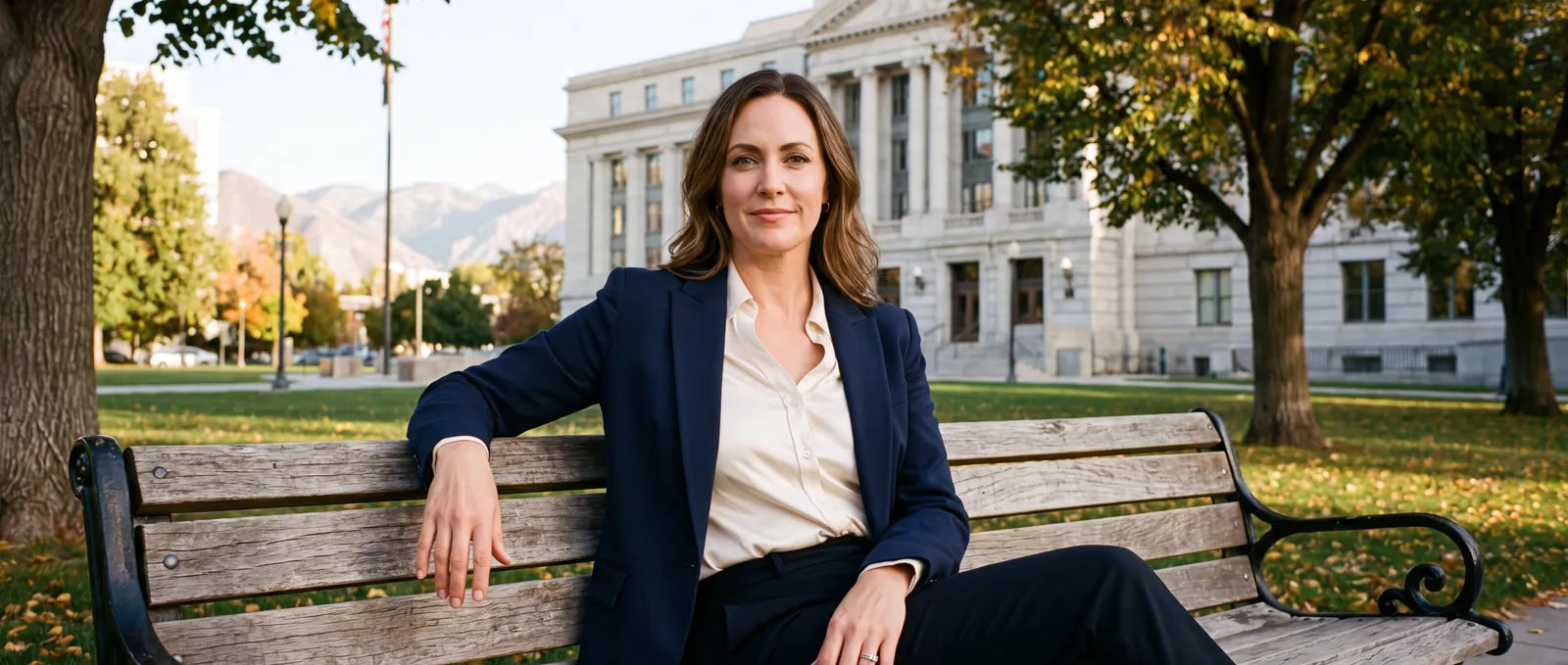
Probate happens where the deceased lived, not where they died. It also happens in a county. Texas has 254 of them. Georgia has 159. Virginia adds 38 independent cities that run their own courts.
Probate is local, but online information about it is generic to the point of useless. Each place has its own courthouse, clerk, fee schedule, forms, hours, and habits. Some of it is on a court website. A lot of it is not.
That is where families get stuck. You learn by standing at the wrong counter, mailing a petition to the wrong address, or calling the clerk's office and hoping someone has time to answer.
Today we are announcing the Probate Resource Center at hellosunset.com/probate: a free guide to probate in all 50 states, the District of Columbia, and more than 3,000 counties and cities. Every state has its own page. So does every county. There is no account to create and nothing to pay.
Thank you to 15,000 Sunset users
This project exists because of the people who used Sunset after a death and told us what really happened. More than 15,000 of them have now worked through an estate settlement with us. Along the way, they showed us the parts of probate that never make it into a clean instruction sheet.
They told us which clerk asked for one more certified copy. Which county moved its filing counter across town without making the new address easy to find. Which court website still listed a fee that changed two years ago. Which forms were accepted the first time, and which came back with a note in the margin.
When a Sunset user hit a wall, we heard about it. Then we wrote it down. Every county page in the Resource Center carries the questions those families asked, the wrong turns they were forced to take, and the small pieces of local knowledge that helped the next person get through.
There was no other way to gather county-level information on more than 3,000 counties. No database has it. No agency publishes it in one place. It lives with the people who have done the work, often while grieving and tired and trying to keep a family moving. Twenty thousand people shared that experience with us. We are grateful for it.
And thank you to the people who answered the phone
The other half of this project came from county employees. Clerks, deputy clerks, probate registrars, and the people at the front counter of courthouses in every state spent a lot of time answering our questions. They also helped our users, many of whom arrived with a stack of paper and no idea where to begin.
Stephen Walter, our CEO, made hundreds of those calls himself. He did not have a single negative interaction. Not one. That stayed with us. These are people who hear the same hard questions all day, often from people at one of the worst moments of their lives, and they still took the time to get us the right answer.
Our 2025 Estate Settlement Report Card gave the financial industry a C for how it treats bereaved families. If we graded county probate offices the same way, they would run away with it.
"I spent months on the phone with probate clerks in every part of the country, and I never once had a negative interaction. Not one. These are people who deal with grieving families all day, for very little recognition, and they were patient with us and with our users, every time," said Stephen Walter, an attorney and the CEO and cofounder of Sunset.
What is on every state page
Each state page is a guide to probate in that state, built so you can read it start to finish or skim for the one answer you need. It covers which court handles probate and where to file. It walks through the probate process step by step, with forms and their official names. It explains the types of probate available, including the faster paths many families do not know exist, like Texas's muniment of title or independent administration.
The state pages also list filing fees with the statute that sets them. They explain executor duties and deadlines, including inventories, creditor notices, and accountings. They cover small-estate alternatives and the dollar thresholds that qualify a family to use them. They include recent changes in the law, dated. They also say when it may be reasonable to do it yourself and when hiring an attorney is the safer call.
Take Utah. The state page tells you there is no separate probate court and the district court in the county where the deceased lived handles it. It gives the $375 filing fee and the statute behind it, and it explains that an estate of $100,000 or less with no real property can skip court entirely with a small-estate affidavit 30 days after death. It also notes that as of May 7, 2025 that affidavit can no longer transfer water-company shares, which matters more in Utah than you might think.
What is on every county page
The county page is where the Resource Center earns its name. This is the information families usually have to learn by calling, because it has never been collected in one place.
Each county page includes the courthouse address, the filing office, the phone number, and the hours. It includes the mailing address when it differs from the street address, which it often does. It notes local fee schedules and add-ons on top of the state fee. It says whether you must e-file, and what still has to arrive on paper. It covers whether you can appear by video, and how. It shows how to look up a case online. Each page also has a local nuance section: the things a clerk will tell you on the phone that no website mentions.
A few examples show why this matters.
Harris County, Texas. Houston has five statutory probate courts, but every case is filed at one counter at 201 Caroline. The fifth court was added on September 1, 2023, and it sits at a different address from the other four. The county clerk's own website still describes four courts. The page lists all five, the judges, the direct phone line for each court, the $360 base fee, and the county's written policy on which filings a family can make without a lawyer.
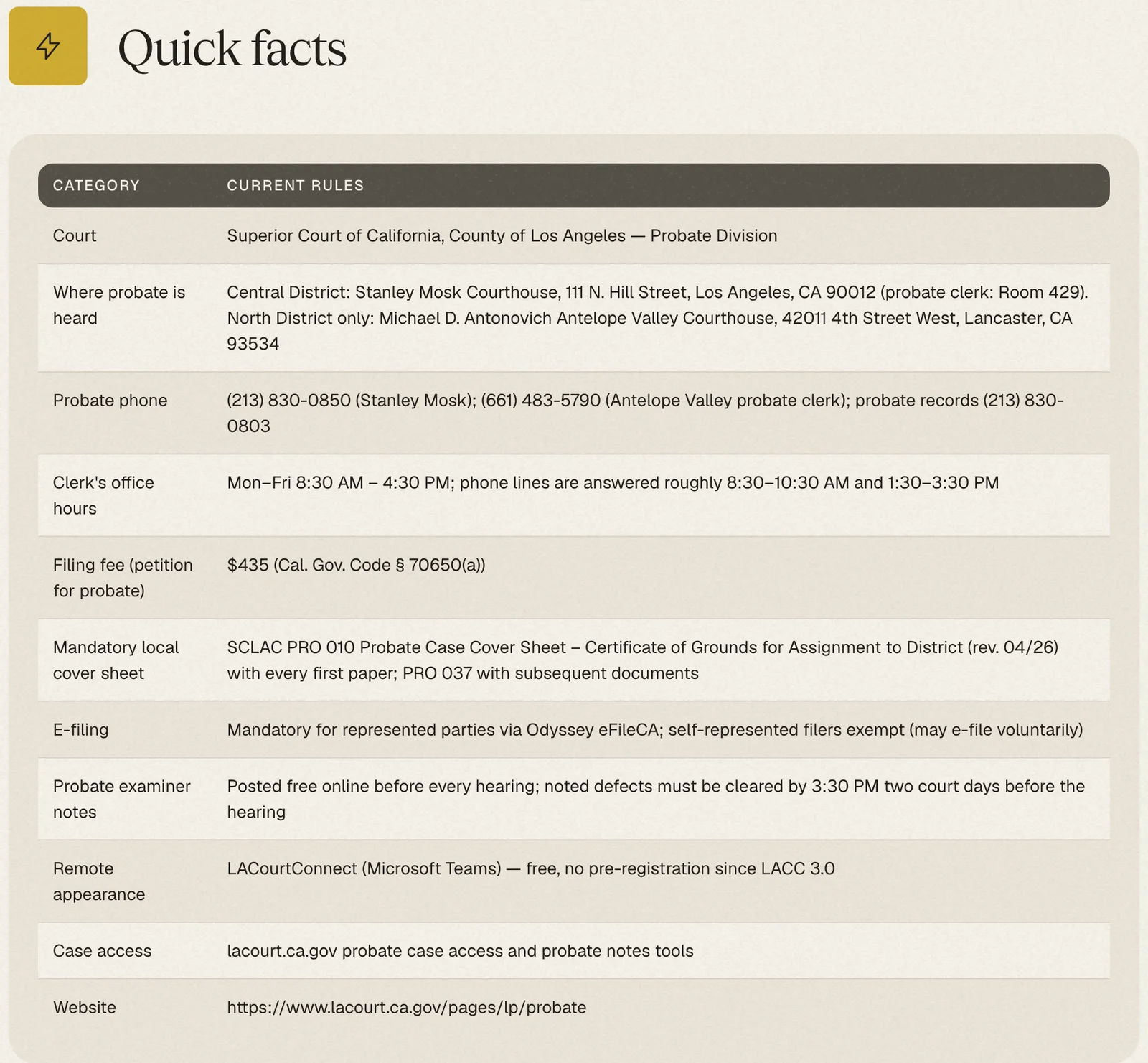
Los Angeles County, California. Probate for the whole county is heard at just two locations, and the cover sheet assigns your case by the deceased's zip code, so a petition lodged at the wrong district gets bounced. Before every hearing the court posts examiner notes online, and any defect must be cleared by 3:30 PM two court days before the hearing or the matter is continued four to eight weeks. Remote appearance is free. The page says all of this on one screen.
Salt Lake County, Utah. The county has two courthouses, but the West Jordan location stopped accepting new filings on December 4, 2023. Everything now goes to the Matheson Courthouse downtown, and the clerk's mailing ZIP code is not the same as the street ZIP code. A family that mails a petition to the address on the building will be waiting a while.
A living project
Probate rules do not sit still, and neither can a probate guide. Pennsylvania doubled the amount a family can collect from the deceased's bank account without opening an estate. Arizona raised its small-estate limits last September. Counties add courts, move counters, and change fees on the first of the year.
As more Sunset users settle estates, they run into the parts of probate that never quite fit in a statute book: a filing counter that moved, a fee that changed, a form the clerk now wants done a different way. We use that experience to keep the Probate Resource Center current, because people making decisions after someone died need plain information they can check.
Every page carries a "Recent updates" table with the date of each change and a "last reviewed" date at the bottom. If you are relying on a rule, a fee, a form, or an address, you should be able to see how fresh the page is. If you find something that has changed, tell us at [email protected]. That is how many of these pages stay useful.
Free, like everything else at Sunset
The Probate Resource Center is free to read, with no signup. Sunset itself is free for families, with no fees and no share of what an estate recovers, because Sunset is paid by its bank partners. If you go on to settle an estate with Sunset, the probate documents we generate for you are built on the same county-by-county rules you are reading here. That is how we can produce a filing-ready packet for every county in the country.
Get started
Go to hellosunset.com/probate, pick the state where the deceased lived, then pick the county. If you are already using Sunset, the link is in the footer of every page. If you have never used Sunset and need to find what the deceased left behind, start a free search at hellosunset.com.
Twenty thousand families and a few thousand county clerks built this. We just wrote it down.
About Sunset
Sunset is the automated estate-settlement platform helping families and professionals manage what comes after a death. Built by attorneys and engineers, Sunset combines authoritative data integrations, document automation, and FDIC-insured estate banking into a single workflow that operates across all 50 states and every U.S. county. The company is headquartered in Salt Lake City, Utah, and backed by Y Combinator.
Sunset is free for consumers. Families never pay a fee or give up a share of what they recover, because Sunset is paid by its bank partners. For attorneys and professional fiduciaries, Sunset offers Sunset Pro, a professional tier that lets them run Sunset's automated search and closure across every estate they administer. Learn more at hellosunset.com.
HOW WE MAKE MONEY
We’re paid by banks, not families
Just like any bank, we make money from interest yielded while money sits in the estate bank account.

No out-of-pocket costs or fees
You never pay for anything out of pocket. Ever.
We make money on interest
No hidden costs. No surprise fees. No fine print.
You keep all your money
We never take a cut of your inheritance.
Frequently asked questions
What is Sunset?
Sunset is an estate settlement platform that helps families discover and close the financial accounts, assets, and debts of a deceased loved one.
Sunset Free is designed for family members, executors, and personal representatives who are settling an estate themselves. It includes the full Sunset closure suite: financial account discovery, bank notifications, assisted phone calls and emails, estate bank account setup, probate document generation, and asset transfers all at no cost.
Sunset Pro is designed for probate attorneys, licensed fiduciaries, trustees, and aftercare specialists who settle estates on behalf of their clients. Sunset Pro starts at $500 per asset search, with monthly subscription plans available for solo practitioners, small firms, and large firms.
Both Sunset Free and Sunset Pro are available in all 50 states and U.S. territories.
Who can use Sunset?
Sunset can be used by family members, executors, administrators, and personal representatives responsible for settling a deceased person's estate.
Sunset supports asset discovery and probate across all 50 states and every U.S. county, helping you manage the estate regardless of where your loved one lived or where the estate is being settled.
How does Sunset help settle an estate?
Sunset handles the most time-consuming parts of estate settlement.
We search 2,500+ financial institutions like banks and retirement funds, the credit bureaus, and state unclaimed-property databases to find accounts and assets the family may not know about. We prepare probate documents specific to your county in all 50 states and help establish an estate bank account where recovered funds can be deposited.
Then Sunset helps close the deceased person’s accounts and move the funds into the estate account, ready for distribution to the heirs.
With Sunset, about 90% of account closures can be completed without you having to call or visit a branch.
What does it mean to settle an estate?
Settling an estate means closing out someone’s financial life after they die.
It involves identifying what they owned and owed, obtaining the legal authority to act on their behalf, paying valid debts and final taxes, and transferring what remains to the people who inherit it.
Depending on the state and the size of the estate, it can be complicated or simple, either way Sunset can help.
What is required to settle an estate?
Most estates require a core set of documents and accounts, including a certified death certificate, legal authority to act for the estate, a federal EIN, an estate bank account, and an inventory of the estate’s assets and debts.
Sunset can help with all of these except the death certificate!
Depending on the circumstances, legal authority may come in the form of letters testamentary, letters of administration, or a small-estate affidavit.
Once that authority is established, the estate can begin notifying financial institutions, paying valid debts and final taxes, and distributing the remaining assets to the heirs or beneficiaries.
Sunset prepares the paperwork required for these steps and submits what we can on your behalf.
How much does Sunset cost?
Sunset Free is completely free for families settling an estate. There are no upfront fees, subscriptions, or deductions from the inheritance. Families get access to asset discovery, probate document generation, account closure, asset transfers, and estate bank account setup at no cost.
Sunset Pro is our paid product for probate attorneys, licensed fiduciaries, trustees, and aftercare specialists. It starts at $500 per asset search, with subscription plans available for solo practitioners, small firms, and large firms.
Sunset's family product is funded through our bank partnership. The estate does not pay Sunset, and all assets ultimately go to the estate's beneficiaries and heirs.
How much does it usually cost to settle an estate?
The cost of settling an estate varies widely depending on its size, complexity, and where you live.
Hiring a probate attorney commonly costs $2,500 to $10,000, with more complex estates costing considerably more. In states with statutory probate fees, attorney fees may instead be calculated as a percentage of the estate. For example, a 3% to 7% fee on a $500,000 estate would be $15,000 to $35,000.
Sunset is free for families. There’s no fee, subscription, or percentage taken from the inheritance.
Can you settle an estate without a lawyer?
Yes. In many cases, you can settle an estate without hiring a lawyer. Sunset helps families handle the process themselves by finding assets, preparing probate documents, closing financial accounts, establishing an estate bank account, and collecting the estate's assets.
What about probate documents?
You can use our software to generate and sometimes file probate documents in every county nationwide.
Online notarization is also available through Sunset.
If your case is unusually complex, or disputed, we recommend hiring experienced probate counsel.
What is an estate bank account? Who controls it?
An estate bank account is a standard bank account in the estate’s name where all funds are consolidated. You can use it to pay expenses, view a full transaction history, and eventually distribute inheritance to beneficiaries.
With one click Sunset can set up an estate bank account.
You control the estate bank account. You can pay bills, taxes, and distribute the funds to heirs.
All estate bank accounts set up by Sunset are FDIC insured and protected from fraud and identity theft.
How can I pay estate expenses?
Once you have an estate bank account, you can use it to pay legitimate expenses related to settling your loved one's estate.
If you paid estate expenses out of your own pocket before the estate account was established, you may also be able to reimburse yourself from the estate, provided the expenses are legitimate and properly documented.
Am I responsible for their debts?
No, the deceased was solely responsible for their debts. If a loan was backed by a physical asset, such as a home or vehicle, you have options to transfer or payoff from estate proceeds.
For a loan that was jointly held, the responsibility remains with the other person on the account, often a spouse. Sunset automatically identifies if a debt has a living responsible party, and clearly flags it.
What security measures does Sunset have?
Sunset is SOC 2 Type II certified and built with security and privacy at the center of how we handle sensitive estate information.
We use robust identity and fraud-prevention measures to verify deceased individuals and beneficiaries, and we conduct background checks on our employees. We continuously monitor and improve our security practices to protect the financial information, documents, and personal data entrusted to us.
Will the financial institution be notified of a Sunset search?
No, we do not notify any financial institutions of the death when performing our searches, except for in the case of life insurance.
Our process combines document review, data integrations, and indirect verification with financial institutions. Families usually discover most accounts within 1 day, although some bank account confirmations take up to two weeks.
Financial institutions are only notified after a request for closure and transfer has been made by you.
Can Sunset help me settle an estate in my county or state?
Yes. Sunset works in all 50 states and all 3,000+ U.S. counties.
Sunset generates probate documents specific to the county where the estate is being settled and helps you complete the required steps. When notarization is required, online notarization is available where permitted.
Can Sunset help my probate attorney?
Yes. Attorneys regularly recommend Sunset to their clients. Before your attorney can guide you on the right probate path, they need a complete picture of the estate's assets and debts. Sunset generates a comprehensive Estate Asset Inventory with account numbers, balances, and more, giving your attorney exactly what they need to move forward quickly.